
Lesson of mankind’s history: None learn from its lessons. War, violence, and peace are cyclical. Peace follows wars. But peace treaties often create the conditions for the next war.
Wars follow peace. And the sheer destruction and exhaustion of war eventually forces nations to seek stability, building structures of peace to prevent further bloodshed.
Let me outline the tectonic geopolitical shifts, global conflicts, and ideological revolutions that reshaped national borders during the 18th, 19th, and 20th centuries. During the 18th Century, three major wars changed the course of history: a transition from absolute royal power to constitutional governance, catalyzed by the birth of modern democracy and systemic global warfare. One, thirteen American colonies successfully revolted against British imperial rule, resulting in the formation of the USA. The Treaty of Paris (1763) ended the Seven Years’ War with France surrendering nearly all its North American territories, ceding Canada and all land east of the Mississippi River to Great Britain. This established Great Britain as the world’s dominant colonial and naval power. The massive war debt later prompted Britain to levy heavy taxes on its American colonies, sparking the American Revolution. The Treaty of Paris (1783) ended the American Revolutionary War with Great Britain formally recognizing the independence of the USA. The ratification of the U.S. Constitution (1787) introduced a federal republic based on the separation of executive, legislative, and judicial powers. Two, the French Revolution (1789–1799): King Louis XVI was executed and the absolute Bourbon monarchy was overthrown, and feudal privileges were dismantled. The Declaration of the Rights of Man and of the Citizen (1789) popularised the values of liberty, equality, and fraternity across Europe, paving the way for the rise of military leader Napoleon Bonaparte. Three, the Seven Years’ War (1756–1763) was a massive global conflict involving the major European powers across Europe, the Americas, and India. The Treaty of Paris (1763) ended France’s presence as a major colonial power in North America, establishing Great Britain as the world’s dominant global empire.
The 19th century was defined by the collapse of old empires, the rise of intense nationalism, and the aggressive expansion of industrialised colonial powers. One, the Napoleonic Wars (1803–1815) were a series of major conflicts pitting Napoleon’s French Empire against various shifting coalitions of European nations. Following Napoleon’s final defeat at Waterloo, the Congress of Vienna (1815) ended the Napoleonic Wars, and conservative monarchies were restored across Europe. The map of Europe was redrawn to establish a balance of power, preserving peace between major European empires for nearly four decades. It established buffer states around France. It created the “Concert of Europe,” a balance of power system that successfully prevented a continent-wide European war for nearly a century. Two, the American Civil War (1861–1865) was fought between the Northern states (Union) and eleven Southern states that seceded to form the Confederacy. The victory of the Union preserved the United States as a single nation and led to the Emancipation Proclamation and the 13th Amendment, permanently abolishing slavery. Third, the Unification of Germany and Italy (1861–1871) was driven by political figures like Otto von Bismarck in Germany and Giuseppe Garibaldi in Italy. The proclamation of the German Empire (1871) fundamentally disrupted the European balance of power, sparking a rapid industrial and military arms race.
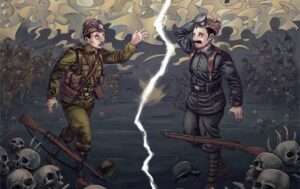
The 20th century witnessed industrial-scale total warfare, the rise and fall of totalitarian regimes, and a subsequent era of global ideological division. World War I (1914–1918) was sparked by the assassination of Archduke Franz Ferdinand, pitting the Allied Powers against the Central Powers. The conflict collapsed four major imperial dynasties (Russian, German, Ottoman, and Austro-Hungarian). The Treaty of Versailles (1919) ended World War I, forcing Germany to accept sole responsibility for the war, stripping it of 13% of its European territory, dismantling its colonial empire, and imposing massive financial reparations. The treaty led to deep economic distress and political humiliation in Germany, directly fueling the rise of Adolf Hitler and the Nazi Party. Two, World War II (1939–1945) was sparked by Nazi Germany’s invasion of Poland, pitting the Axis powers against the Allies. The war ended with the collapse of European colonial empires, the dawn of the nuclear age, and the founding of the United Nations (1945) to safeguard international security. The Paris Peace Treaties (1947) World War II settled land disputes and reparations for minor Axis powers (Italy, Romania, Hungary, Bulgaria, and Finland). Three, following World War II, weakened European empires could no longer sustain their global colonies. The resulting wave of decolonization dismantled centuries of imperial rule, creating dozens of newly independent nations across Asia and Africa. This historic shift occurred through two primary mechanisms: negotiated independence of India and Ghana; and armed liberation struggles & wars of independence – Algeria and the Vietnam War (1955–1975). Fourth, the Cold War (1947–1991) was a prolonged period of geopolitical, economic, and ideological tension between the USA and the USSR. This era produced intense proxy conflicts (such as the Korean and Vietnam wars) and concluded with the Fall of the Berlin Wall (1989) and the Dissolution of the Soviet Union (1991).
Armed Conflicts – 2021 to 2026
The leading authority on war tracking, the Uppsala Conflict Data Program (UCDP), records state-based conflicts (conflicts involving at least one government that result in 25 or more battle-related deaths in a calendar year).
| Year | Total Active State-Based Conflicts | High-Intensity “Wars” (1,000+ Annual Deaths) | Annual Estimated Fatalities |
| 2021 | ~54 | 5 | ~120,000 |
| 2022 | ~55 | 8 | ~238,000 (Tigray & Ukraine peak) |
| 2033 | 59 | 9 | ~180,000 |
| 2024 | 61 | 11 | ~187,000 |
| 2025 | 65 | 13–15 | ~244,600 (Highest since 1994) |
| 2026 (Current | 50+ active (14–20 major theaters) | Tracking ongoing | Scaling via active fronts |
Geopolitics: 6 Major Trends Driving Surge in Numbers between 2021–2026
The surge in numbers between 2021 and 2026 is primarily attributed to several massive geopolitical developments. Conflicts have Internationalized War. Wars are increasingly involving multiple nations. The number of direct interstate conflicts (state vs. state) doubled in 2025 alone to eight active theaters, including direct clashes or proxy frameworks: Russia-Ukraine (2022-Present); Iran-Israel War (October 2023-Pressent); Afghanistan-Pakistan; Sudan’s brutal civil war, alongside the legacy of the Ethiopia-Tigray war (2020–2022); escalating Sahel insurgencies (Mali, Burkina Faso, Niger); Myanmar Civil War (2021–Present); severe non-state gang violence in countries like Ecuador, Mexico, and Brazil; and Haiti conflict.
The fundamental paradigm shift in military technology is the result of a dramatic surge in global conflicts between 2021 and 2026. One, the rapid convergence of artificial intelligence (AI) and unmanned aerial vehicles (UAVs / drones) has altered the speed, cost, and frequency of warfare. According to tracking data, while only 10 non-state armed groups had access to weaponized drones in 2010, nearly 470 non-state groups (including cartels, insurgencies, and proxy militias) deployed drones in combat operations between 2024 and 2025. This allows under-funded actors to drag conventional forces into brutal, attritional “forever wars”. Success is increasingly evaluated by the sheer number of targets processed per hour rather than physical territory gained, driving up the raw number of strikes.
Two, militaries are field-testing interconnected autonomous swarms. Instead of a single human controlling a single machine, a single operator can launch hundreds of low-cost drones that communicate dynamically with one another—distributing tasks, dividing up defensive radar networks, and overwhelming premium air defenses by sheer saturation.
Three, previously the primary defense against drones was electronic jamming (cutting the radio or GPS signal between the operator and the aircraft). The 2025–2026 generation of warfare has circumvented this defense through fully autonomous navigation. If a drone’s communications link is jammed, edge-AI software takes absolute control. The drone reads the physical terrain, identifies target parameters autonomously, and executes the strike without requiring a human operator’s radio signal.
Four, the timeframe between a military system detecting an adversary and executing a lethal strike (the “kill chain”) has dropped to unprecedented levels. At the onset of the Russia-Ukraine conflict in 2022, processing a target required roughly 20 minutes; by 2026, AI-driven data pipelines have compressed this process down to less than two minutes, and sometimes seconds.
Five, as automation outpaces human cognitive processing speeds, the nature of human oversight has degraded. Efforts to internationally regulate Lethal Autonomous Weapons Systems (LAWS) face deep diplomatic paralysis. In September 2026, major global frameworks meant to curb “killer robots” in Geneva were heavily watered down due to major powers stripping out strict human-oversight mandates to preserve technological advantages. Human rights bodies warn that removing the direct physical risk to a nation’s own soldiers lowers the psychological and political threshold required to declare or escalate a war.

Six, large-scale operations are now guided by predictive algorithm platforms that sift through massive streams of intelligence data. Platforms like Israel’s “Lavender” AI system used in the Gaza theater processed tens of thousands of individuals to automatically flag potential targets. Modern tactical drones, such as the Seikka Scout or SkyStriker, utilize onboard machine learning motherboards capable of instantly recognizing dozens of distinct categories of military vehicles and personnel, drawing automated targeting boxes and computing target confidence metrics in real time.
To sum up, mankind’s history is replete with “Never-Ending Wars and Peace.” They are shaping geopolitics, cultures, and daily life across eras. In political science, sociology, and psychology, this reality is analyzed through distinct lenses.
Most important, national borders are a temporary sketch on a changing map, not a permanent fixture of geography. Throughout human history, the lines dividing nations have been continuously drawn, erased, and redrawn—serving as a stark lesson in the fluid nature of power, identity, and geopolitics.
Today, the Technology Age is shaping future outcomes. Nations and societies cannot help but prepare to counter worst contingencies. Otherwise, be prepared to perish. Maintaining parity, if not superiority, in the Technology Age is an imperative. “WAKE UP” India! The pace of innovations and transfer of technologies to users must keep pace, if not race ahead of the two technology superpowers: China and the USA.