



The Mundakopanishad occupies a distinguished place in the spiritual and philosophical heritage of the Vedas. It presents a profound enquiry into the nature of knowledge, the purpose of human existence, the limitations of ritualistic action and the ultimate realisation of Brahman, the Supreme Reality. Its teachings establish a meaningful distinction between knowledge that concerns the external world and the higher wisdom through which the eternal truth is perceived. The Upanishad does not dismiss the significance of Vedic rituals or prescribed duties; rather, it places them within their proper spiritual perspective and explains that actions, however sacred, cannot independently lead to the imperishable state of liberation. The ultimate purpose of human life is not merely to accumulate the merits of righteous actions but to transcend the limitations of worldly existence through Self-knowledge.
The sages who perceived the eternal truths embodied in the Vedic Mantras were not merely observers of religious practices. They were seekers whose disciplined minds, uncompromising commitment to truth and spiritual experiences enabled them to recognise the deeper principles governing existence. Their vision was founded upon sincerity, self-restraint, purity of conduct and an unwavering pursuit of wisdom. The Vedic tradition recognises different branches of learning and prescribed disciplines through which an individual gradually cultivates moral responsibility and spiritual awareness. Those who faithfully follow these disciplines develop control over their senses, regulate their thoughts and actions, and acquire the inner refinement necessary for higher understanding. Truthfulness, righteous conduct and self-discipline are therefore not isolated virtues; they are the foundations upon which the majestic edifice of spiritual realisation is constructed.
The Mundakopanishad makes a fundamental distinction between Apara Vidya, the lower or worldly knowledge, and Para Vidya, the higher knowledge through which the imperishable Brahman is realised. The Vedas, their auxiliary disciplines, grammar, ritual knowledge and other branches of intellectual learning have their legitimate place in human development. Nevertheless, they belong to the domain of knowledge that prepares the seeker for a more profound enquiry. Para Vidya transcends intellectual acquisition because it concerns the direct understanding of that eternal principle from which everything originates, by which everything is sustained and into which everything ultimately returns. This distinction is essential to understanding the Upanishadic philosophy: knowledge becomes truly liberating when it transforms the consciousness of the individual rather than merely enlarging the storehouse of information.
The Upanishad subsequently examines the significance of sacrificial rituals and the sacred responsibility associated with their performance. Agni, the divine fire, represents the sacred medium through which offerings are conveyed, while the ritual itself symbolises the disciplined relationship between human responsibility and cosmic order. The sacred fire is kindled with appropriate materials, and the sacrificial offerings must be presented with reverence, precision and an understanding of their prescribed significance. The fire does not merely consume the physical offerings; within the Vedic imagination, it becomes the visible expression of a sacred relationship between the human and the divine. Consequently, every aspect of the ritual demands attention, purity of intention and adherence to the prescribed discipline.
The Mundakopanishad, however, issues a serious warning against the careless or incomplete performance of sacrifices. It refers to the prescribed obligations associated with the new-moon and full-moon observances, the seasonal sacrifices, the offerings connected with the appropriate ritual occasions and the respectful reception of deserving guests. When these essential elements are neglected, the sacrificial undertaking loses its completeness. The text describes such deficiencies as destructive to the spiritual purpose of the ritual and warns that an inadequately performed sacrifice cannot produce the full benefits expected from it. The reference to the seven worlds and the seven flames conveys the larger cosmic significance attributed to the sacrificial order. It reminds humanity that religious observances are not mechanical exercises in which outward performance alone determines merit. Their sanctity rests upon completeness, discipline, knowledge, and devotion.
The seven tongues of Agni are described through evocative names: Kali, Karali, Manojava, Sulohita, Sudhoomravarna, Sphulingini and Visvaruchi. These manifestations portray the many expressions of the sacred fire, from its dark and formidable appearance to its brilliant, rapidly moving and radiant forms. The imagery captures the vitality, intensity and transformative power of Agni. Fire is both a physical phenomenon and a profound spiritual symbol: it illuminates darkness, consumes impurities and transforms the substance offered into another state. The seven tongues therefore enrich the ritual imagination by presenting Agni as a dynamic divine presence through which the sacrificial offering acquires its sacred significance.
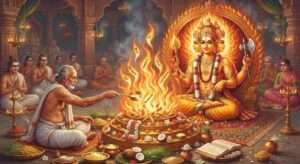
The seeker who performs the prescribed sacrifices with proper understanding, reverence, and completeness is symbolically guided along the path of the sun’s rays towards the higher worlds. The Upanishad describes the sacrificial flames as inviting the performer through radiant expressions and directing him towards the heavenly destination earned through righteous action. The innumerable rays of the sun become symbolic pathways through which the accumulated merit of the sacrifice is conveyed. The imagery of the welcoming flames and their sweet words is particularly significant because it personifies the consequences of disciplined religious action. The journey towards heaven is not presented merely as a geographical movement through the cosmos; it represents the fruition of actions performed in accordance with sacred injunctions. Nevertheless, the heavenly destination remains within the sphere of conditioned existence. The merits accumulated through action eventually diminish, and the individual must return to the cycle of worldly existence when those merits are exhausted.
The Upanishad further refers to the eighteen essential constituents or prescribed elements of sacrificial performance and cautions that those who regard ritual accomplishment as the ultimate objective misunderstand the deeper purpose of Vedic wisdom. The eighteenfold sacrificial arrangement represents an elaborate system of religious observance sustained through prescribed responsibilities. Yet the impermanence of its rewards must be recognised. Those who become excessively attached to the fruits of sacrificial actions, without seeking the knowledge of the imperishable, remain confined to the limitations of worldly achievement. The problem is not the performance of righteous action itself, but the mistaken belief that action and its temporary rewards constitute the highest fulfilment of human existence.
In a particularly penetrating passage, the Mundakopanishad criticises those who remain immersed in ignorance while imagining themselves to be exceptionally learned and wise. Such individuals may possess considerable familiarity with ritual practices, intellectual arguments or conventional religious knowledge, yet they fail to understand the ultimate truth towards which all genuine spiritual enquiry must lead. Their confidence becomes an obstacle to wisdom because they mistake the possession of information for the realisation of truth. The Upanishad compares them to blind people being led by another blind person. The metaphor is extraordinarily powerful: when the guide himself has not perceived the destination, the followers cannot hope to reach it merely through unquestioning dependence. Spiritual leadership, therefore, demands knowledge, discernment and personal realisation rather than superficial authority or outward scholarship.
This criticism has enduring relevance to every age. Society often confuses intellectual display with wisdom, religious observance with spiritual transformation, and outward prestige with inner refinement. An individual may speak eloquently about righteousness while failing to practise fairness, compassion and self-restraint in daily life. Similarly, a person may perform elaborate ceremonies without examining the motives governing those actions. The Upanishadic warning is directed against this contradiction. True learning must produce humility, clarity of thought and an improved understanding of one’s responsibilities towards fellow beings. Knowledge that strengthens vanity and self-importance has not fulfilled its spiritual purpose.
The text also describes those who remain attached to worldly actions and mistake temporary accomplishments for permanent fulfilment. Their minds are dominated by desires, expectations and the pursuit of rewards. They may consider themselves successful because their actions produce immediate advantages, but they do not recognise the impermanence underlying those achievements. Such individuals repeatedly pursue external objects, hoping that each new acquisition will provide lasting satisfaction. Yet when the merits of their actions are exhausted, they fall from the heavenly worlds and return to the cycle of birth and death. The Upanishad thus establishes a logical distinction between temporary happiness and eternal liberation. Anything dependent upon accumulated merit, material possession or the consequences of finite action must eventually undergo change. The imperishable cannot be attained through attachment to that which is perishable.
The description of such people as childish does not merely refer to a lack of intellectual maturity. It signifies an absence of spiritual discrimination. They fail to distinguish between the enduring and the transient, between the real and the apparently attractive, and between the ultimate purpose of life and its temporary diversions. Their actions remain centred upon personal gratification, with little concern for the welfare of others. Consequently, their understanding of righteousness becomes narrow and self-serving. The Upanishad exposes the limitations of this outlook by demonstrating that actions performed without higher understanding cannot free the individual from the consequences of desire and attachment. Even apparently meritorious deeds may become instruments of continued bondage when they are undertaken exclusively for personal reward.
In contrast, the Mundakopanishad presents the ideal of those who pursue truth through tranquillity, self-restraint, penance, faith and steadfastness. Such seekers withdraw from excessive worldly preoccupations and cultivate an atmosphere conducive to contemplation. The reference to dwelling in serene forests reflects the ancient tradition of forest hermitages, where the absence of material distractions enabled individuals to devote themselves to spiritual enquiry. The forest is not merely a physical location; it symbolises the inward withdrawal of consciousness from the restless demands of worldly desire. Such individuals do not measure fulfilment by the accumulation of possessions or the expansion of personal influence. They seek contentment through simplicity, disciplined living and the realisation of the eternal principle within themselves.
The Upanishad describes the spiritual journey of such enlightened seekers through the imagery of the solar realm and the golden passage leading towards the immortal destination. The reference to the golden orifice and the path associated with the sun conveys the transition from the limitations of conditioned existence towards the imperishable reality. The imagery of the feet of Lord Vishnu evokes the supreme spiritual destination, understood in the broader Vedic tradition as the highest abode of divine existence. The sun, which illuminates the external universe, becomes a symbol of the inner light of consciousness. The journey towards that light is ultimately a journey from ignorance to knowledge, from attachment to freedom and from the temporary to the eternal.
The true meaning of Brahminhood is also illuminated through the philosophical spirit of the Upanishad. It is not merely a matter of outward designation, inherited status or ceremonial observance. Its highest significance lies in the pursuit of Brahman through knowledge, righteous conduct, self-discipline and spiritual discrimination. A person who seeks the eternal truth must examine the universe with an enquiring intellect, understand the limitations of worldly existence and cultivate contentment with the resources legitimately available. Such a person does not become a slave to insatiable desire. Instead, moderation, integrity and inner fulfilment become the guiding principles of life. The greatness of an individual is therefore measured not by the extent of possessions or social recognition but by the depth of understanding, purity of conduct and freedom from selfish attachment.

