Upadhyayula Lakshman Rao
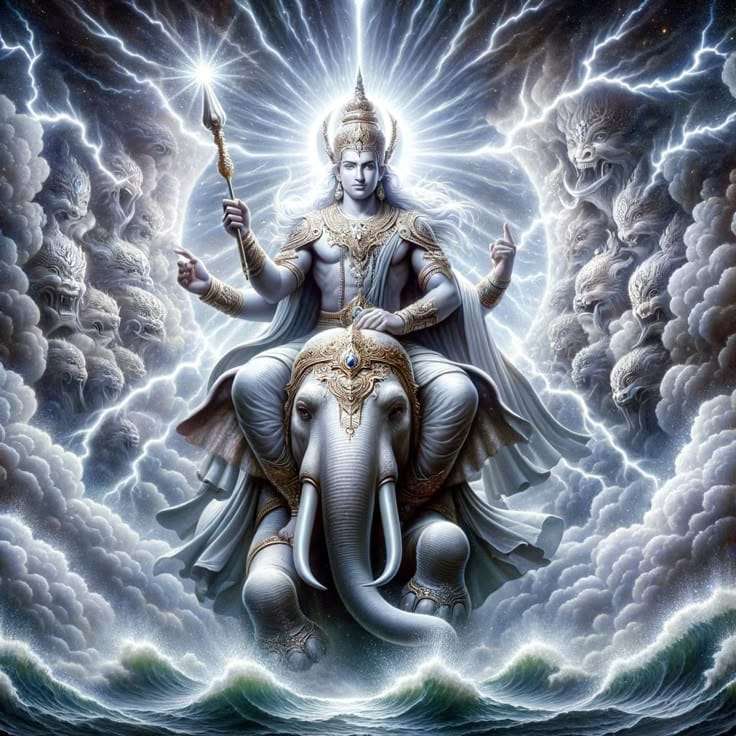
The sage Puruchhepa, immersed in profound spiritual insight, raises his voice in sacred invocation through the measured rhythms of Athyasti, Athisakvari, and Astibha chandas of the Rigveda. His hymns are not mere words, but resonant currents of devotion, aligning cosmic forces with human aspiration. In this elevated state of consciousness, he invokes Indra, the embodiment of wisdom and शक्ति, who traverses the celestial paths in his radiant chariot, approaching the sanctified halls of yajna. Indra is envisioned as the divine patron who uplifts the sacrificer, guiding him toward spiritual heights while ensuring that every ritual act bears its rightful fruit.
Indra, in his omniscience, nurtures the sacred exchange between mortals and the divine. He enriches the yajamana with oblations and, in turn, calls forth offerings that sustain the cosmic order. The subtle interplay between action and result, often delayed by the forces of nature such as wind, is harmonized by Indra’s grace, ensuring that no righteous कर्म remains unfulfilled. With compassion, he receives the hymns of the sages, protecting them from inconsistency and doubt, and responding swiftly when invoked in times of संघर्ष, accompanied by the fierce and luminous Maruts.
As the wielder of divine शक्ति, Indra assures humanity of protection and sustenance. He provides nourishment not only in material form but also through the wisdom of priests who serve as mediators of sacred knowledge. The priests, in their devotion, praise him through Vedic hymns, serving him with the same गति and dedication as swift horses yoked to a celestial chariot. Indra, the conqueror of foes, possesses the discernment to distinguish between fertile and barren clouds, releasing life-giving waters from their उचित source, thus sustaining the rhythm of nature and civilization.
His महान deeds, especially the release of rain, are celebrated across realms. The sage proclaims Indra’s glory alongside revered deities such as Rudra, Mitra, and Varuna, acknowledging the interconnectedness of cosmic governance. Indra is not distant or abstract; he is deeply relevant to the common person, arriving at the yajna in a spirit of मित्रता, sustaining righteousness by subduing forces that threaten sacred continuity.
The enemies subdued by Indra lose their शक्ति to harm, whether in battle or in subtle disruption of ritual order. His ferocity is reserved for those who oppose dharma, as seen in his legendary conquest of Vritra, symbolizing the triumph of प्रकाश over अवरोध. Through both divine weapons and the accumulated merit of yajna, he ensures that righteousness prevails. The blessings he bestowed upon ancestors are invoked again, as the sage seeks continuity of grace for present and future generations.
Indra is revered as sinless, the organiser of the universe, whose presence is acknowledged across all realms. The sage implores him to remove the sins of the patron, dispel sorrow, and grant comfort and stability. Alongside Indra, the invocation extends to Chandra, the ever-evolving luminary who governs the rhythms of time and mind. Chandra, like Indra, is called upon to protect the sanctity of rituals, to remove those who harbor ill intent, and to discipline those who act with चोरी and हिंसा.
Chandra’s progressive nature symbolizes growth and renewal. He is invoked to eliminate false आरोप and to safeguard the community from hidden adversaries. The imagery of punishment, such as suspending wrongdoers upside down, reflects the moral order upheld by divine forces. Together, Indra and Chandra represent the dynamic balance of शक्ति and शांति, action and reflection, day and night.
The sage continues to praise Indra’s पूर्ण स्वरूप through Vedic hymns, seeking wealth that is not merely material but beautiful, sustainable, and supportive of lineage. Such wealth nurtures children and grandchildren, ensuring continuity of dharma. Yet, Indra remains beyond पूर्ण comprehension, a reminder of the सीमाएँ of human understanding in the face of cosmic vastness.
The priests, acting as conduits of devotion, pray on behalf of the people, and Indra, pleased by their sincerity, grants victory over enemies. Under his संरक्षण, opposing forces lose their शक्ति and cannot prevail. Indra moves along the path of purity, untouched by sin or demonic influence, bringing with him wealth that is both divine and sustainable, bridging the realms of देव and मानव.
He is invited to accept oblations from the sacred halls, to protect both the yajna and its performers. As a powerful and prosperous deity, Indra embodies both protector and destroyer—gentle to the righteous, yet formidable to adversaries. The hymns offered by the sages are believed to strengthen him further, elevating his glory across दिशाएँ, where he shines like the सूर्य in brilliance and उत्साह.
Mounted upon his chariot, Indra is called to arrive swiftly, to trouble the enemies and eliminate those who obstruct the sacred path. He is the guardian against wickedness and sin, the remover of obstacles, and the sustainer of cosmic harmony. The sage concludes by affirming that Indra, created by Parameshwara, exists to eliminate demonic forces and to remain a स्रोत of life for all beings, thus uniting spiritual significance with an inherent scientific temperament that reflects order, causality, and universal balance.