Lakshmanrao Upadhyayula
The revered sage Śaunaka Gṛtsamada, immersed in the luminous wisdom of the Rigveda, invoked the mighty Indra through exalted hymns composed in the Jagatī and Triṣṭubh metres, those sacred rhythmic patterns through which Vedic seers harmonised human consciousness with cosmic order. In the Vedic vision, sound was not merely language but a force of creation itself, and the chanting of mantras was regarded as a scientific alignment of breath, vibration, intellect, and spiritual intent. Thus the sage prayed that the brilliance of Indra might once again shine forth in the worlds as it had in ancient times, renewing courage, vitality, rainfall, wisdom, and divine protection among living beings.
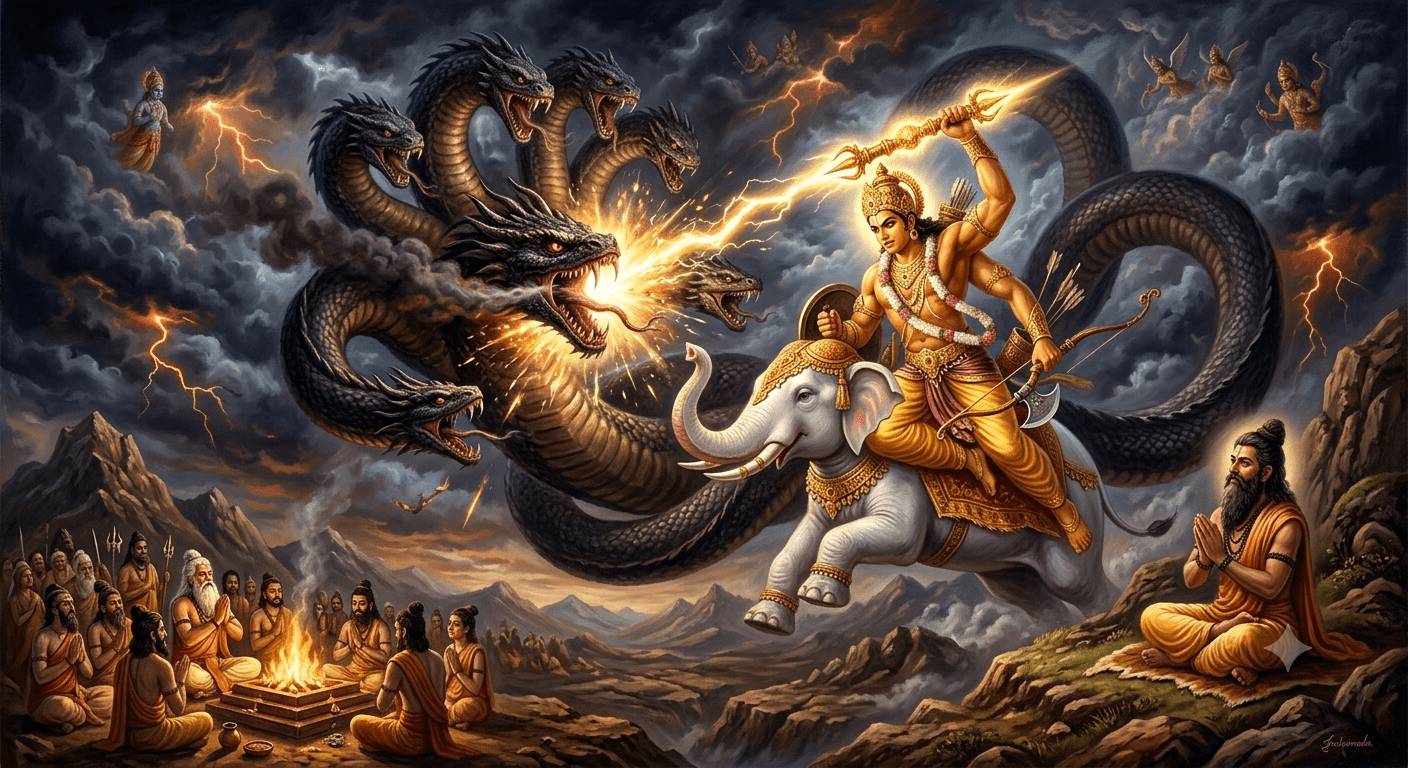
Like the inspired seers of the Aṅgirasa lineage, the sage awakened Indra through fresh and dynamic hymns filled with fervour and illumination. The Vedic thinkers understood that divinity responds not to mechanical worship but to awakened consciousness charged with sincerity and insight. Indra, exhilarated by the sacred Soma elixir, arose in divine enthusiasm and struck down the serpent-like Vṛtra, the power that imprisoned the celestial waters within the darkened clouds. This profound imagery carried both spiritual and natural significance. Spiritually, Vṛtra symbolised ignorance, obstruction, fear, and stagnation within the human mind; scientifically, the hymn reflected the observation of atmospheric phenomena, where thunder, lightning, and rainfall released life-sustaining waters upon the earth. Thus the slaying of Vṛtra became a timeless metaphor for the victory of dynamic intelligence over forces of inertia and suppression.
Through the manifestation of immeasurable strength, Indra expanded his glory and became worthy of receiving the foremost Soma oblations in the sacred rituals. The Vedic sages perceived Soma not merely as a ritual drink, but as the principle of divine exhilaration, heightened consciousness, and spiritual vitality. Indra, the destroyer of hostile forces, protected the cosmic order during fierce battles between harmony and chaos. His power was not celebrated for conquest alone, but for the preservation of Ṛta, the universal law that governs both the movements of the heavens and the ethical balance of human life. Therefore the sages prayed that such a mighty Indra might remain gracious toward humanity and uphold righteousness in every age.
Indra, by his majestic energy, upheld not only the heavens but all the worlds that move within the vastness of existence. The hymns describe him as delighted by sacred chants, for the Vedic tradition regarded sincere speech as a bridge between mortal and divine intelligence. Through his immeasurable force he washed away enemies just as torrential rains cleanse the earth of impurity. His valour was not blind aggression, but enlightened strength guided by wisdom. Even the omens and harbingers of misfortune that advanced with destructive intent upon his celestial chariot were scattered and dissolved before his irresistible brilliance. Here the hymns portray the eternal triumph of disciplined consciousness over fear, disorder, and destructive tendencies.
Rich in nourishment and inexhaustible vigour, Indra pervaded all realms through his own innate power. The sages envisioned him flourishing as the sovereign of heaven, earth, and the atmospheric regions between them. He dispelled the inferior heap of darkness that covered the worlds, symbolising both the physical removal of storm clouds and the inner illumination that destroys ignorance. The Vedic seers possessed a remarkable scientific temperament in observing nature. They recognised the interdependence between sunlight, rain, fertility, and human survival, and they transformed these observations into sacred poetry that united natural law with spiritual symbolism. Thus Indra became not merely a tribal deity of storms, but the living embodiment of awakened force sustaining cosmic equilibrium.
The hymns further declare that Indra stabilised the wandering mountains and released the waters from the imprisoned clouds onto the earth. Such imagery reflects ancient observations of geological stability, rainfall cycles, river systems, and the sustaining balance of nature. Earth itself was envisioned as upheld by divine strength, while the heavens were fixed intact through the intellectual power of Indra. In this profound symbolism, the Vedic sages perceived intelligence as the governing principle of the universe. The cosmos was not viewed as accidental chaos but as an ordered reality maintained through subtle laws, measurable rhythms, and hidden harmonies. Thus Indra’s might represented not only physical force but also the supreme organising intelligence operating within creation.
Indra spread himself among all living beings as protector and sustainer. The hymns proclaim him wiser than every creature and describe him as the architect who fashioned the worlds through genius and insight. Here the Vedic mind revealed a deep reverence for intellect guided by spiritual awareness. Knowledge was considered sacred only when used for protection, nourishment, and harmony. Indra’s incomparable brilliance was demonstrated when the hostile Dasyu known as Kṛivi fell to the earth under the blow of the Vajra, the thunderbolt of divine power. Symbolically, the Vajra represented concentrated energy, decisive wisdom, and the irresistible force of truth that destroys ignorance and oppression.
In a deeply human and tender prayer, the hymn invokes the image of a devoted daughter who remains loyal to her parental home throughout her life and continually prays for its welfare. Through this moving comparison, the worshipper approaches Indra seeking prosperity, stability, and abundance for the community. Wealth in the Vedic vision was never celebrated as selfish accumulation alone. Rather it was valued as a means for sustaining society, performing sacred duties, supporting learning, feeding guests, protecting families, and preserving harmony. Therefore, the prayer asks for riches that are earned rightly, shared wisely, and sufficient to sustain the body and fulfil righteous living. The seeker implores Indra to honour these hymns devoted to prosperity and benevolent abundance.
Indra is finally praised as the sovereign ruler, the giver of food, and the guardian of sacrificial order. The worshippers invite him with reverence, asking him to bestow many shelters, protections, and blessings upon humanity. His gifts are described as abundant and capable of fulfilling the sincere aspirations of those who pray with devotion. Yet the deeper meaning of these petitions lies not merely in material gain, but in the attainment of security, wisdom, courage, continuity of lineage, and spiritual fulfilment. The sages desired prosperity that could sustain generations while preserving righteousness and gratitude toward the divine powers governing existence.
Thus the hymn concludes with a vision of continuity across generations, where parents, children, and grandchildren together sing melodious Vedic hymns in honour of the sustaining cosmic powers. This collective chanting symbolised the transmission of wisdom, discipline, memory, and sacred culture from one generation to another. The spiritual significance of the hymn therefore extends far beyond ritual praise. It reveals a civilisation that united observation of nature, psychological insight, ethical responsibility, poetic excellence, and metaphysical contemplation into one integrated vision of life. In the glory of Indra, the Vedic sages celebrated the triumph of awakened intelligence, the release of life-giving energies, the preservation of cosmic order, and the eternal aspiration of humanity toward light, abundance, and divine harmony.