



Democracy is not driven solely by elections, but also by the active participation, dialogue, dissent, and accountability of citizens. In any democratic system, movements are a vehicle for social consciousness. They hold power to account, give voice to public suffering, and pave the way for policy reforms. But history also shows that not every movement is inherently sacred, nor is it beyond suspicion. If serious questions arise about a movement’s objectives, leadership, funding sources, organizational structure, and functioning, they must be answered with democratic transparency. Similarly, allegations made against a movement must be evaluated based on evidence, not merely political assumptions.
In recent years, numerous movements in India have influenced national discourse. Examples include the farmers’ movement, protests against the Citizenship Amendment Act, movements against alleged irregularities in various recruitment examinations, and numerous youth-related campaigns. These movements have made it clear that the country’s youth are vocal about their rights and future. Furthermore, they have raised the question that the legitimacy of a mass movement is determined not only by its objectives, but also by the transparency and accountability of its conduct.
When a new face suddenly emerges on the national stage, gains immense popularity on social media in a short time, or appears to be leading a major movement, curiosity naturally arises. People want to know about their life, background, ideological journey, financial sources, and organizational capabilities. This curiosity is not unreasonable in a democracy. It is also natural to expect public accountability from those active in public life. But there is a clear line between curiosity and accusation. Asking questions is a democratic right, while jumping to conclusions without evidence is contrary to democratic prudence.
Today, social media has transformed the nature of politics. Popularity used to be achieved through years of struggle; now, reaching millions and even billions of people can sometimes happen in a matter of days. Algorithms, viral content, media coverage, supporter campaigns, advertising, and digital networks can rapidly expand a person’s reach. Therefore, it’s inappropriate to conclude a conspiracy based solely on the number of followers. On the other hand, if a digital campaign shows signs of artificial propaganda, bot networks, or opaque resources, independent investigations should be part of a democratic system.
In a democracy, the success of a movement isn’t measured solely by the size of the crowd. Sometimes small movements can lead to significant change, and sometimes even large crowds fail to leave a lasting impact. However, if a movement results in violence, damage to public property, clashes between police and protesters, or incidents of provocation, an impartial investigation becomes necessary. It’s equally important to identify the culprits based on individual responsibility, rather than painting the entire movement or society as one.
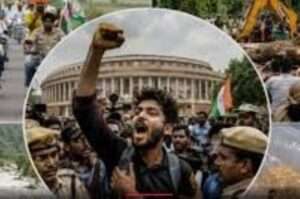
The Indian Constitution grants citizens the right to peaceful protest. It also places an obligation on the state to maintain law and order. Therefore, in a democracy, both movements and administration are tested. If a movement turns violent, its moral foundation is weakened. If the administration uses excessive force, its legitimacy is questioned. Balance is the hallmark of democracy.
The involvement of political parties in protests is a long-standing tradition in Indian politics. The opposition’s role is not only to debate in Parliament, but also to go among the public and oppose the government’s policies. Similarly, the ruling party’s responsibility is not merely to dismiss protests as political conspiracies, but also to offer solutions to the public’s genuine concerns. In a democracy, both a healthy opposition and a responsive government are equally essential.
The question of transparency regarding the financial sources of movements is also crucial. Long-term protests, platforms, publicity, transportation, food, and other arrangements require resources. Therefore, it is not unreasonable to expect organizers of large movements to be transparent about their financial sources. Similarly, if an organization is accused of foreign funding or other illegal financial assistance, its resolution should be based solely on legal investigation and judicial process. In a democracy, accusations and evidence are not synonymous.
India’s youth today face numerous challenges. Allegations of irregularities in competitive exams, delays in recruitment processes, unemployment, and uncertainty about the future fuel discontent among youth. If these real problems are not addressed in a timely manner, any movement can garner widespread support. Therefore, the best response for governments is not to suppress movements, but to address the underlying causes that underlie them.
Meanwhile, the responsibility of the protesters is no less. If the movement is about a specific issue, its focus should remain on that issue. If various unrelated political or ideological agendas become involved, it is natural for confusion to arise among ordinary citizens. This is why the credibility of any mass movement is built on its discipline, clear purpose, and peaceful nature.
India’s democracy has gone through many ups and downs. This country has witnessed both the Emergency and peaceful mass movements. Therefore, the path to strengthening democracy lies neither in blind support nor blind opposition. The power of democracy lies in critical thinking. Citizens should question both the government and the protesters. The media should also investigate both sides with equal seriousness.
Today, there is a need for increased transparency in public life. Anyone claiming leadership at the national level should not hesitate to provide clear information about their background, organizational structure, and resources. Similarly, governments should consider criticism as part of democratic discourse rather than slandering it. Asking questions is the soul of democracy, but answers must be based on evidence.
The future of democracy will depend on whether we are able to transform differences into dialogue. If every dissent is considered a conspiracy and every government an enemy, democratic institutions will be weakened. Similarly, if every question is dismissed as treason or every criticism is dismissed as a foreign agenda, democracy will also suffer.
A vast and diverse nation like India is governed not by mere emotions, but by institutions, the Constitution, and civic conscience. Therefore, the final decision about any movement, leader, or government must be based on facts, evidence, and impartial investigation. In a democracy, the greatest power is neither the crowd nor power, but truth. The path to truth certainly lies through questions, but the answers to those questions are found only in evidence. This is the maturity of democracy and its greatest strength.


excellent review of present day crisis situations