Lakshmanrao Upadhyayula
The sage Vishwamitra, speaking in the sacred rhythms of Anuṣṭup and Gāyatrī chandas, offers a profound invocation to Indra, the mighty lord of divine power, wisdom, and victorious action. The hymn recalls that through sacred devotion, disciplined yajñas, and the offering of Soma, Indra was strengthened to destroy Vṛtra, the great obstructer who withheld the life-giving waters. In the Vedic vision, Vṛtra is not merely a hostile being but a symbol of every force that blocks the natural flow of truth, prosperity, knowledge, and spiritual progress. Thus, the victory of Indra signifies the triumph of divine order over chaos, illumination over ignorance, and movement over stagnation.
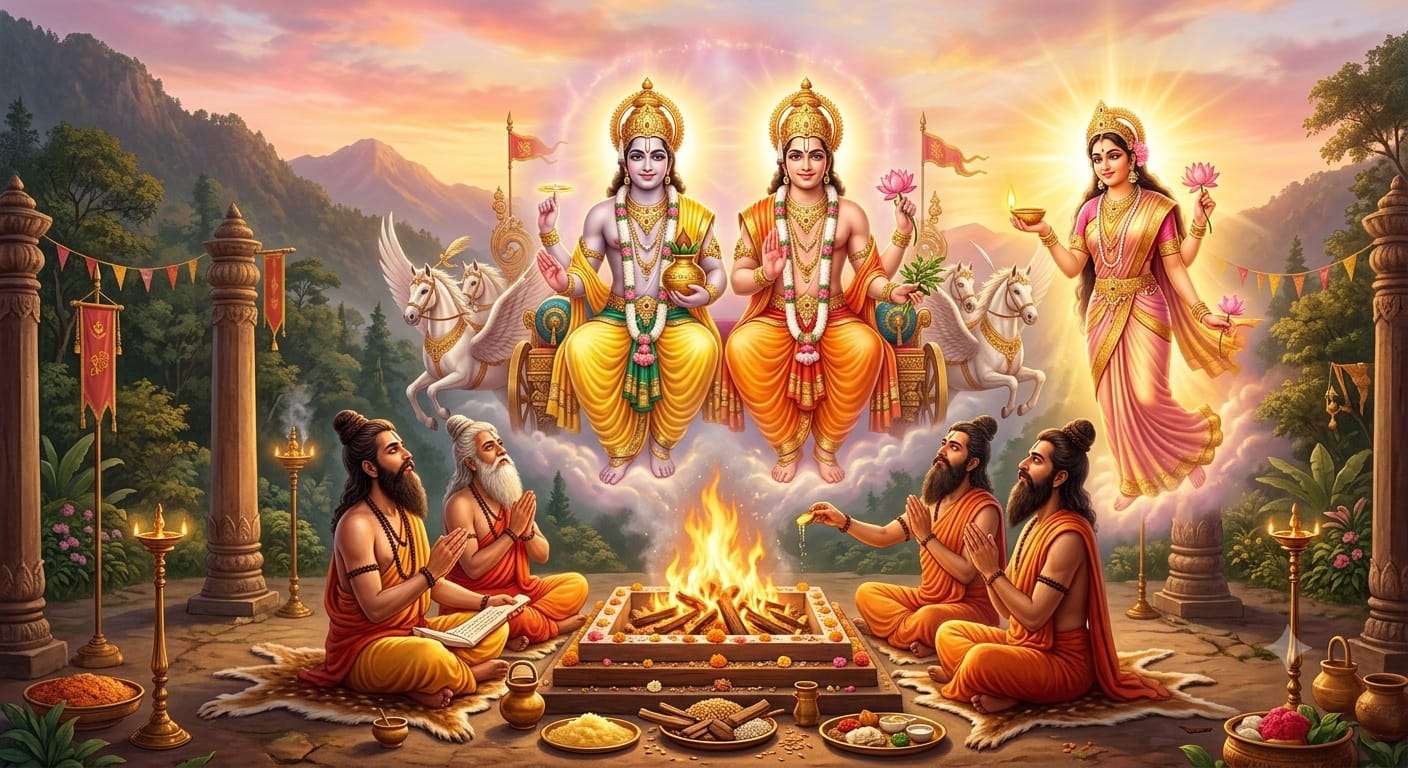
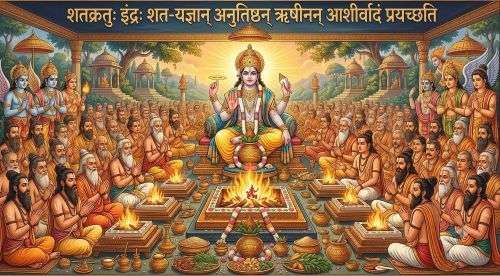
The seer praises Indra as Śatakratu, the performer of a hundred sacrifices, whose mind and vision are gladdened by the sincere devotion of priests and worshippers. The yajña is presented not as a mere ritual but as a profound cooperation between humanity and the cosmic powers. Through disciplined thought, sacred recitation, and selfless offering, human consciousness aligns itself with the universal order known as Ṛta. The priests seek to make Indra their inspirer and motivator, recognizing that noble achievements arise when divine strength is joined with human effort.
The hymn further celebrates Indra as the protector of righteous people in times of conflict. When noble warriors confront hostile forces, they invoke his name and recount his glorious deeds. Such remembrance is more than praise; it is a method of awakening courage, discipline, and confidence within the human heart. The Vedic sages understood that the mind possesses immense power, and that noble thoughts, when repeatedly contemplated, shape character and action. Therefore, chanting the hymns of Indra becomes both a spiritual exercise and a psychological discipline that transforms fear into determination.
Indra is extolled as the lord worthy of all prayers, radiant with inexhaustible brilliance and supreme among leaders. His luminosity symbolizes the awakening of higher intelligence that guides humanity through uncertainty. In the scientific temperament reflected within the Vedas, light is consistently associated with knowledge and perception. Just as physical light reveals the forms of the world, spiritual illumination reveals deeper truths hidden beneath appearances. Indra’s radiance therefore signifies the expansion of awareness that enables individuals and societies to overcome confusion and make wise decisions.
The hymn acknowledges that wealth and prosperity are often attained through struggle and effort. Indra, the conqueror of obstacles, is invoked as the source of victory in both material and spiritual endeavors. The battles described in the Vedas frequently possess an inner dimension, representing humanity’s continuous effort to overcome ignorance, weakness, selfishness, and fear. Through divine assistance and disciplined action, these internal enemies are subdued, allowing the treasures of wisdom, virtue, and abundance to emerge.
The Soma prepared for Indra occupies a central place in the prayer. The seer invites the mighty deity to partake of the purified offering and bestow protection, strength, and shelter upon his devotees. Symbolically, Soma represents the refined essence of life, the bliss that arises from purity, devotion, and elevated consciousness. The preparation of Soma reflects a process of transformation, where raw elements are purified into something sacred. This mirrors the scientific principle that refinement and discipline release latent potential, whether in nature, society, or the human mind.
The hymn also presents a remarkable philosophical insight by declaring that the sensory powers operating through the five elements belong ultimately to Indra. This reflects the Vedic understanding that all perception is sustained by a unifying cosmic intelligence. Earth, water, fire, air, and space provide the framework through which life functions, while consciousness integrates their activities into meaningful experience. Such ideas reveal the profound observational spirit of the Vedic seers, who sought to understand both the outer universe and the inner workings of awareness.
The devotees pray that the supreme nourishment may reach Indra and that, in return, the streams of abundance withheld by adversaries may flow freely among the people. Here food symbolizes not only physical sustenance but also knowledge, vitality, inspiration, and spiritual fulfillment. The relationship between giving and receiving is emphasized throughout the hymn, illustrating the Vedic principle that harmonious exchange sustains the cosmos. Prosperity flourishes when gratitude, generosity, and responsibility accompany material gain.
Finally, Vishwamitra calls upon Indra to come from afar or from nearby realms, descending from his highest abode to the sacrificial ground. Armed with the Vajra, the thunderbolt of divine power, Indra is invited to be present among his worshippers. This concluding invocation expresses the Vedic conviction that the divine is never distant from sincere aspiration. Whenever individuals dedicate themselves to truth, discipline, and selfless action, the power represented by Indra manifests within them. Thus the hymn becomes an enduring message that spiritual strength, enlightened intelligence, and unwavering perseverance can overcome every obstruction and lead humanity toward abundance, harmony, and the realization of the cosmic order.