



Sanjaya spoke to Dhritarashtra, saying, “O King, the mighty Karna, blazing with unconquerable valor, advanced against Dharmaraja with the fury of a tempest. His bow sang without pause as torrents of keen arrows descended upon the son of Dharma. Though assailed from every side, Yudhishthira stood firm, meeting every assault with unwavering courage. The encounter between the two renowned warriors shook the hearts of all who witnessed it, for each sought to uphold the honor of his lineage amid the thunder of battle.”
Karna then displayed the astonishing mastery for which he was celebrated throughout Aryavarta. With nine swift and unfailing shafts, he shattered the bow of Dharmaraja. Without granting his adversary even a moment’s respite, he pierced and tore apart his radiant armor. Adorned with priceless gems and precious metals, the resplendent armor flashed brilliantly as it fell from his body, resembling a luminous cloud torn apart by a violent wind while streaked with lightning. As it descended upon the battlefield, it appeared like a fragment of the star-filled heavens itself cast down upon the earth.
Bereft of his armor, Dharmaraja was struck repeatedly by Karna’s merciless arrows. Blood streamed from his wounds until his entire body glowed crimson, resembling a flourishing palasha tree adorned with clusters of brilliant scarlet blossoms. Yet neither pain nor humiliation weakened his resolve. The son of Dharma remained steadfast before his formidable adversary, refusing to yield despite the relentless storm that sought to overwhelm him.
Determined to reverse the tide of battle, Dharmaraja hurled a mighty Shakti weapon charged with immense force. Karna, displaying extraordinary precision, shattered it in midair before it could reach its mark. Undeterred by this failure, Dharmaraja renewed his assault with a shower of arrows that grievously wounded Karna. Filled with fresh determination to humble the great warrior, he slew Karna’s horses, struck down his charioteer, cut off his standard, and caused considerable distress within his ranks.
At that critical moment, Satyaki and Shikhandi hastened to defend the endangered king. They attacked Karna from opposite sides in an attempt to restrain his advance. Karna, however, proved irresistible. With astonishing speed he smashed their chariots, pierced both heroes with razor-sharp arrows, and swept past them. Closing swiftly upon Dharmaraja once more, he inflicted grievous wounds with deadly precision. Unable to withstand the overwhelming force of Karna’s assault, Dharmaraja reluctantly turned his chariot away from the battlefield.
Karna pursued him for some distance, then halted and addressed him with cutting words. “O Dharmaraja,” he declared, “you speak often of Kshatriya duty, yet how can retreat from the battlefield be worthy of one born to arms? Today your true nature has been revealed. Your heart is inclined toward the peaceful righteousness of the Brahmanas rather than the stern obligations of a warrior. Return to sacrifices, sacred rituals, and the performance of yajnas, for such pursuits better suit your disposition. Warfare against heroes of great prowess is not your calling. Should you again confront one such as I, you will suffer far greater calamity than this. Go instead to Krishna and Arjuna, for there alone may you preserve your life. I have no desire to slay you.”
Though his words were harsh and filled with ridicule, Karna restrained his hand. He remembered the solemn promise he had given to Kunti that he would not take the life of Yudhishthira. Honoring that sacred vow even amid the frenzy of war, he spared Dharmaraja and turned away to devastate the Pandava army with an unending torrent of weapons, celestial missiles, and irresistible shafts.
Overwhelmed with shame and burdened by the memory of public humiliation, Dharmaraja withdrew from the field. Sanjaya continued, “O King, when the soldiers witnessed their sovereign retreating after suffering defeat at Karna’s hands, the Pandava army began to fall back in confusion. Karna and your sons pursued the fleeing warriors as herdsmen drive frightened cattle. Victorious cries echoed through the heavens, conches resounded, war drums thundered, and the twanging of mighty bows filled the Kaurava ranks with confidence and exultation.”
Yet Dharmaraja, though wounded in body and spirit, did not abandon his duty. Gathering the retreating warriors, he called aloud to them, commanding them to turn back and subdue the Kaurava forces. Inspired by his words, the Pandava soldiers regained their courage. With renewed determination, they wheeled about and charged once again into the enemy formations, eager to redeem their honor.
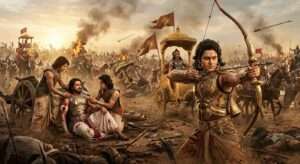
Leading this renewed assault, Bhima, accompanied by Satyaki and Dhrishtadyumna, descended upon the Kaurava host like the very embodiment of destruction. The battlefield became a terrifying spectacle. Elephants, horses, chariots, and countless foot soldiers fell in rapid succession. Rivers of blood flowed across the earth, mingled with shattered armor, broken weapons, and lifeless bodies. Even the celestial beings who watched from the heavens were astonished by the dreadful carnage unfolding below.
Bhima, Satyaki, and Dhrishtadyumna strode through the battlefield like messengers of Death itself. Wherever they advanced, terrified warriors abandoned hope and fled for their lives. Karna, however, remained unshaken. He rallied the discouraged Kaurava troops, restoring their confidence and urging them once more into the terrible conflict.
Then Bhima saw the wounded Dharmaraja seated upon the chariot of Shrutakirti. Turning to Satyaki and Dhrishtadyumna, he spoke with blazing wrath. “Karna continues his cruel deeds solely to gratify Duryodhana. Before my very eyes, the son of Dharma has endured unbearable humiliation. I entrust his protection to both of you. My grief shall know no peace until Karna falls. Either he shall perish today, or I myself shall give up my life in this battle. Guard our king with unwavering vigilance while I seek the son of Radha.”
Roaring like a lion whose fury could no longer be restrained, Bhima rushed toward Karna with irresistible force. Seeing him approach, Shalya addressed Karna, saying, “Behold, Bhima comes, consumed by blazing anger. When his wrath is fully awakened, he fears not even the three worlds. Neither at the death of Abhimanyu nor at the fall of Ghatotkacha have I witnessed such terrible fury in him. Meet his strength with equal courage and restore confidence to our warriors.”
Karna replied calmly, “Bhima is indeed a fearless warrior, yet I am in no way his inferior. I shall display my valor against him, though I shall not slay him. Soon Arjuna will appear, and then you shall witness the full measure of my strength. O King of Madra, Bhima who slew the hundred Kichakas is exceedingly proud of his might. To humble that pride is but a sport for me. Drive my chariot toward him without delay.”
Obeying Karna’s command, Shalya urged the chariot forward. Once again the conches, drums, and trumpets roared across the battlefield. Bhima surged into the enemy ranks like the advancing waves of a mighty ocean. Karna welcomed him with a ceaseless rain of arrows that pierced Bhima’s broad chest. Bhima answered instantly with an equally devastating shower of shafts that greatly troubled Karna. Their contest resembled the collision of two mountains shaken by celestial thunder.
Karna shattered Bhima’s bow and struck him repeatedly with deadly arrows. Bhima seized another bow without hesitation and answered with relentless volleys. Karna then severed Bhima’s magnificent armor with twenty-five razor-edged arrows, causing it to crash upon the earth. Enraged beyond measure, Bhima lifted an enormous spear and hurled it with tremendous force. The mighty weapon struck Karna with crushing impact, causing him to collapse unconscious upon his chariot. Witnessing their greatest champion momentarily overcome, the Kaurava army was seized with fear and scattered in every direction.
Thus Sanjaya faithfully narrated these astonishing events to the anxious and sorrowful Dhritarashtra, whose heart trembled as he listened to the ever-changing fortunes of the great war, eagerly awaiting the fate of the heroes upon whom the destiny of the Kuru race now rested.

