



Sanjaya said to Dhritarashtra, “The dreadful death of Dussasana shook the hearts of your sons. The sight of Bhimasena tearing open his chest and fulfilling his terrible vow filled them with grief, humiliation, frustration, and an unquenchable thirst for vengeance. Blinded by rage rather than guided by wisdom, they resolved that Bhima must perish before another moment passed. Your sons—Kavachi, Nishangi, Pasi, Dandadhara, Dhanurdrahu, Alolupa, Shanda, Vathavega, and Suvarchasu—advanced together with unwavering determination. Surrounding Bhimasena on every side, they showered him with countless weapons, hoping that their united assault would succeed where individual valor had failed.
Arjuna, however, remained ever vigilant. Though his hands never ceased from battle, his watchful eyes continually surveyed the field, anticipating every movement of the enemy. Knowing that Bhima had become the principal object of Kaurava fury after slaying Dussasana, he stood ready to shield his beloved brother from every danger. The moment he perceived your sons advancing with defiant resolve, the wielder of Gandiva acted with astonishing speed. His arrows flashed like streaks of celestial lightning. Before the warriors could execute their design, Arjuna severed their heads with terrifying precision. Their lifeless bodies fell upon the blood-soaked earth, and the dreadful spectacle deepened the despair that had already gripped the Kaurava ranks.
The irresistible fury of Bhima, joined with the unmatched skill of Arjuna, shattered the confidence of your army. Warriors who had once proclaimed their invincibility now hesitated to engage in combat. Fear spread silently through their ranks. Even Karna, the commander of the Kaurava forces, stood motionless for a moment. His face lost its brilliance, his mind was burdened with sorrow, and silence replaced his customary confidence.
Observing this discouragement, Salya addressed Karna with firm yet inspiring words. “O mighty warrior,” he said, “Suyodhana himself stands overwhelmed by the terrifying sight of Dussasana’s blood being drunk by Bhima. If you too yield to despair, it will neither suit your greatness nor the responsibility entrusted to you. Many kings and heroic princes have already abandoned courage and turned back in fear. Kripacharya and the foremost warriors remain beside you only because of the royal command. Gather them once more with unwavering resolve. This is the hour that demands steadfastness, not grief. Vrushasena has already entered the battlefield with fearless determination. The burden of preserving the Kaurava cause now rests upon your shoulders. Remember your sacred duty and prepare yourself for the decisive encounter.”
These words rekindled Karna’s spirit. Casting aside hesitation, he once again prepared for battle. At the same time, his valiant son Vrushasena advanced against the Pandava forces with youthful vigor. Nakula confronted him boldly and shattered his banner, royal umbrella, bow, and arrows. Enraged by this challenge, Vrushasena immediately seized another mighty bow. With astonishing speed he destroyed Nakula’s horses, shattered his chariot, and reduced him to fighting on foot.
The son of Madri displayed extraordinary courage. Sword and shield in hand, he leapt fearlessly into the battlefield, encouraging the Pandava soldiers by his example. Yet Vrushasena’s relentless skill proved overwhelming. Like black cobras striking their prey, his arrows shattered Nakula’s shield, cut his sword to pieces, and pierced his body repeatedly. Witnessing Nakula’s peril, Dhrishtadyumna, Yudhamanyu, Uttamauja, Sikhandi, Janamejaya, Satyaki, and the Upapandavas rushed together to rescue him. Instantly Kripacharya, Ashwatthama, Kritavarma, Duryodhana, Sakuni, and his brothers met them with a furious rain of arrows, driving back large divisions of the Pandava army.
Soon the princes of Kulinda entered the conflict with magnificent elephant divisions. Advancing with fearless determination, they covered the heavens with dense showers of arrows. The twanging of countless bowstrings echoed across the battlefield like peals of thunder, while the charging elephants shook the earth beneath their feet. Their arrival created grave anxiety among the opposing forces, for the battlefield itself seemed transformed into a roaring ocean of steel and blood.
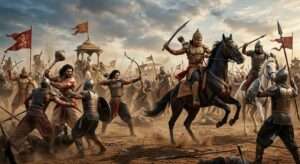
Consumed by unrestrained wrath, Karna now reached the forefront of battle. His only resolve was to avenge the humiliation inflicted upon the Kauravas. His arrows flew without pause, striking elephants, horses, chariots, and warriors alike. Mighty elephants collapsed in torrents of blood, while shattered bodies floated amid streams of crimson. The battle blazed with renewed fury. Dust, smoke, blood, and broken weapons clouded every direction until friend and foe could scarcely distinguish one another. Warriors struck down whoever came within reach, and confusion reigned over the entire field.
For a brief time the Kauravas appeared to gain the advantage, and renewed pride brightened their weary hearts. Yet Bhimasena charged forward like an irresistible tempest. Driving his chariot through the enemy ranks as though herding frightened cattle, he crushed every warrior who dared oppose him. Inspired by his fearless advance, the Pandava divisions followed close behind, raining arrows upon the retreating Kauravas and restoring balance to the conflict.
Vrushasena continued to display extraordinary martial brilliance. Yet his valor resembled the final radiant flame of a lamp that shines brightest before it is extinguished. In the midst of the struggle he slew a son of Nakula, shattered mighty elephants, and severed the head of a skilled charioteer. Observing these exploits, Arjuna could no longer remain a distant witness. Vrushasena boldly confronted him, striking both Arjuna and Bhima with three arrows each, and even pierced Lord Krishna with twelve sharp shafts. The Kaurava warriors applauded the young hero’s astonishing courage, though beneath their praise lingered the fear of Arjuna’s inevitable response.
Breaking through the mass of soldiers surrounding him, Arjuna advanced directly toward Vrushasena. The fearless youth met him without hesitation, striking Arjuna’s shoulders with ten keen arrows and wounding Krishna with nine more while shouting proudly across the battlefield. His audacity amazed warriors on both sides. Yet the son of Pandu, calm amid the storm, displayed the perfection of celestial archery. With flawless precision he shattered Vrushasena’s bow, severed the powerful sinews of his arms, and finally struck off his head with a blazing arrow. The prince’s lifeless body fell from his chariot before the astonished gaze of both armies. Duryodhana stood speechless, while Karna’s heart broke under the weight of unbearable grief.
Overcome by sorrow for his fallen son, Karna shed tears, yet grief swiftly transformed into blazing fury. Urging his horses forward, he drove straight toward Arjuna and challenged him to the long-awaited duel. Arjuna accepted without hesitation, advancing eagerly to meet his greatest rival. As the two supreme archers approached one another, the entire battlefield fell strangely silent. Warriors from both armies ceased fighting and stood motionless, knowing that the destiny of the war rested upon the encounter that was about to unfold.
The majesty of those two heroes resembled cosmic powers standing face to face. They appeared like Rama and Rudra, like the blazing Sun confronting irresistible Time. Their radiance drew the attention of celestial beings. Ancestors, Siddhas, Vidyadharas, Maharishis, Indra, Brahma, Rudra, and countless divine hosts assembled in the heavens to witness the incomparable contest.
Then Brahma spoke thoughtfully to Rudra. “Both these warriors possess immeasurable mastery over celestial weapons. They understand every mystery of archery, every science of warfare, and every secret of divine missiles. Their courage never falters, their strength never diminishes, and their heroic spirit knows no restraint. Should such mighty souls unleash the full measure of their power, the very universe may tremble beneath their conflict. Is there no means by which this dreadful encounter may yet be prevented?”
Rudra listened with serene composure and replied, “Heroes whose strength is sustained by destiny cannot be restrained. Their vows, their honor, and the course of Time itself compel them toward this inevitable encounter. Their battle cannot be averted. Therefore abandon every thought of preventing what has already been woven into the fabric of destiny.”
Hearing this divine exchange, Indra bowed respectfully before Brahma and spoke with quiet certainty. “Why should there be uncertainty regarding the outcome? The glorious embodiment of Nara and Narayana stands united upon the earth as Arjuna and Krishna. Their strength, wisdom, and divine purpose uphold the worlds themselves. When they advance with righteous anger to destroy the forces of unrighteousness, who among mortals or celestials can withstand them? The victory of Dharma has already been ordained, though Time still awaits its final revelation.”
Thus Sanjaya continued his solemn narration to Dhritarashtra, revealing not merely the outward movements of armies, but the deeper truth that the Kurukshetra war had become the theatre where destiny, divine purpose, human valor, and the inexorable law of righteousness converged in preparation for the greatest duel ever witnessed by gods and men alike.

