



॥ Om Devi Kushmandayai Namah ॥
॥ सुरासम्पूर्णकलशं रुधिराप्लुतमेव च ।
दधाना हस्तपद्माभ्यां कूष्माण्डा शुभदास्तु मे ॥
The present Durga Kund Temple in Varanasi is generally believed to date back to the 18th century. It is traditionally associated with Rani Bhabani of Natore, Bengal, who was known for building and supporting temples. Dedicated to Goddess Durga, the temple is an important centre of Shakti worship in the holy city of Kashi.
Maa Kushmanda is worshipped as the fourth form of Navadurga on the fourth day of Navaratri. She represents the divine creative energy of the universe and is revered as a source of vitality, radiance, and cosmic power.
Her name is traditionally explained through the words “Ku”, meaning little, “Ushma”, meaning warmth or energy, and “Anda”, meaning cosmic egg. This devotional interpretation connects her name with the cosmic egg, or Brahmanda, and the divine energy of creation. The name is also associated with the Sanskrit word for pumpkin, which is offered to the Goddess in certain worship traditions.
Maa Kushmanda is commonly depicted with eight arms and is therefore also known as Ashtabhuja. In her hands, she holds a kamandalu, bow, arrow, lotus, pot of nectar, discus, mace, and a rosary. The rosary is associated with spiritual attainment and divine blessings. She is generally shown riding a lion, symbolising courage, strength and Dharma.
She is also associated with the innermost region of the Sun, from where her divine radiance is believed to spread throughout creation. Devotees worship her seeking good health, wisdom, prosperity, strength and longevity.
The temple features elements of the North Indian Nagara style. Its red and ochre exterior reflects the powerful symbolism associated with Goddess Durga. The structure has rising shikharas and traditional architectural details.
Beside the temple lies the famous Durga Kund, a large rectangular sacred pond. Traditional accounts associate the pond with the River Ganga. During Navaratri, the temple attracts numerous devotees who gather to offer prayers to the Goddess.
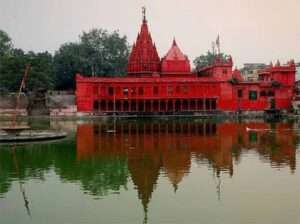
The present temple is traditionally attributed to Rani Bhabani of Natore, Bengal, and is generally dated to the 18th century. Over the centuries, it has remained an important place of worship for devotees of Goddess Durga.
The idol of the Goddess is believed by devotees to be Swayambhu, meaning that it manifested on its own rather than being fashioned by human hands. This sacred belief adds to the spiritual significance of the shrine.
hasaram – The Divine Mother Who Created the According to Hindu tradition, before creation, darkness prevailed everywhere. Maa Kushmanda brought the universe into existence with her gentle smile and divine energy. Through her cosmic power, the Brahmanda, or cosmic egg, came into being, marking the beginning of creation and filling the universe with light, warmth and life.
According to one traditional account, Maa Kushmanda manifested three supreme Goddesses through her divine powers. From her left eye emerged Mahakali, a powerful and fearsome form. From her forehead appeared Mahalakshmi, while from her right eye emerged Mahasaraswati, a radiant Goddess associated with wisdom and knowledge.
The narrative continues by describing the divine beings who emerged from these three Goddesses.
From Mahakali came a male form with five heads and ten arms, named Shiva, and a female form named Saraswati, with one head and four arms.
From Mahalakshmi came Brahma, with four heads and four arms, and Goddess Lakshmi, with one head and four arms.
From Mahasaraswati came Vishnu, with one head and four arms, and Goddess Shakti, also with one head and four arms.
According to this account, Maa Kushmanda arranged the divine pairs by giving Shakti to Shiva, Saraswati to Brahma and Lakshmi to Vishnu. This narrative describes the divine relationships associated with the cosmic functions of creation, preservation and transformation.
Finally, Maa Kushmanda absorbed the three supreme Goddesses into herself and entered Shakti as an eternal source of divine energy. This story portrays her as the supreme creative power from whom the other divine manifestations emerge.
The worship of Maa Kushmanda on the fourth day of Navaratri reminds devotees of the creative power of the Divine Mother. Her story inspires us to overcome darkness through faith, face challenges with courage and bring positivity into our lives.

