



Today’s Mahabharata episode was inadvertently published as a repetition of the earlier Infinity Flow post. The inconvenience is regretted.
— Editor
When the appointed hour arrived for the destruction of the three impregnable cities, the great Lord Shiva blazed forth in immeasurable wrath. Standing as the Supreme Archer, He lifted His celestial bow and fastened the sacred string upon it. The thunderous twang that arose from His bow reverberated through the heavens, the earth, and the nether regions, causing the three worlds to tremble with awe. Then the Lord placed the mighty Pashupata Astra upon the string and fixed His divine contemplation upon the three cities of the Tripurasuras. At that very moment, by the irresistible force of destiny, the three wandering cities aligned as one. The sages, the hosts of gods, and the celestial beings raised jubilant cries of “Jaya! Jaya!” Their voices resounded through the universe as they glorified the Supreme Lord.
Rudra then drew the bow to its fullest extent and released the incomparable Pashupata Astra. Its impact was beyond imagination. The mighty missile consumed the fortified cities together with their demonic inhabitants, reducing them to ashes. Their enchanted aerial citadels collapsed into the western sea, while the blazing fire released by the divine weapon spread with such intensity that it threatened the entire creation. Having accomplished His purpose, the compassionate Slayer of Tripura subdued the consuming flames, restoring peace to the worlds. The universe rejoiced, and the gods, sages, and celestial beings praised Mahadeva with sacred Vedic hymns. Having received His gracious permission, they departed joyfully to their respective abodes.
Recalling this glorious event, Duryodhana addressed Shalya with profound reverence. “Just as the Creator Brahma once guided the chariot of Lord Shiva during the destruction of Tripura, so too I desire that you become the charioteer of Karna. In wisdom, valor, and nobility you surpass even Karna, Arjuna, and Krishna. My life, my kingdom, and the future of the Kauravas now rest entirely in your hands. You alone possess the authority to preserve my honor, secure victory, and protect our kingdom. Therefore, I beseech you to guide Karna’s chariot and rescue me from humiliation.”
Sanjaya then said to Dhritarashtra, “O King, these were the words your son spoke to Shalya. While I was present, a venerable Brahmin narrated an ancient and sacred history. The illustrious sage Jamadagni was born in the exalted lineage of Bhrigu, and to him was born the mighty Parashurama, whose intellect was pure and unwavering. Desiring to obtain the supreme celestial weapons, Parashurama approached Lord Shiva with deep devotion. The Lord, possessing infinite wisdom, declared that divine astras could never remain with one whose heart was impure. ‘Purify yourself through unwavering righteousness,’ He said, ‘and then you shall become worthy of receiving these celestial powers.'”
Parashurama bowed low before the Lord, circumambulated Him with reverence, and humbly prayed, “O Lord, when I become worthy, bestow upon me the divine astras. Until that time, permit me to remain in Your service.” Pleased by such humility, Lord Shiva graciously accepted his request. For many years Parashurama worshipped the Lord with steadfast devotion, never deviating from his sacred vows.
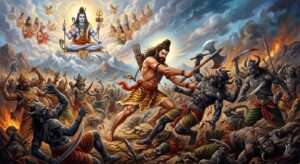
One day, filled with delight, Lord Parameshwara spoke to His divine consort Parvati. “Behold this Rama. He observes every vow with perfect purity. He is My beloved devotee, and I shall shower him with the nectar of My grace and affection.” At that very time the gods approached Shiva in distress. They complained that powerful demons had become unbearable, tormenting the celestial beings without restraint and disturbing the balance of the worlds.
Hearing their plea, Lord Shiva commanded Bhargava Rama, “Go forth and destroy these wicked demons, restoring peace and happiness to the gods.” Though overjoyed by the divine command, Parashurama replied with humility, “O Lord, I have not yet mastered the use of celestial weapons. These demons possess extraordinary strength and profound mastery of divine astras. How shall I overcome them?” Shiva smiled and answered, “My thoughts shall remain fixed upon you. Through My grace, victory will certainly be yours. Go forth without delay, O sinless warrior.”
Strengthened by unwavering faith, Bhargava Rama advanced fearlessly against the dreadful hosts of demons. The battle was fierce, and the enemies wielded terrifying weapons capable of devastating even the gods. Yet through the unseen power of Shiva’s grace, Parashurama slew them all. Though victorious, his body was covered with grievous wounds inflicted during the conflict. When he returned, Lord Shiva gently touched him with His divine hand, and instantly every wound disappeared without leaving the slightest mark.
Then the Lord instructed him, “When a warrior enters battle with unwavering determination and a mind firmly established in righteousness, bodily injuries lose their power to trouble him. A pure life and steadfast virtue grant strength greater than any weapon. The time has now come for you to receive My supreme gift.” Thereupon Shiva bestowed upon Parashurama the complete treasury of celestial weapons and divine astras. Overwhelmed with gratitude, Bhargava Rama prostrated before the Lord, accepted the priceless inheritance with profound reverence, took leave of Mahadeva, and returned to his father’s hermitage.
Sanjaya continued, “This ancient account explains the greatness of Bhargava Rama. Through severe austerities he acquired immeasurable divine strength, and in later years he entrusted all those celestial weapons to Karna. The great sage of the Bhrigu lineage would never have accepted a disciple of unworthy birth. He embraced Karna only because he believed him to be descended from the noblest Kshatriya lineage. Karna’s radiant complexion, majestic appearance, natural armor, celestial earrings, and extraordinary prowess revealed a greatness far beyond that of ordinary men. Could a common woman give birth to one adorned from birth with divine armor and earrings resembling the splendor of the Sun himself? Can a timid deer ever bring forth a lion? The only shadow upon Karna’s life was that he had been raised in the household of a charioteer, but such a circumstance was insignificant before the brilliance of his destiny.”
Therefore Duryodhana pleaded with Shalya, “Just as Brahma accepted the role of charioteer for Lord Shiva, you should likewise guide Karna in battle. The sacred code of warfare declares that the charioteer must possess wisdom and skill surpassing even that of the warrior he guides. By your kindness my deepest desire has been fulfilled.”
Shalya embraced Duryodhana affectionately, his face bright with satisfaction, and replied, “Prince, since you recognize my abilities, I shall indeed fulfill your wish. Yet remember this well: my words may often appear harsh, but every counsel I offer is intended solely for your welfare. Neither you nor Karna should become angry when I speak frankly.”
Hearing these words, Karna addressed Shalya with respect. “Just as Brahma guided Rudra and Krishna guided Arjuna, so too display your wisdom and valor while directing my chariot. I know that every word you speak arises from sincere concern for my welfare.”
Shalya answered with calm wisdom, “For the truly noble, blame and praise possess equal value. Wise men are never disturbed by either. There will always be those who approve and those who criticize. A person of discernment accepts both with patience and remains steadfast in duty. I am capable even of guiding the chariot of Indra himself. As a charioteer, I shall always speak what is appropriate, ensuring that the warrior never loses concentration nor becomes careless. Arjuna achieved lasting fame because of Krishna’s flawless guidance. Since you seek victory over him, it is fitting that I guide your chariot.”
Delighted by Shalya’s acceptance, Duryodhana declared, “When measured with true understanding, even Krishna’s skill as a charioteer is not superior to that of Shalya. Not even Matali, the celestial charioteer of Indra, can equal this noble king. By the grace of Providence he has agreed to direct your chariot. Therefore, O steadfast Karna, under his guidance go forth and humble the pride of Arjuna.”
Sanjaya concluded his narration to Dhritarashtra, saying, “Thus your son wisely recounted these ancient and sacred histories to persuade Shalya, while at the same time encouraging Karna to receive his counsel with humility. In this manner he united both men in preparation for the decisive battle that would determine the fate of the Kuru dynasty.”

