


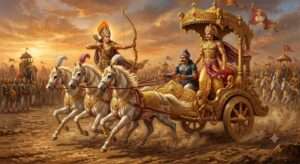
After prolonged deliberations and many words of persuasion, the mighty King Salya of Madra at last consented to assume the reins of Karna’s chariot. Knowing the incomparable stature of the monarch who would guide him into the final and most decisive battle of his life, Karna commanded his attendants to prepare a magnificent chariot worthy of Salya’s royal dignity. It was adorned with celestial emblems, furnished with every weapon required for prolonged warfare, and equipped with steeds of unmatched vigor. Learned priests performed sacred rites, offered auspicious oblations, and invoked divine blessings upon the chariot. Karna, with profound reverence, circumambulated it in solemn devotion, fixed his mind upon the radiant Lord Surya, his divine father, and offered silent prayers for strength, steadfastness, and glory. With folded hands and deep humility, he invited King Salya to ascend the chariot.
Salya mounted the chariot with regal grace and effortless majesty, like a lion springing from one lofty cliff to another. His commanding presence illuminated the chariot as lightning adorns a rain-bearing cloud. When Karna himself stepped upon it, his golden armor and radiant countenance made him appear like the resplendent sun emerging from masses of dark clouds. Warrior and charioteer together formed a vision of irresistible splendor, inspiring admiration among friends and apprehension among foes. It was this memorable acceptance of Salya as Karna’s guide that Sanjaya vividly described before King Dhritarashtra, who listened with anxious expectation, eager to know how Karna, under Salya’s guidance, would reveal his mastery of warfare, tactical brilliance, and unconquerable courage.
The assembled warriors beheld their newly appointed commander with reverence and jubilation. Salutations echoed through the vast ranks of the Kaurava host as soldiers bowed before both Salya and Karna. Their eyes then turned toward Duryodhana, the architect of this carefully devised strategy, who stood filled with hope. Addressing Karna with earnest emotion, he declared that he had once believed the invincible Bhishma and the peerless Drona would surely slay Bhima and Arjuna, yet fate had denied the fulfillment of that cherished hope. Now he entrusted that unfinished destiny to Karna. He urged him to capture the eldest Pandava, the righteous Yudhishthira, alive, while destroying every other enemy without hesitation, thereby securing enduring victory for the Kaurava kingdom.
Receiving the king’s command with unwavering confidence, Karna instructed Salya to drive directly into the heart of the enemy formations. At once, conches thundered across the battlefield, kettle drums rolled like storm clouds, tabors resounded, mighty horns blared, and countless war bells filled the heavens with terrifying vibrations. The majestic chariot advanced with measured grandeur, its swift horses moving like the winds of destiny. Inflamed by confidence, Karna spoke proudly to Salya, declaring that the gods themselves would rejoice upon witnessing his valor and would shower praises from the heavens. He proclaimed that even Salya, despite his wisdom and restraint, would be compelled to acknowledge his unmatched heroism.
These words stirred displeasure within the seasoned king of Madra. Salya, unwilling to flatter empty pride, replied with calm yet piercing truth. He reminded Karna that he had never ventured to challenge the Pandavas while Bhishma and Drona still commanded the Kaurava armies. He extolled the courage, discipline, and invincible prowess of the sons of Pandu, describing them as radiant heroes, supreme masters of archery and warfare, whose valor could not be measured by ordinary standards. Even Indra himself, he declared, would struggle to overcome such warriors in open combat. He warned Karna that when the thunderous twang of Arjuna’s Gandiva echoed across the battlefield, when Bhima’s terrible mace descended like the wrath of destruction, when Nakula and Sahadeva displayed their swift mastery, and when Yudhishthira stood immovable with his spear and steadfast righteousness, Karna would discover the true measure of those whom he so lightly underestimated.
Each word struck Karna’s heart like an unseen arrow. Though inwardly consumed by anguish at hearing his enemies repeatedly praised by his own charioteer, he concealed the fire raging within his soul. He silently lamented the misfortune he himself had invited by accepting Salya’s guidance, yet outwardly maintained composure as though he had not heard a single rebuke. His silence revealed the discipline of a warrior determined not to be distracted on the threshold of destiny.
Breaking that silence, Karna once more proclaimed his confidence, inviting Salya to witness the full measure of his strength and martial excellence. His declaration rekindled the spirits of the Kaurava army. Realizing that their commander was preparing to blaze upon the battlefield like an all-consuming fire, the soldiers raised mighty cries of victory and encouragement. The neighing of restless horses mingled with the deafening trumpeting of elephants, electrifying the atmosphere with fierce anticipation. The earth trembled beneath countless chariot wheels, while the sky itself seemed to roar with dreadful foreboding. Fierce winds lifted clouds of dust that darkened the horizon, and terrifying omens appeared on every side, as though nature herself warned of approaching destruction. Yet, blinded by destiny and driven by unyielding hope, the Kauravas dismissed every evil sign, believing that triumph still awaited them.
Within Karna’s heart another storm raged. He brooded over the defeats suffered under Bhishma and Drona, blaming their failures for the growing confidence of the Pandavas. His resentment toward Arjuna burned with increasing intensity, hissing within him like a coiled serpent preparing to strike. Filled with fierce manliness, indomitable self-esteem, and an unshakable desire to vindicate his honor, he declared before Salya that when he fully stretched his mighty bow and released its deadly torrents of arrows, even the lord of the heavens would be unable to withstand his assault. He vowed to crush the pride of those who gloried in the fall of Bhishma and Drona and to reveal a power that would shake the very foundations of the battlefield.
Thus Sanjaya narrated to King Dhritarashtra the opening movements of that fateful day, when Salya first guided Karna’s chariot toward the armies of the Pandavas. Beneath the splendor of royal ceremony, the brilliance of martial vows, and the deafening acclaim of assembled warriors, there flowed an unseen current of destiny. One warrior was consumed by unyielding ambition, another by uncompromising truth, while fate silently guided both toward the final encounter that would determine the course of the great war and forever shape the immortal history of the Mahabharata.