


(………….Continued)
Security Trajectory – Great Power Politics
The Arctic has risen on the world’s strategic agenda because the U.S. and Russia are already in the region, and because China has been progressively expanding its presence there. Both USA and NATO have been lambasting both Russian and Chinese actions in the region, which represented a clear break with notions of the Arctic as a “zone of peace.”
The Arctic is critical to U.S. national security interests and the defense of the homeland. The USA must work with allies to preserve defense treaty commitments.
Also, Russia has long harbored grand designs of developing its vast Arctic coastline and extracting more of the resources found off them. As a result, many believed it would have an interest in maintaining peace and stability in the Arctic, so that it could attract foreign investment to these projects and increase cargo traffic in the Northern Sea Route. Russia has substantially increased its military assets in the region and Vladimir Putin is openly threatening war if other states cross his red lines.
Furthermore, greater Chinese presence in the Arctic is inevitable. The USA lawmakers pointed out that China’s “access to the Arctic for satellite communication ground stations and scientific research greatly expands the operational effectiveness of the PLA and furthers the PRC’s global ambitions.”
Should relations between these three superpowers continue on their current path of increasingly bellicose statements, confrontational military posturing, technological decoupling and ever more targeted sanction regimes, the prospect of greater tensions in the Arctic cannot be discounted?
Ukraine War Impact
Russia’s invasion of Ukraine signals that, as the era of multipolarity kicks in, nations with a historical sense of either grievance or entitlement—or both—may give in to the temptation of disregarding international law and using force to assert strategic red lines.
In the initial chapter of the Eastern European war, the geopolitical narrative was simple and binary: Vladimir Putin was framed as the ultimate villain, Volodymyr Zelenskyy as the lone hero, and the battle lines of global democracy clearly drawn. Yet, as the conflict drags on—with Donald Trump signalling a shift in American posture, European nations preparing their publics for long-term militarization, and leaders like Xi Jinping and Narendra Modi navigating complex neutralities—the moral framing begins to fray. The question of who is the real villain or hero misses the larger truth: morality plays are often distractions designed to keep the world focused on today’s battlefield, while the real architects shape tomorrow’s map.
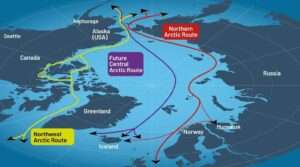
Seen through this lens, the framing of Putin as a single, existential threat serves a specific structural purpose. By reducing a multi-decade resource competition down to one dictator’s moral failings, the public conversation remains fixed on regime survival rather than geographic control. The ultimate long-term strategic objective of Western policy is not merely to defend Ukraine, but to exhaust Moscow, fragment its sphere of influence, and weaken its ability to monopolize the far north.
Meanwhile, the broader machinery of global influence works quietly. Ukraine bleeds Russia’s conventional strength; NATO expands its perimeter; Europe rearms; and sanctions exert pressure on Moscow while simultaneously attempting to constrain China’s access and alter India’s strategic autonomy. America funds the Western flank, keeping Russia’s eyes locked on Europe, even as the real wealth shifts toward the polar north and the Indo-Pacific.
India-Russia Strategic Partnership – Multi-polarity
This structural reality explains why India refuses to abandon its strategic partnership with Russia despite intense Western pressure. For New Delhi, this is not about endorsing a war, but about preserving balance on the Eurasian supercontinent. If Russia is completely isolated or balkanized, China becomes the sole dominant partner in Eurasia and the primary beneficiary of Arctic development—an outcome directly counter to India’s national interest. By maintaining ties, energy imports, and strategic coordination with Moscow, India ensures that Russia remains a multipolar actor rather than a client state of Beijing.
Ultimately, geopolitical power rarely aligns with simple moral labels. Leaders like Putin, Zelenskyy, Trump, Xi, and Modi operate within the cold calculus of geography, trade routes, and resource security. Ukraine may be where the war is fought today, and Putin may be the villain the narrative requires, but the Arctic is the high-stakes board hiding in plain sight. India moves quietly because it understands this underlying logic: when national interest and long-term strategic posture are at stake, the true players look past the noise and position themselves for the next hundred years.
To sum up, the stability and security of the “Arctic” is dependent on the outcomes of divergent and convergent interests of not only the Arctic Circle nations but also China, NATO, SE Asian and Asian nations. (Concluded)

