



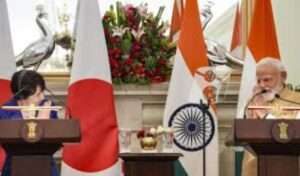
In the twenty-first century, wars may still be fought with armies, but power is increasingly determined by supply chains, technology and energy security. Nations that control these strategic arteries will shape the global order. It is against this backdrop that the India-Japan summit assumes significance far beyond a routine diplomatic engagement. The growing strategic convergence between India and Japan is no longer merely about strengthening bilateral ties. It is about preparing Asia for an era in which economic security, resilient supply chains and technological leadership are as critical as military strength. Japanese Prime Minister Sanae Takaichi’s visit to New Delhi and the outcomes of the 16th India-Japan Annual Summit must therefore be viewed through this broader geopolitical prism. The importance of the summit lies not merely in its headline announcements. Japan’s commitment to mobilise 10 trillion yen—nearly $68 billion—in private investment over the next decade reflects extraordinary confidence in India’s long-term growth story. More importantly, both countries have recognised that the future contest for global influence will be shaped by trusted supply chains, critical minerals, semiconductors, artificial intelligence, pharmaceuticals and energy security. These are precisely the sectors where excessive dependence on a single country has emerged as a strategic vulnerability. The COVID-19 pandemic, followed by successive geopolitical crises, exposed the risks of concentrated manufacturing and fragile logistics. Much of the world still relies heavily on China for manufacturing, processing critical minerals and producing industrial components. Such dependence gives Beijing considerable leverage over global trade and strategic decision-making. That is why India, Japan and Australia must move beyond diplomatic rhetoric and institutionalise deeper economic and strategic cooperation. Together with the United States through the Quad framework, these democracies possess the economic strength, technological capability and maritime reach to build alternative supply chains that are transparent, secure and resilient. Energy security deserves equal attention. The LNG security partnership between India and Japan, along with the creation of a joint task force on energy storage and stockpiling, represents a timely and pragmatic initiative. The Indo-Pacific carries a substantial share of the world’s crude oil and LNG shipments. Any disruption—whether caused by military tensions, piracy or geopolitical coercion—can send shockwaves through global markets. Australia’s abundant reserves of critical minerals and energy resources, Japan’s technological excellence and India’s expanding manufacturing ecosystem create a natural strategic complementarity. Together, these partners can diversify sourcing, reduce vulnerabilities and establish dependable transshipment and logistics networks that benefit not only themselves but the wider Indo-Pacific region.
Yet strategic realism demands balance. India’s rise does not require permanent hostility towards China. Geography cannot be altered. China will remain India’s largest neighbour and one of Asia’s most influential economies. While New Delhi must deepen strategic partnerships with Japan, Australia and the United States, it should also pursue stable engagement with Beijing wherever India’s national interests permit. The objective is not confrontation for its own sake. India needs a peaceful Line of Actual Control, predictable diplomatic engagement and effective mechanisms to prevent border tensions from escalating into prolonged military stand-offs. Stability along the frontier is equally important for economic growth. Global corporations seeking to diversify manufacturing away from China look not only at market potential but also at geopolitical stability. Persistent military tensions inevitably undermine investor confidence. This is where India’s diplomatic maturity will be tested. It must remain unwavering on sovereignty, uncompromising on national security and vigilant against strategic coercion, while avoiding unnecessary provocation. A confident India need not choose between strategic partnerships and pragmatic diplomacy. It can—and must—pursue both simultaneously. The agreements covering semiconductors, artificial intelligence, pharmaceuticals, the Mumbai-Ahmedabad High-Speed Rail project and the ambitious plan to facilitate the movement of 500,000 skilled professionals demonstrate a partnership that extends far beyond conventional diplomacy. They lay the foundation for shared prosperity, technological innovation and regional stability. The Indo-Pacific is entering an era of intense strategic competition. Nations that build trusted partnerships today will shape tomorrow’s economic order. India, Japan and Australia, backed by the Quad, have an unprecedented opportunity to create resilient supply chains, secure energy routes and drive technological advancement. The challenge is to strengthen this democratic partnership without allowing strategic rivalry to eclipse diplomatic prudence. India’s national interest is best served not through needless confrontation but through strategic confidence, economic resilience and sustained peace. That is the path that will enable India to emerge not merely as a balancing power, but as one of the principal architects of the Indo-Pacific century.



Thank you for writing a detailed report
I am sure this is how India should approach irrespective of size of the country and India should also lend its hand in improving their economies