


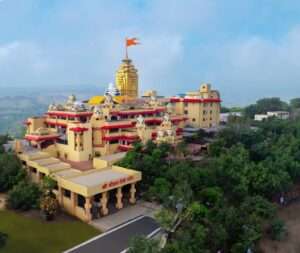
Shri Mohata Devi Temple, situated on Mohatagad hill near Mohate village, about 9 km east of Pathardi town, is a prominent Devi pilgrimage centre in Maharashtra. The presiding deity is Shri Jagdamba Mohata Devi, revered by devotees as a manifestation of Renuka Mata of Mahurgad. The temple is regarded as a sacred place where devotees come to offer prayers, fulfil their vows and seek the blessings of the Divine Mother.
The exact age of the original shrine has not been conclusively established through reliable historical records. The temple trust describes the site as an ancient place of worship whose older structure underwent renovation and reconstruction to accommodate the growing number of devotees. The present temple features an elaborate design centred on the Shri Yantra.
The presiding deity is Shri Jagdamba Mohata Devi, also known as Mohata Devi or Mohatadevi Amma. According to the temple tradition, she is associated with Renuka Mata of Mahurgad and is revered as a powerful, self-manifested form of the Divine Mother. Devotees affectionately regard her as a goddess who responds to sincere prayers and fulfils the vows of her devotees. The shrine is particularly associated with faith, protection, family welfare, and the fulfilment of heartfelt wishes.
The temple stands atip Mohatagad hill and its elevated setting adds to the spiritual atmosphere of the shrine. The present shrine features a distinctive Shri Yantra-based design and architectural elements inspired by the South Indian temple style. The complex includes a sanctum housing the goddess, an elaborate superstructure with multiple smaller spires, and a spacious assembly area for devotees.
The history of Mohata Devi Temple is closely connected with the religious traditions of the Pathardi region and the worship of Jagdamba Devi. The temple is regarded as an important regional pilgrimage destination, drawing devotees from different parts of Maharashtra.
The traditional accounts of the shrine connect its origin with the Navnath saints and the manifestation of Jagdamba Devi. Another important tradition centres on Bansi Baba Dahiphale, a devotee of Renuka Mata, whose devotion is associated with the development of the temple’s distinctive annual pilgrimage and worship customs.
According to the traditional Sthalapurana of Mohata Devi, the region once experienced a severe drought that brought immense suffering to its people. Wells and water sources dried up, agricultural activities were affected, and the people prayed for relief from the hardship.
At this time, the Navnath saints are said to have undertaken a great yajna for the welfare of the world. Sages and spiritual personalities were invited, and the sacred ritual was performed with devotion to Jagdamba Devi. At the conclusion of the yajna, a divine power is believed to have manifested from the sacrificial fire. This divine manifestation was identified as Jagdamba Renuka Mata.
The goddess was worshipped with traditional rituals, and the Navnaths prayed that she would remain in the region to protect its people and ensure their welfare. According to the legend, the goddess promised to manifest at the appropriate time and establish her presence there. She subsequently appeared at Mohatagad and became renowned as Mohata Devi. Devotees regard this manifestation as the sacred origin of the temple and believe that the goddess continues to bless those who approach her with sincere faith.
Another important legend concerns Bansi Baba Dahiphale, a devoted worshipper of Renuka Mata. He is traditionally remembered for undertaking an annual pilgrimage on foot to Mahurgad, where he worshipped the goddess and offered her traditional garments. As he grew older, the difficult journey became increasingly challenging, and he prayed to the Divine Mother that he should not be separated from her.
According to the temple tradition, one day his cow went missing. While searching for the animal, he climbed the hill and discovered the cow releasing its milk at a particular spot. On investigating the place, he found a sacred stone form of the goddess, known traditionally as a taandala. This discovery is associated with the establishment and worship of the goddess at Mohatagad.
The villagers subsequently travelled to Paithan and brought holy water in a kavadi to perform the goddess’s abhishek. The ritual is traditionally associated with Ashwin Shukla Ekadashi, the eleventh day of the bright fortnight of the Hindu month of Ashwin. This sacred observance became an important part of the temple’s annual tradition, connecting the devotion of the villagers with the continuing worship of Mohata Devi.
Sharadiya Navratri is one of the important festivals celebrated at Mohata Devi Temple. During these nine days, devotees worship the goddess with special prayers and traditional rituals. Many devotees observe fasts, perform Ghatasthapana and undertake vows seeking the blessings of the Divine Mother.
The annual Mohata Devi Yatra is another significant observance associated with Ashwin Shukla Ekadashi. As part of the traditional custom, villagers and devotees undertake a pilgrimage on foot to Paithan to bring holy water in a kavadi for the goddess’s abhishek. The ritual is followed by the temple festivities and a palanquin procession from Mohate village to the temple. A distinctive feature of the procession is the participation of large numbers of women who sweep the path ahead of the palanquin with the ends of their sarees, expressing devotion and reverence to the goddess.

