



Rahul Gandhi’s “Chhatron Ki Goonj” in Indore was billed as an outreach to students and an occasion to put their concerns—education, examination irregularities, recruitment and unemployment—at the centre of political debate. Yet, as the event unfolded, politics and entertainment appeared to compete with the very issues the programme was expected to highlight.
The most contentious moment was a satirical performance on stage that reportedly mocked an incident involving Prime Minister Narendra Modi helping arrange a chair for an elderly woman during a public programme. The phrase “Maa ko kursi do” became part of the routine. Rahul Gandhi was seen watching the performance and laughing.
Satire is certainly part of democratic political discourse. Politicians can be criticised, caricatured and even mocked. But there is a difference between criticising a political decision and turning an ordinary gesture of courtesy towards an elderly citizen into material for ridicule. For a Leader of the Opposition, that distinction matters.
This is where Salman Khan’s recent message to online trolls offers an interesting lesson—even if it comes from an unlikely quarter of political discourse.
Speaking about trolling, Salman said: “Kisi ko neecha dikha ke aap paise kama rahe hain” and added, “Aap apni upbringing dikha rahe ho.” His larger point was simple: pulling somebody down for their appearance, weight, family, career setbacks or personal milestones does not elevate the person doing the trolling. It reveals the nature of the discourse itself.
Why should the same principle not apply to politics?
Rahul Gandhi is not an ordinary political commentator. He is the Leader of the Opposition in the Lok Sabha. His words, conduct and the political culture surrounding his programmes therefore carry greater responsibility.
There is nothing wrong with Rahul Gandhi attacking the Narendra Modi government. There is nothing wrong with raising questions about unemployment, examination systems, education policy or the functioning of government. Indeed, that is precisely what a parliamentary Opposition is expected to do.
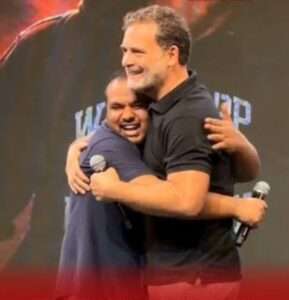
But political criticism becomes less persuasive when the accompanying spectacle begins to overshadow the substance.
The Indore programme itself had already acquired a political edge before Rahul Gandhi arrived. The event was shifted after permission to use the Jawaharlal Nehru Stadium was denied, with Congress alleging political obstruction and the BJP disputing that interpretation. The programme eventually moved to another venue.
Then came the “Jhooth Ki Goonj” posters across Indore, with Congress accusing the BJP of trying to disrupt the event while the BJP presented them as criticism of Rahul Gandhi’s previous claims.
In such an atmosphere, the Opposition has an opportunity to rise above the political noise.
Students do not merely need political entertainment. They need answers. They need credible arguments on examinations, jobs, skills, recruitment and opportunities. If a programme called “Chhatron Ki Goonj” is reduced to slogans, political attacks and theatrical performances, the actual student voice risks being drowned out.
Rahul Gandhi has every democratic right to oppose Modi and challenge the government. But opposition need not mean derision. Political disagreement need not become personal ridicule.
Perhaps, therefore, Salman Khan’s words deserve to be heard beyond the world of cinema: one does not strengthen an argument by pulling somebody else down.
For a Leader of the Opposition seeking to speak for India’s youth, that may be a lesson worth considering.

