



Mantra 2.5
This (Prana) burns as fire; this is the sun; this is the clouds; this is Indra; this is the wind. This bright one is verily earth, moon, form and formless, and also what is immortal.
Prana is the nucleus, the divine energy that vitalises matter. Prana is form and formless. Form refers to the gross elements, and formless is the subtle element. Gross elements, which have form, are fire, water and earth. They are visible and tangible. Subtle elements are space and air.
That also is immortal; Prana never dies.
Mantra 2.6
अरा इव रथनाभौ प्राणे सर्वं प्रतिष्ठितम् ।
ऋचो यजूꣳषि सामानि यज्ञः क्षत्रं ब्रह्म च ॥ २.६॥
arā iva rathanābhau prāṇe sarvaṃ pratiṣṭhitam.
ṛco yajūgͫṣi sāmāni yajñaḥ kṣatraṃ brahma ca .. 2.6..
Like the spokes are fixed to the hub of a wheel, the Rig mantras, the Yajur Veda and the songs of Sama, all yajnas, Kshatriya and Brahmana — everything rests in the Prana.
The Guru compares the Prana to a hub of a wheel and the spokes that are fixed to the hub. So Prana is the hub, and the spokes are all the activities.

The maintenance of morality and social responsibility is the job of Kshatriya, a warrior or ruler.
A Brahmana is involved in the higher vocation of studying and imparting the shastras.
All yajnas refer to all actions that you perform, which can be converted into yajna. So all actions are Prana. Just like every spoke is connected to the hub, everything you do is but Prana. To realize that Prana, the awareness is important.
Just like an egoistic person has awareness of himself, a spiritual person has awareness of Prana. A spiritual person thinks everything is happening because of Brahman. When every action of yours is to serve the cause, you and your interest becomes insignificant.
Mantra 2.7
प्रजापतिश्चरसि गर्भे त्वमेव प्रतिजायसे ।
तुभ्यं प्राण प्रजास्त्विमा बलिं हरन्ति
यः प्राणैः प्रतितिष्ठसि ॥ २.७॥
prajāpatiścarasi garbhe tvameva pratijāyase .
tubhyaṃ prāṇa prajāstvimā baliṃ haranti
yaḥ prāṇaiḥ pratitiṣṭhasi .. 2.7..
As Prajapathi, thou alone movest in the womb and art born again. To thee, O Prana, who art always residing in the other pranas (senses), the creatures offer oblations.
Everything that is born is thy own manifestation. Every perception, action, emotion, and thought is happening because of Prana. The moment you offer them as an oblation to Prana, it becomes yajna. Prana is the supreme Brahman, and yajna is the means to get to Brahman. One should have the awareness that everything is happening because of Prana, Brahman. When you offer the action as an oblation to Brahman, it becomes a yajna. Yajna is a means to nullify the ego.
Guru Pippalada is trying to explain Brahman to us. It is like we are trying to explain electricity to an aboriginal. We all are spiritual aboriginals.
Eg: When we can bring an aboriginal and show that the power in a bulb, mixer, refrigerator, geyser, heater, etc. is all because of electricity. The water in a geyser is hot and, in a refrigerator, it is cool, it is because of electricity. We are explaining electricity only through its manifestations. Similarly, you can only understand Brahman through its manifestations. You cannot understand Brahman per se, just like electricity. Mahatmas are trying to explain Prana to spiritual aboriginals. So they explain through its manifestations that you are in the womb, sun, fire, clouds, rain, food, and everything. It’s like saying that electricity is there in a fan, refrigerator, bulb, etc. Just as we understand electricity through its manifestations, similarly we can understand Brahman or Prana through its manifestations. Without manifestation we don’t know how to relate to it.
Mantra 2.8
देवानामसि वह्नितमः पितॄणां प्रथमा स्वधा ।
ऋषीणां चरितं सत्यमथर्वाङ्गिरसामसि ॥ २.८॥
devānāmasi vahnitamaḥ pitṝṇāṃ prathamā svadhā .
ṛṣīṇāṃ caritaṃ satyamatharvāṅgirasāmasi .. 2.8..
Thou art the best carrier (fire) to the Gods and first offerings to the manes. Thou art the true principle behind the senses the essence of the body.
Fire is symbolically used as a means to carry your offerings to the gods and manes. Fire plays a major role in the traditional Vedic culture. Fire is symbolised as Brahman in the Vedas because fire is the first element seen with the eyes.
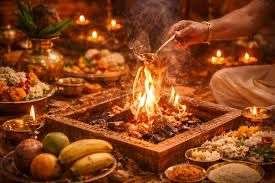
When there is drought, the community comes together and perform yajna for rain and good harvest. In yajna you are offering and the flame shoots up, clouds gather, and it brings rain. There is an agriculture metaphor in the Bhagavad Gita, chapter 3, verses 14 & 15:
अन्नाद्भवन्ति भूतानि पर्जन्यादन्नसम्भवः ।
यज्ञाद्भवति पर्जन्यो यज्ञः कर्मसमुद्भवः ॥ 14 ॥
annādbhavanti bhūtāni parjanyādannasambhavaḥ ।
yajñādbhavati parjanyō yajñaḥ karmasamudbhavaḥ ॥ 14 ॥
From food come forth beings; from rain food is produced, from yajna (sacrifice) arises rain and yajna (sacrifice) is born of action.
कर्म ब्रह्मोद्भवं विद्धि ब्रह्माक्षरसमुद्भवम् ।
तस्मात् सर्वगतं ब्रह्म नित्यं यज्ञे प्रतिष्ठितम् ॥ 15 ॥
karma brahmōdbhavaṃ viddhi brahmākṣarasamudbhavam ।
tasmātsarvagataṃ brahma nityaṃ yajñē pratiṣṭhitam ॥ 15 ॥
Know that action arises from Brahma (the creator) and Brahma arises from the Imperishable. Therefore, the all-pervading Brahman ever rests in yajna (sacrifice).
Rain comes when you perform yajna. Yajna is fire worship, and when you worship fire, rain comes. There is a connection amongst Brahman, yajna, and life. Yajna is the pivot or hub to take you to Brahman. Fire is the best offering to the Gods and the manes.
Yajna is not about fire ritual. Sage Vyasa gave a new meaning to yajna. In Chapter 4 of Gita, he talks about how to convert every action and perception into yajna.

