



(Groundwater crisis: A serious challenge facing Indian agriculture)
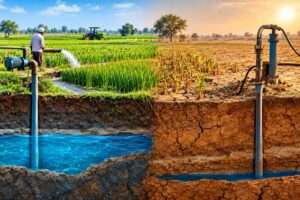
Behind the glitter of India’s agricultural achievements lies a grim reality—rapid groundwater depletion. More than 78 percent of the country’s irrigation needs depend on groundwater, and the agricultural sector accounts for nearly 90 percent of groundwater withdrawals. In agricultural states like Punjab, Haryana, and Rajasthan, groundwater withdrawals far exceed annual recharge; in Punjab, the rate has reached 152 percent. This situation not only threatens long-term agricultural sustainability but also has serious consequences, including rural inequality, rising energy demand, and ecosystem degradation.
The roots of this crisis lie in structural policies and incentives. Since the Green Revolution, the Minimum Support Price (MSP) and guaranteed government procurement have pushed farmers toward monopolizing wheat and rice cultivation, especially in Punjab and Haryana. Water-intensive crops like rice, which are not suited to the local climate, have been cultivated extensively as markets and policies reward them. Furthermore, free or heavily subsidized electricity for agriculture has reduced pumping costs to negligible, making the marginal cost of extracting additional groundwater zero for farmers and encouraging indiscriminate extraction. The rapid expansion of tubewells and private borewells, weak regulation, and a lack of community-level management have exacerbated this situation.
Irrigation methods also contribute to the problem. Traditional flood irrigation is still widespread, with high water wastage and low efficiency. Schemes to promote micro-irrigation (drip and sprinkler) exist, but high initial costs and maintenance concerns for small farmers limit adoption. The uncertainty of climate change and the vagaries of monsoons have made farmers increasingly dependent on groundwater.
The consequences of this crisis extend far beyond the farm. Falling water levels force farmers to install deeper borewells and more powerful pumps, increasing irrigation costs and disproportionately affecting small and marginal farmers. Extracting water from deeper levels requires more energy, further tightening the water-energy relationship. Ecologically, over-extraction poses the risk of land subsidence, salinity intrusion into coastal areas, and long-term degradation of water quality. At the social level, water scarcity fuels conflict between agriculture, industry, and domestic use, and between states with shared river basins. Economically, rising irrigation costs reduce farm profitability.
This challenge cannot be addressed solely through technological improvements, but rather by realigning incentives, institutions, and practices to ecological limits. First, crop diversification must be transformed from a slogan into a strategy. Paddy cultivation in Punjab and Haryana cannot continue in the same way as in Bengal or Assam; less water-intensive crops like maize, pulses, oilseeds, and horticulture must be promoted with similar market guarantees, processing infrastructure, and price support. Without economic viability, diversification will remain only on paper. Second, rapid expansion of irrigation efficiency is essential. The ‘Per Drop More Crop’ component of the Pradhan Mantri Krishi Sinchai Yojana (PMKSY) has promoted drip and sprinkler systems with up to 55 percent subsidy for small farmers, but coverage remains limited. Expanding micro-irrigation, adopting water-saving practices like direct-seeded rice and alternate wetting and drying in paddy, and investing in laser land leveling can reduce farm-level water use by 30–50 percent.
Third, groundwater governance must be strengthened. Community management through panchayats and water-user associations, along with participatory aquifer mapping and local water budgeting, can ensure accountability on extraction. Regulatory measures, such as permitting new borewells in over-exploited blocks and linking electricity connections to sustainable extraction criteria, should complement voluntary efforts. Fourth, subsidy reform is essential. Moving from flat-rate or free electricity to metered volumetric pricing, as well as targeted direct benefit transfers to protect small farmers, can be equitable while preventing wastage. Agricultural support schemes should include water-use criteria to reward farmers who adopt water-efficient crops and technologies. Finally, expanding recharge and conjunctive use is essential. Rainwater harvesting, check dams, recharge shafts, and watershed management can enhance natural recharge, while developing canal command areas and promoting conjunctive use of surface and groundwater can reduce excessive dependence on aquifers.
India stands at a crossroads: either continue exploiting groundwater for short-term yields, or adapt agriculture to ecological reality. The current path will deepen rural distress, increase inequality, and undermine food security. Diversified crops, efficient irrigation, improved incentives, and community-led governance—this alternative path leads to sustainable agricultural prosperity. Groundwater is not just a resource, but a generational asset; how it is managed today will determine whether India’s farmlands remain fertile or become a relic of the past.

