



Former Vice-President Hamid Ansari has every democratic right to express his political and ideological views. But when a former occupant of one of Bharat’s highest Constitutional offices describes Hindu right-wing communalism as the greater danger to the nation, he cannot expect the statement to pass without scrutiny. At the A.G. Noorani Memorial Lecture, Ansari invoked a remark attributed to former Prime Minister Jawaharlal Nehru that the real danger to Bharat was not communism but Hindu right-wing communalism. He also spoke of an alleged shift from “civic nationalism” to “cultural nationalism”. The question is simple: Why must the faith followed by the overwhelming majority of Bharatiyas repeatedly be placed under a political microscope as a potential threat to the nation? Hinduism is not an imported political ideology. Sanatana Dharma is one of the world’s oldest living spiritual traditions, and its civilisational presence predates the modern Bharatiya State by millennia. To equate the faith of millions with extremism merely because some political groups invoke Hindu identity is intellectually dishonest. Extremism, wherever it exists, must be confronted—but a faith cannot be put in the dock for the actions of individuals. Ansari’s formulation is particularly troubling because it risks creating precisely the communal divide that he claims to oppose. If majoritarianism is defined merely by the numerical strength of a community, then democracy itself becomes suspect. In a democracy, a majority formed through elections is not automatically a religious majority seeking to suppress minorities. It is a political majority that remains bound by the Constitution. And Ansari, of all people, should appreciate the distinction. There is another reason his latest intervention invites uncomfortable questions. In 2022, Pakistani journalist Nusrat Mirza claimed that he had visited Bharat several times and passed information gathered here to Pakistan’s Inter-Services Intelligence (ISI). Political opponents subsequently alleged that Mirza had been invited by Ansari and linked the former Vice-President to the episode. Ansari emphatically denied ever inviting or meeting Mirza, calling the allegations a “litany of falsehoods”. That allegation, therefore, cannot responsibly be presented as a fact against Ansari. Indeed, contemporary reports recorded Ansari’s denial, while Mirza himself was subsequently reported as saying that he had never met Ansari.
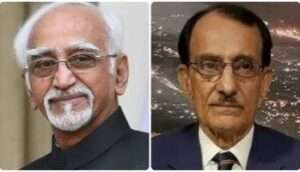
But the controversy remains part of the public record—and that is precisely why a former Vice-President should exercise exceptional care when making sweeping assertions about the country’s majority community.There is a larger irony here. Those who constantly warn Bharat against communalism should also recognise that repeatedly portraying Hindus as the principal danger can itself become a form of communal stereotyping. At the same time, the allegations surrounding Ansari’s alleged links with Pakistan’s ISI through journalist Shahid Mirza also need to be placed in the right perspective. Political opponents released a photograph showing Ansari and Mirza sharing a stage at a 2009 seminar on terrorism. However, organisers and media reports clarified that Ansari was merely the chief guest at the public seminar, which was attended by more than 100 people. Sharing a public platform, by itself, does not establish personal contact, collaboration or any intelligence-related association. Such allegations therefore should not be presented as established fact without supporting evidence. But this clarification does not alter the larger constitutional principle. Bharat’s promise is neither Hindu supremacy nor minority appeasement. It is equal citizenship. Hindus, Muslims, Christians, Sikhs, Buddhists, Jains and others are Bharatiyas first in the constitutional sense, and their individual faiths deserve equal respect. Ansari’s criticism of any form of extremism is legitimate. But Hinduism itself cannot be put on trial because of the political conduct of some Hindus. A former Vice-President should be building bridges, not reinforcing old fault lines. Bharat has moved far beyond the political vocabulary of suspicion in which one community is permanently cast as the problem and another as its presumed victim. If Ansari wants to debate majoritarianism, let him debate specific policies, actions and constitutional questions. But painting the majority faith with the brush of communal danger is neither secularism nor statesmanship. It risks becoming a politics of perpetual suspicion. And Bharat deserves better.

