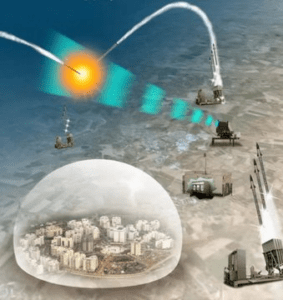
There was a time when the usual chorus of Doubting Thomases would ask, with almost predictable cynicism: Where is Bharat’s technological prowess? Can it really protect itself? Can it compete with the technologically advanced nations? Today, the answer is increasingly staring them in the face—and they may want to look away. From space and semiconductors to artificial intelligence, quantum technology, cyber security and advanced defence systems, Bharat is steadily acquiring something far more valuable than imported hardware: the technological capability to protect its own national interests and strategic assets. The reported development of DRDO’s SHIELD programme, centred on high-power microwave technology, is yet another indication of how warfare—and Bharat’s response to it—is changing. This is not merely another weapon being added to an already crowded arsenal. It represents a shift from the traditional philosophy of shooting at a target to potentially attacking the electronics that make the target work. That distinction could become crucial in the age of drone warfare. One hostile drone is a nuisance. A coordinated swarm of dozens of relatively inexpensive drones can pose a far more complicated challenge. Using conventional missiles or ammunition to engage every individual drone could mean spending enormously more to destroy comparatively cheap platforms. High-power microwave technology offers a radically different proposition. Instead of physically chasing every drone, a directed electromagnetic burst can potentially disrupt, degrade or damage the electronics upon which electronically dependent systems rely. The SHIELD programme is reportedly being developed around the S-band microwave spectrum and incorporates gallium-nitride-based solid-state power technology, which can enable high power density and more compact electronic architectures. In simple terms, the battlefield is becoming increasingly electronic—and Bharat is learning to fight on that battlefield. This is precisely where the transformation of Bharat deserves greater attention.
For decades, the country was routinely described as a developing nation condemned to remain dependent on others for critical technologies, defence equipment and strategic capabilities. Worse, successive governments often seemed more comfortable managing dependency than eliminating it. The result was a country with extraordinary scientific talent but an ecosystem that too frequently imported what it could have developed at home. The Narendra Modi era has sought to turn that equation on its head. Whether it is indigenous defence manufacturing, space technology, drones, electronic warfare, semiconductor ambitions, artificial intelligence or directed-energy systems, the underlying message is unmistakable: Bharat cannot afford to outsource its security. And this is where the Opposition’s perpetual pessimism increasingly looks out of date. The Congress-led political establishment that ruled for decades cannot easily lecture the nation today about technological self-reliance when its record was marked by bureaucratic inertia, dependence on imports and an economic model that struggled to transform India from a perpetually “developing” country into a technologically confident power. The criticism becomes even more hollow when those who once had decades to build indigenous capabilities now appear more interested in questioning every achievement than asking how Bharat can go further. Nobody is suggesting that every DRDO project is automatically a game-changer, or that every indigenous technology is already deployment-ready. Serious technological progress demands testing, refinement, production capacity and battlefield validation. But that is precisely the point. Bharat is no longer merely buying the future. It is increasingly building it. SHIELD is therefore significant not simply because it represents another futuristic defence technology. Its real significance lies in the direction of travel—a Bharat that is attempting to anticipate tomorrow’s threats rather than wait for them to arrive at its doorstep. The message to the pessimists is brutally simple: the nation they keep describing as incapable is quietly becoming capable. And perhaps that is what bothers the Doubting Thomases most.