


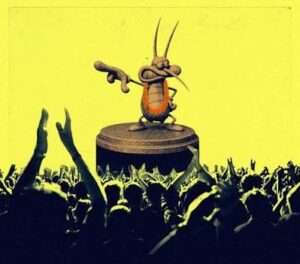
When the Chief Justice of India used the term ‘cockroaches’ during a hearing, referring to unemployed youth, he also added that they were parasites of society. Within hours, he clarified that the term was meant only for those with fraudulent and fake degrees and was not intended to apply to everyone. Whether his utterance was accidental or by design is a question many people are now asking, especially after witnessing the fury it generated, which has now evolved into a CJI vs BJP confrontation.
Since our school and college days, many of us have been familiar with this word. In fact, during the 1970s, cockroaches, along with frogs, were commonly used for dissection in Zoology practical classes to study their anatomy.
Let us briefly refresh our understanding of the role of cockroaches from an environmental perspective. Google, at our beck and call, tells us that cockroaches are vital environmental sanitisers and nutrient cyclers. By scavenging rotting vegetation and animal waste, they return essential nitrogen and minerals to the soil, besides providing several other ecological benefits.
When real cockroaches perform such a useful function, why take offence at the CJI’s remark? To avoid a severe backlash, he issued a rather quick clarification to put the controversy to rest. However, it seemed to have backfired, almost as if the clarification aggravated the issue rather than putting a lid on it.
The manner in which this controversy has multiplied, rallied, and gained momentum across the country has put even major political parties to shame in attracting millions of views on social media. Even Covid took time to spread, unlike this controversy, which assumed monstrous proportions within perhaps 48 hours — not an easy feat without substantial backing in terms of people, money and logistics.
Cockroaches are omnivorous and feed on almost anything they encounter. These poor creatures often feed on naphthalene balls and perish, or are eliminated by insecticides like Hit. In their absence, they continue to rule their kingdom by feeding on whatever comes their way. There is hardly anyone, particularly among the youth, who is not startled by a cockroach. Throw a fake one at a young person of any gender and observe the reaction — fear, disgust and instant rejection. A cockroach is vulnerable and can be easily crushed with any available object, yet it creates fear before ultimately surrendering.
At present, however, this controversy appears to be feeding only on the demand for Dharmendra Pradhan’s resignation and little beyond that. It could equally focus on several other pressing issues rather than just the concerns surrounding 26 lakh students in a country of 147 crore people.
For perspective:
26 lakh = 0.26 crore (1 crore = 100 lakh)
This translates to approximately 0.18 per cent of the population.
This is not to undermine the gravity of the NEET issue. However, the manner in which this campaign is being projected and promoted does create an element of suspicion that perhaps a Version 2.0 of the Anna Hazare-Arvind Kejriwal phenomenon is emerging in a new avatar.
At a time when the country is grappling with multiple challenges, including a fuel economy under pressure due to the West Asia crisis, the campaign appears singularly focused on one demand — “Resign, D. Pradhan.”
Many people feel this controversy has become a convenient diversion from several other issues that are steadily eroding the country’s foundations. Political parties, whether in power or in opposition, seem to have found in this episode a useful distraction from the many complex problems confronting India and the difficult task of finding solutions.
When everyone acknowledges that we live in a different era, why are comparisons repeatedly drawn with Lal Bahadur Shastri’s resignation after a train accident? We have, perhaps, become thick-skinned and immune to what are now considered obsolete moral standards.
Having witnessed the Anna Hazare and Arvind Kejriwal episodes, people are watching this development cautiously rather than jumping to the conclusion that it will transform India and Indians overnight.
The latest remark on Swachh Bharat is another example of what some perceive as a casual approach to important issues. It did not sufficiently address the lack of civic sense among citizens while placing the blame primarily on the government.
Next time, let us avoid insulting any animal, insect, bird, plant, leaf, fruit or seed through stray comparisons made by constitutional dignitaries. Let us allow them to continue taking care of our environment while we humans, unfortunately, often do the opposite.
Perhaps it is time for people to change rather than constantly expecting governments to change. Many are now wondering whether India needs a political force that can curb anarchy in the name of democracy and restore order through firm action rather than kid gloves.


