



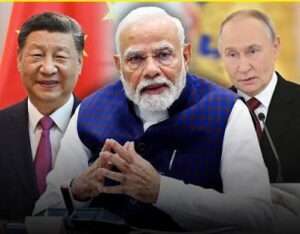
The 18th BRICS Summit, to be hosted by Bharat in New Delhi on September 12–13, could turn out to be far more politically uncomfortable for China than Beijing may have anticipated. With President Xi Jinping expected to lead a large Chinese delegation, the devastating Himalayan catastrophe on the Tibet-Nepal border is likely to cast a long shadow over the summit.
The tragedy could not have come at a more inconvenient time for Beijing.
An enormous ice-rock avalanche in Tibet triggered catastrophic flash floods that swept through Nepal’s Rasuwa district, destroying settlements, hydropower installations, roads and the crucial Gyirong-Rasuwagadhi border infrastructure. Hundreds have died and thousands remain missing. The scale of the devastation has also raised uncomfortable questions about disaster preparedness, early-warning mechanisms and transparency in the Himalayan region.
In my view, the most uncomfortable question for China will not simply be about the natural disaster itself, but about what was known, when it was known and how much information was shared with downstream neighbours.
Reports have emerged that authorities in Gyirong had conducted an evacuation drill in the area just weeks before the catastrophe. That naturally raises the question: if the authorities were sufficiently conscious of the risks to conduct emergency exercises, what warning systems were available and what information was communicated across the border to Nepal?
China may find it difficult to answer that question convincingly at a summit whose central theme is “Building for Resilience, Innovation, Cooperation and Sustainability.”
And this is where the tragedy intersects directly with BRICS diplomacy.
Bharat is expected to push discussions on financial integration, greater use of local currencies, reform of global governance institutions and a stronger voice for the Global South, besides fighting terrorism. Climate resilience, sustainable development and disaster-management cooperation will also inevitably acquire greater significance after the Himalayan catastrophe.
For Beijing, however, the issue is bigger than one flood.
China’s ambitious infrastructure plans in Tibet, including the proposed mega hydropower project on the Yarlung Tsangpo—the Brahmaputra after it enters Bharat—have already generated serious environmental and strategic concerns downstream. The recent disaster has inevitably revived questions about the wisdom of undertaking enormous infrastructure projects in one of the world’s most fragile, seismically active and climatically vulnerable mountain systems. The proposed project is not responsible for the present catastrophe, but the disaster has inevitably sharpened scrutiny of the risks associated with large-scale interventions in the Himalayas.
For Bharat, this is not merely an environmental concern. The Brahmaputra is a strategic lifeline for millions of people. Any major alteration of its flow, coupled with inadequate transparency on water data, dam operations or disaster warnings, has implications far beyond engineering.
Interestingly, just days before the catastrophe, Bharat and China held the 25th round of Special Representatives’ talks on the boundary question. National Security Adviser Ajit Doval and Chinese Foreign Minister Wang Yi agreed to continue dialogue towards a fair, reasonable and mutually acceptable settlement, while reaffirming the importance of peace and tranquillity along the border. The next round is scheduled to be held in India in 2027.
That diplomatic engagement is significant. It demonstrates that New Delhi is prepared to engage Beijing where India’s interests demand engagement, without necessarily ignoring difficult questions.
I believe this is precisely the approach Bharat should adopt at BRICS.
New Delhi need not turn the summit into an anti-China forum. Nor should it allow a humanitarian catastrophe to become a political spectacle. But neither should it allow diplomatic niceties to suppress legitimate questions about transparency, transboundary disaster management and environmental responsibility.
There is another uncomfortable dimension for Beijing: information.
While the devastation in Nepal has been extensively documented by journalists, independent reporting from Tibet remains considerably more restricted. International observers have consequently found it much easier to assess the scale of destruction on the Nepalese side than on the Chinese side.

That contrast could become increasingly embarrassing for a country seeking to project itself as a leading voice of the Global South.
The irony will be difficult to miss. A BRICS summit in Bharat will speak of resilience, sustainability, cooperation and a more equitable world order, while one of the bloc’s most powerful members arrives carrying questions about a disaster unfolding in its own Himalayan backyard.
China will also have to deal with the fact that Bharat has demonstrated considerable readiness to assist its neighbours during the crisis. Nepal, for its part, has said it currently needs specialised technical assistance rather than foreign search-and-rescue teams, while countries including Bharat have offered support.
The tragedy should therefore become an opportunity—not for confrontation, but for accountability and cooperation.
The BRICS platform can and should demand stronger regional early-warning systems, real-time sharing of hydrological and meteorological information, transparent disaster alerts and greater consultation before undertaking projects capable of affecting downstream countries.
China’s reported willingness to improve relations with India, following the latest border talks, is welcome. But trust cannot be built merely through diplomatic statements. It has to be demonstrated through transparency and responsible conduct.
In my personal view, the Himalayan disaster may prove to be an unexpected test of China’s credibility at the BRICS table. Beijing may arrive in New Delhi with a formidable delegation and an ambitious geopolitical agenda. But it may also find that the Himalayas have brought an inconvenient subject into the room—one that cannot simply be negotiated away.
For Bharat, the challenge is to handle the issue with maturity and firmness: neither exploiting the tragedy for political theatre nor allowing it to disappear beneath the usual summit declarations.
After all, resilience is not merely about constructing bigger dams, stronger borders or larger institutions. It is also about having the honesty to acknowledge risks, warn neighbours in time and put human lives above strategic calculations.
That is the real test awaiting BRICS—and perhaps China most of all.

