
Upadhyayula Lakshman Rao
The son of Shakti, the sage Parāśara, in the cadence of Tristubh chandas, raises his voice in the hymns of the Rigveda to praise Agni, the eternal flame that bridges the realms of gods and men. His subtle contemplations, refined through disciplined intellect, magnify the unity of cosmic order and human endeavour. In his vision, existence is not fragmented but harmonized through the dynamic interplay of nature’s forces, where Agni stands as the everlasting principle—omniscient, all-pervading, and the silent witness to both creation and sacrifice.
Agni is the possessor and distributor of inexhaustible riches, holding within himself the treasures required for the sustenance of humanity. He is the knower of sacred incantations, the one who realizes the creative intellect of Brahma, and manifests it through the transformative power of fire. Worship of Agni is thus not merely ritualistic but profoundly philosophical; it is an invocation of divine intelligence into human life. To the devoted, he grants prosperity symbolized by gold, yet his true wealth lies in illumination and knowledge. There exists none richer than Agni, for he embodies both material abundance and spiritual radiance.
Though all-pervading, Agni once eluded even the gods. The celestial beings, weary in their search, traversed the vastness of earth and sky, tracing subtle signs of his presence. Their journey reflects the human quest for truth—arduous, uncertain, yet guided by faith. At last, they reached his resplendent abode, a realm of brilliance and serenity. There, the Maruts, in unwavering devotion, worshipped him with pure ghee for three years. Through their perseverance, Agni revealed himself, and in that revelation, the sacred names and chants suitable for yajña were discovered. The Maruts, renewed in spirit, attained the celestial realms once more.
The vast expanses of earth and space, filled with celestial hosts, resonate with the worship of Agni. In his fierce aspect as Rudra, he manifests as Rudragni, embodying both destruction and regeneration. The gods, having realized his presence, approached him with reverence. They beheld him seated in meditative stillness, radiant and composed, and offered hymns in precise Vedic order. Accompanied by their consorts, they formed a bond of sacred friendship with him. Though their bodies grew lean through prolonged ritual discipline, their spirits were fortified, and under Agni’s protection, they attained both strength and divine grace.
The framework of Vedic sacrifice unfolds through a detailed and disciplined system of yajñas, reflecting a profound scientific temperament intertwined with spiritual aspiration. The seven household sacrifices, known as Pakayajñas, regulate the rhythm of domestic and ancestral life. Astaka marks the sacred observance following the full moon; Parvana aligns with the cycles of new and full moon; Śrāddha sustains the continuity of ancestral reverence; Śrāvaṇa, Agrahāyaṇī, Caitrī, and Āśviyujī correspond to seasonal and lunar transitions, ensuring harmony between human life and cosmic time.
The seven Haviryajñas expand this order into more elaborate sacrificial systems. Agnyādheya establishes the sacred fires—Āhavanīya, Gārhapatya, and Dakṣiṇāgni—forming the triadic foundation of ritual energy. Agnihotra, performed daily at sunrise and sunset, sustains the continuity of sacred obligation. Darśa–Pūrṇamāsa iṣṭis align offerings with lunar phases, while Āgrayaṇeṣṭi sanctifies the first fruits of harvest, acknowledging nature’s bounty. Cāturmāsya rituals mark seasonal transitions, Nirūḍha Paśubandha represents symbolic sacrifice, and Sautrāmaṇi addresses restoration, power, and transcendence. These rituals, conducted primarily in the Āhavanīya fire, reveal a systematic understanding of energy transformation and ecological balance.
The Soma yajñas, seven in number, represent the pinnacle of Vedic ritual sophistication. Beginning with Agniṣṭoma, the archetypal sacrifice, they extend into variations such as Atyagniṣṭoma, Ukthya, Ṣoḍaśin, Vājapeya, Atirātra, and Aptoryāma. These rituals involve the extraction and offering of Soma, symbolizing purification, vitality, and transcendence. Each yajña is designed with precision to address specific dimensions of life—health, longevity, nourishment, spiritual power, and societal prosperity—demonstrating an intricate synthesis of ritual practice and empirical observation.
Agni, as the bearer of all twenty-one yajñas, unifies their diverse purposes into a single cosmic function. He receives the oblations of patrons, becoming the divine messenger who carries offerings across the realms. His knowledge of all paths—terrestrial and celestial—enables the seamless transmission of energy between humans and gods. Through his agency, food and nourishment multiply, sustaining life in abundance. The seven sacred rivers, descending from the heavens, flow across the earth as channels of vitality, reflecting the cyclical movement of cosmic waters.
The ancient seers, the Angirasas, understood these pathways of wealth and sacred action. Through Agni, the nourishment derived from the cow is transformed into strength for Indra, while the Adityas perform uninterrupted sacrifices in pursuit of immortality. The Earth, as their mother, bears the weight of all beings, strengthened by the sacrificial acts of her divine sons. The first sacred cake offered by the Adityas is received by Agni, signifying the acceptance of cosmic order.
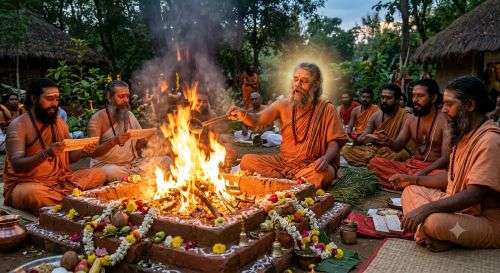
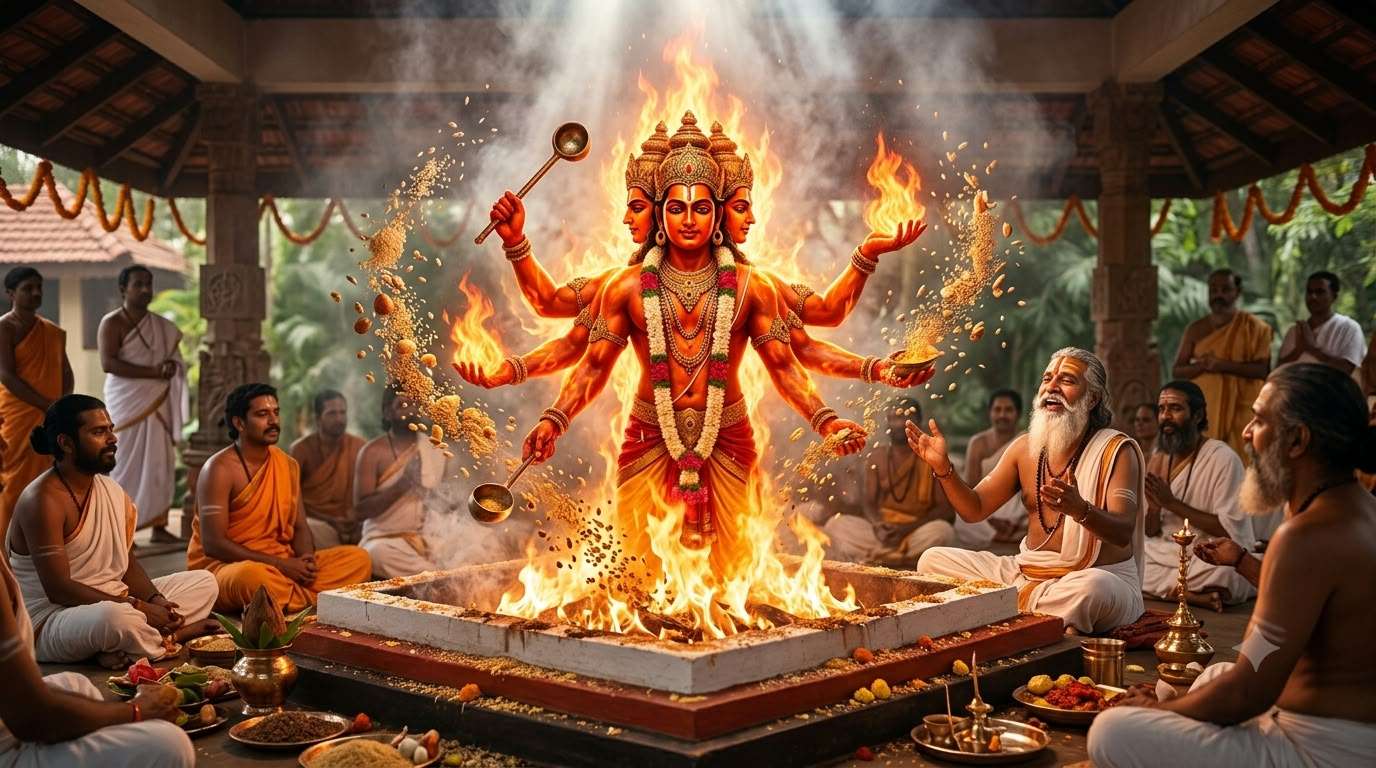
The ritual space itself is meticulously prepared, with sacred grass spread upon the altar, forming the foundation for divine descent. The dual flames of Agni, likened to a pair of watchful eyes, receive the critical oblations. As offerings are made, the celestial hosts descend, and Agni blazes forth, his flames extending in all directions, illuminating both the physical and metaphysical realms. In this moment, the unity of nature, ritual, cosmos, and consciousness is fully realized.
Thus, the greatness of Agni, as envisioned by Parāśara, is not confined to myth but extends into a comprehensive system of thought. It integrates spiritual insight with observational precision, revealing an intricate web where human action, natural processes, and divine forces are inseparably linked. The ever-renewing intellect of the sages, driven by inquiry and devotion, constructs diverse models of understanding, addressing the vast needs of existence. In this grand synthesis, Agni remains the central flame—eternal, radiant, and unifying all dimensions of life.