The question may sound like science fiction, but governments across the world are taking it seriously as climate change makes rainfall increasingly erratic.
For Hyderabadis, the question became particularly relevant after weeks of sweltering heat, cloudy skies and frustratingly brief showers. If the clouds are already there, why can’t we persuade them to rain?
Countries such as the UAE have been trying to do exactly that through cloud seeding. But can Telangana?
Why clouds don’t always bring rain
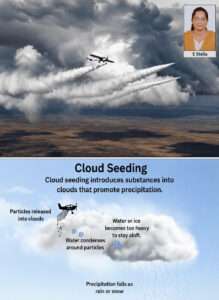
Cloud seeding does not create clouds. Nor can it make rain fall from a blue sky.
S. Stella, Scientist-F and Head of the India Meteorological Department’s Meteorological Centre in Hyderabad, sums it up neatly: cloud seeding modifies existing clouds; it does not create them.
That is perhaps the biggest misconception surrounding artificial rain. We have all looked up at dark clouds and wondered why they simply drifted away.
The answer lies inside the clouds themselves. They need enough moisture, strong upward air currents and the right internal structure before raindrops can form.
This monsoon, Hyderabad experienced several overcast days, but many clouds simply failed to develop into mature rain-bearing systems. Cloud seeding cannot overcome those basic shortcomings.
Why the UAE gets better results
The UAE’s cloud-seeding programme didn’t become successful overnight. Meteorologists use Doppler radars, satellites and weather stations to identify suitable clouds before specially equipped aircraft are sent into action. Even then, the operation is attempted only when conditions are favourable.
The country’s reported increase of 15 to 30 per cent in rainfall comes under carefully selected circumstances – not every time an aircraft takes off.
Does Telangana have what it takes?
In terms of weather monitoring, Bharat is well equipped. Telangana is covered by Doppler Weather Radar at Begumpet, satellite observations and a growing network of automatic weather stations.
What is missing is the operational infrastructure – specialised aircraft, cloud physicists, dedicated flight crews and continuous monitoring needed to run a sustained cloud-seeding programme.
It isn’t cheap, and it isn’t guaranteed
Cloud seeding is an expensive gamble. Aircraft have to be kept on standby, every mission requires scientific monitoring and success can never be guaranteed.
Scientists often find it difficult to determine how much rain fell because of seeding and how much would have fallen naturally. That uncertainty makes governments think twice before investing large sums.
What have Bharat’s experiments shown?
Several states have experimented with cloud seeding over the years, with mixed results.
Some missions appeared encouraging. Others achieved little. The recent experiment over Delhi, despite meticulous planning, failed to produce measurable rainfall over the target area.
The lesson is simple: even the best technology cannot compensate for unsuitable weather conditions.
Should Telangana give it another shot?
Probably – but only after careful scientific evaluation. Before spending public money, researchers must establish whether Telangana’s monsoon clouds consistently possess the characteristics needed for successful seeding.
Without suitable clouds, the programme would remain an expensive exercise with uncertain returns.
Artificial rain isn’t the real solution
Even Stella does not see cloud seeding as a cure for drought. At best, it can supplement nature. It cannot replace a weak monsoon or compensate for poor water management.
The bigger priorities remain rainwater harvesting, groundwater recharge, efficient irrigation, reservoir management and better weather forecasting.
Cloud seeding may eventually become another tool in Telangana’s climate-resilience kit. But it should never be mistaken for the solution itself.