


Artificial intelligence has entered politics. Now, who will pay its bills?
The Telangana government offered a glimpse of the future by unveiling India’s first AI minister at DevFest 2026 in Hyderabad on October 24.
It is an AI-powered digital twin of D Sridhar Babu, the state’s Minister for IT, Industries and Legislative Affairs.
Built on TensorGo’s HumAIn platform, the avatar has demonstrated its ability to answer questions from Gen Z participants in English and Telugu.
The next phase promises direct citizen interaction, feedback and grievance submission. Now, that is digital governance. But a few questions arise.
A minister without a body
What exactly will be the designation of this invisible minister? Minister without Portfolio? Or Minister without a Body?
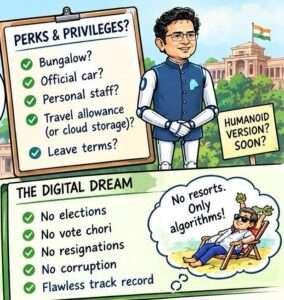
Will the digital twin eventually acquire a tangible form – a humanoid robot in a Nehru jacket, complete with a solemn expression, to interact with officials and the public?
Some files may require more than a few lines of code; a traditional ministerial glare might still come in handy.
And what about salary, perks, privileges and leave? Will this virtual functionary draw the same pay as his biological counterpart?
Will the government provide a bungalow, an official car and personal staff? Perhaps the travel allowance can be replaced with cloud storage and bandwidth. If he develops a software bug, will that qualify as sick leave or dereliction of duty?
Politics without politicians
Now imagine a government run entirely by digital Prime Ministers, Chief Ministers and ministers.
No elections, no vote chori allegations, no demands for resignations and no midnight defections. Horse-trading would become redundant; there would be no MLAs to spirit away to luxury resorts, only algorithms to update.
What would a digital politician do with bundles of cash, gold biscuits, benami properties or a farmhouse on Hyderabad’s outskirts? Sting operations might capture nothing more scandalous than a software update.
Their track records could be immaculate, promises archived and decisions logged. Efficiency would be at its efficient best—at least on paper.
Of course, the humans behind the algorithms would remain human. Biases could be coded in, inconvenient questions dodged and accountability passed from the minister to the developer, the IT department and, finally, the server.
Breaking news goes offline
There is one casualty this brave new world might not anticipate: the daily news cycle.
Without political bickering, backstabbing, floor-crossing and muckraking, what would television anchors scream about at nine in the evening?
BREAKING: AI MINISTER REFUSES TO BREAK RANKS!
EXCLUSIVE: DIGITAL CM DENIES HIDDEN AGENDA!
STING OPERATION: CHATBOT CAUGHT ACCEPTING A COOKIE!
Editors would be scratching their heads for fresh material. How long could newspapers and news channels survive on stories about leaders without flesh and bones?
Would cartoonists caricature computer chips and photojournalists compete for the best picture of a server rack?
Jokes apart, AI could make government services more accessible and grievance redressal more efficient. But an instant response is not the same as a solution.
A digital avatar can acknowledge a complaint; it cannot, by itself, fill a pothole or ensure a pension is released. Perhaps AI should handle the files while humans remain responsible for the decisions.
Meanwhile, the Telangana government should publish the service rules for its newest political functionary. Is he a permanent employee, a contractual appointee or a cloud-based consultant?
And if the digital minister resigns, one final question: will his pension be paid in cash or cryptocurrency?

