



Tamil Nadu politics has a habit of declaring political winners and losers rather quickly. But if there is one national party that has repeatedly demonstrated its willingness to absorb electoral setbacks and keep working towards a distant objective, it is the BJP.
The 2026 Tamil Nadu Assembly election was certainly not the breakthrough the BJP would have wanted. Contesting 33 seats as part of the AIADMK-led alliance, the party won just one seat and polled 2.97 per cent of the vote. The alliance itself secured 53 seats, while Vijay’s Tamilaga Vettri Kazhagam (TVK) emerged as the single largest bloc with 108 seats and about 35 per cent of the vote.
But in my view, it would be a mistake to read the 2026 result as the final verdict on the BJP’s Tamil Nadu ambitions. The party’s strategy has rarely been about one election, one leader or even one political cycle. It has generally been about creating a presence first, building an organisation next and waiting for the political circumstances to create an opening.
That is why the BJP’s Tamil Nadu challenge cannot be viewed merely through the prism of the latest Assembly numbers. The real question is whether it can create a durable political space in a State where the Dravidian parties have dominated for decades and where national parties have generally survived through alliances rather than by building an independent base.
There are already indications that such a space exists.
In the 2024 Lok Sabha election, the BJP contested 23 seats in Tamil Nadu and secured 11.24 per cent of the State’s vote, compared with 3.62 per cent in 2019. The sharp difference between the 2024 parliamentary performance and the 2026 Assembly result is significant. It tells us that the BJP’s support in Tamil Nadu is neither uniformly deep nor permanently consolidated, but it is certainly not irrelevant.
As someone who has followed the BJP’s political journey for several decades, I have come to believe that one of the party’s greatest strengths is its ability to think beyond immediate electoral gratification. It works throughout the year, not merely during elections. Maharashtra is perhaps the most obvious example of how a party that once operated as a junior partner of the Shiv Sena eventually became the dominant force in the alliance. Bihar offers another example of patient political positioning. Karnataka and several northeastern States provide further evidence of how the BJP has gradually expanded into territories once considered beyond its natural reach.
Tamil Nadu, therefore, should not be viewed in isolation.
The departure of K. Annamalai certainly complicates the BJP’s calculations. The former IPS officer was one of the party’s most recognisable Tamil faces and formally left the BJP in June before announcing the ‘We The Leaders’ movement, with an eye on the 2031 Assembly election.
But I would hesitate to conclude that Annamalai’s departure automatically represents the collapse of the BJP’s Tamil Nadu project. Political parties, particularly the BJP, have demonstrated repeatedly that individual leaders can become important components of a strategy without necessarily becoming the strategy itself.
There is another dimension that deserves attention—Tamil identity and culture.
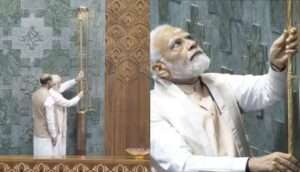
Prime Minister Narendra Modi’s decision to install the Sengol in the new Parliament building was an unmistakable attempt to bring a symbol associated with Tamil history and traditions into the national political narrative. There has been considerable debate over the precise historical interpretation surrounding the sceptre and its role in the 1947 transfer-of-power story. But politically, the symbolism was unmistakable.
And now comes another gesture.
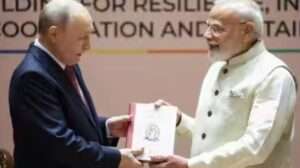
During his meeting with Russian President Vladimir Putin on the sidelines of the BRICS Summit, Modi presented him with a Russian translation of the Thirukkural, the celebrated work of Thiruvalluvar comprising 1,330 couplets dealing with virtue, wealth and love.
To me, this is more than a diplomatic courtesy. It is precisely the kind of cultural symbolism that the BJP appears increasingly willing to use to connect Tamil identity with a larger Bharatiya civilisational narrative.
Whether Tamil voters accept that proposition is, of course, another matter.
For decades, Tamil Nadu’s political discourse has been shaped by the DMK-AIADMK contest and the powerful Dravidian ideological framework. Yet the emergence of Vijay’s TVK has demonstrated that the electorate is not necessarily frozen into that traditional binary. Winning 108 seats in the 2026 election has fundamentally altered the political arithmetic and created a new pole of attraction.
In my assessment, this is where the BJP may see an opportunity rather than merely another obstacle.
The BJP does not necessarily have to replace the Dravidian parties overnight. Its immediate objective could be much simpler: become an unavoidable component of Tamil Nadu’s political arithmetic.
That requires organisation, local leadership, cultural engagement and, most importantly, patience.
The BJP’s Tamil Nadu strategy should therefore not be judged simply by the number of Assembly seats it wins in one election. The more important question is whether it continues to build its organisation, cultivate local leadership, engage with Tamil cultural consciousness and identify social constituencies that have traditionally remained outside its political reach.
Having watched the BJP expand into States where, not very long ago, its presence appeared marginal, I would not write off its Tamil Nadu experiment merely because the latest election did not produce the desired result.
Tamil Nadu has rejected many political predictions in the past.
It may yet surprise those who believe the BJP’s long game has already failed.


TVK’s emergence is due to active missionary web. There is a serious threat to Tamil identity & heritage which has by and large eroded by cinema culture which has succeeded rubbing salt into its wounds. Ironically, Tamilnadu boasts temples of magnificent structures built over centuries is a testimony to its hoary history. Sadly, this spiritual leader & the original abode of gods faces the ignominy of being questioned by fringe political forces about its Sanatana roots! This brings back an hapless & helpless onlooker BJP into the picture which itself is struggling to hold on whatever little gains it made during Annamalai’s leadership. BJP, to make inroads into the tamil politics has to start its innings afresh, follow on!