The advancement of the Lindsey O. Graham Sanctioning Russia and Iran Act of 2026 in the United States Senate has once again cast a shadow over Bharat-US trade negotiations. If enacted in its present form, the legislation would empower the US President to impose punitive tariffs of up to 100 per cent on countries purchasing Russian oil and gas, placing Bharat squarely in the crosshairs of Washington’s sanctions regime. The timing could hardly be more delicate. Bharat and the United States have spent years building what is today one of the world’s most consequential strategic partnerships—spanning defence, technology, trade, semiconductors, critical minerals and the Indo-Pacific. It would, therefore, be unfortunate if a relationship built painstakingly over decades were to be strained over a matter that is fundamentally one of Bharat’s energy security. There is little merit in viewing Bharat’s purchase of Russian crude through the simplistic prism of geopolitics. For Bharat, it is first and foremost an economic necessity. Unlike many developed nations, Bharat is not merely managing energy consumption—it is powering the aspirations of over 1.4 billion people. It remains the world’s third-largest consumer of crude oil and imports nearly 85 per cent of its oil requirements. Affordable energy is not a matter of convenience for Bharat; it is central to its developmental priorities. When discounted Russian crude became available following the outbreak of the Russia-Ukraine conflict, Bharat did what every responsible government is expected to do—it acted in its national interest. New Delhi did not violate international law. It purchased oil that was legally available in global markets while complying with prevailing international regulations and price cap mechanisms wherever applicable. Ironically, several European nations themselves continued purchasing Russian energy in different forms long after the conflict began. Bharat’s decision also produced tangible domestic benefits. Discounted crude helped moderate inflationary pressures, reduced the country’s import bill, stabilized fuel prices and provided fiscal space for developmental expenditure. In a country where rising fuel prices inevitably affect transportation costs, food prices and household budgets, cheaper energy translates directly into economic relief for millions of citizens. It is difficult to fault Bharat for prioritizing the welfare of its people.
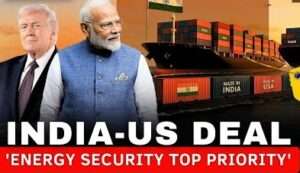
The United States itself has historically pursued policies dictated by its national interests. Washington imports commodities and negotiates trade agreements that advance American economic and strategic objectives. To expect Bharat to behave differently would be inconsistent with the very principles of sovereign decision-making that underpin international relations. Strategic partnerships cannot be premised on strategic conformity. Friends need not agree on every policy issue to remain trusted partners. More importantly, equating Bharat with China in matters relating to Russian energy imports overlooks significant differences in their respective strategic relationships with both Washington and Moscow. Bharat has consistently maintained an independent foreign policy—whether during the Cold War or in today’s multipolar world. Its approach has never been one of alignment but of engagement based on national interests. Attempting to compel Bharat through punitive tariffs may also prove counterproductive. Such measures risk undermining growing bilateral trade, disrupting supply chains and sending an unintended message that strategic autonomy comes at an economic cost. At a time when both nations seek to deepen cooperation across emerging technologies, defence manufacturing and critical industries, avoidable trade frictions would benefit neither side. Bharat has repeatedly demonstrated that it values its relationship with the United States. Equally, it has made it abundantly clear that its energy choices will be guided by affordability, availability and national interest. There is no contradiction in these two positions. The Bharat-US partnership is far too important to become hostage to differences over oil imports. Mature democracies must accommodate differences even while expanding areas of convergence. Bharat’s purchase of discounted Russian crude is neither an ideological statement nor a diplomatic provocation—it is a pragmatic economic decision aimed at safeguarding the interests of its people. Energy security cannot become collateral damage in geopolitical contests. Bharat’s first obligation is, and must always remain, towards its citizens. No sovereign nation can be expected to apologize for that.