Lakshmanrao Upadhyayula
The sage Vāmadeva’s invocation to Vāyu in the Ṛgvedic tradition presents a profound meditation on the divine force of movement, breath, vitality and cosmic dynamism. Composed in the disciplined cadence of Anuṣṭubh, the hymn portrays Vāyu not merely as the physical wind but as a subtle and pervasive principle that animates life and connects the visible world with the invisible forces of existence. The prayer combines spiritual symbolism with an extraordinary sensitivity to natural processes, revealing the Vedic tendency to perceive the forces of nature as expressions of an underlying cosmic order.
Vāyu is approached with the dignity and authority of a sovereign. Like a powerful king who causes hostile forces to retreat, Vāyu is invoked to overcome every destructive influence and remove impediments from the path of the seeker. The imagery is not simply that of physical violence against enemies; it may also be understood inwardly. Fear, confusion, inertia, negative tendencies and mental disturbances are the enemies that obstruct human progress. Vāyu, representing movement and vitality, is therefore asked to sweep away these forces and restore equilibrium. The prayer suggests that whenever stagnation is overcome, life once again begins to move toward harmony.
The Soma offered first to Vāyu carries a particularly rich significance. Soma in Vedic thought operates simultaneously at several levels: as a sacred offering, as a symbol of divine exhilaration, and as an image of the refined essence of life and consciousness. Vāyu is invited to partake of this Soma because movement and vitality must be nourished by an equally subtle source of energy. The ritual thus becomes a symbolic interaction between the dynamic force represented by Vāyu and the concentrated essence represented by Soma. The priest does not merely perform an external ceremony; he participates in a cosmic exchange between energy, consciousness and nourishment.
The sage further asks Vāyu to bestow riches upon the priests. Vedic wealth, however, should not be reduced to material possessions alone. Riches may signify cattle, food, prosperity and social well-being, but they can also represent wisdom, strength, inspiration, vitality and the inner resources necessary for righteous living. The prayer therefore embraces both dimensions of prosperity. A society flourishes when its material foundations are secure, but human existence becomes meaningful only when material abundance is accompanied by knowledge, discipline and spiritual insight.
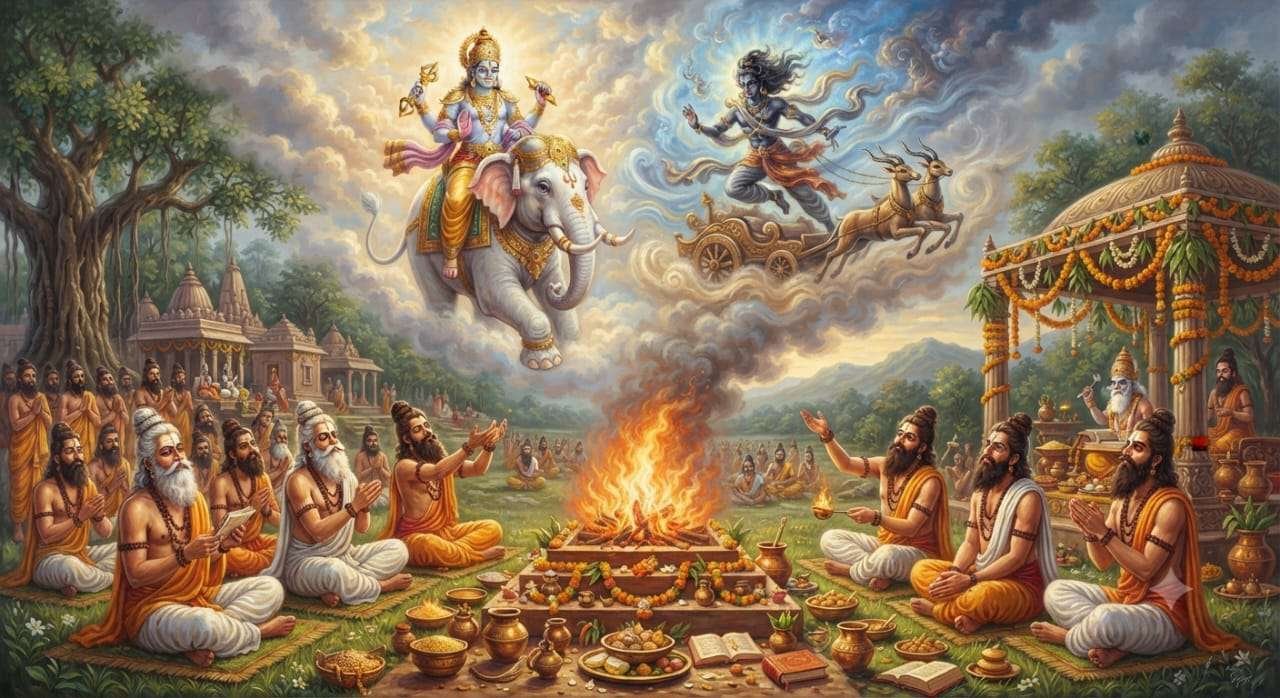
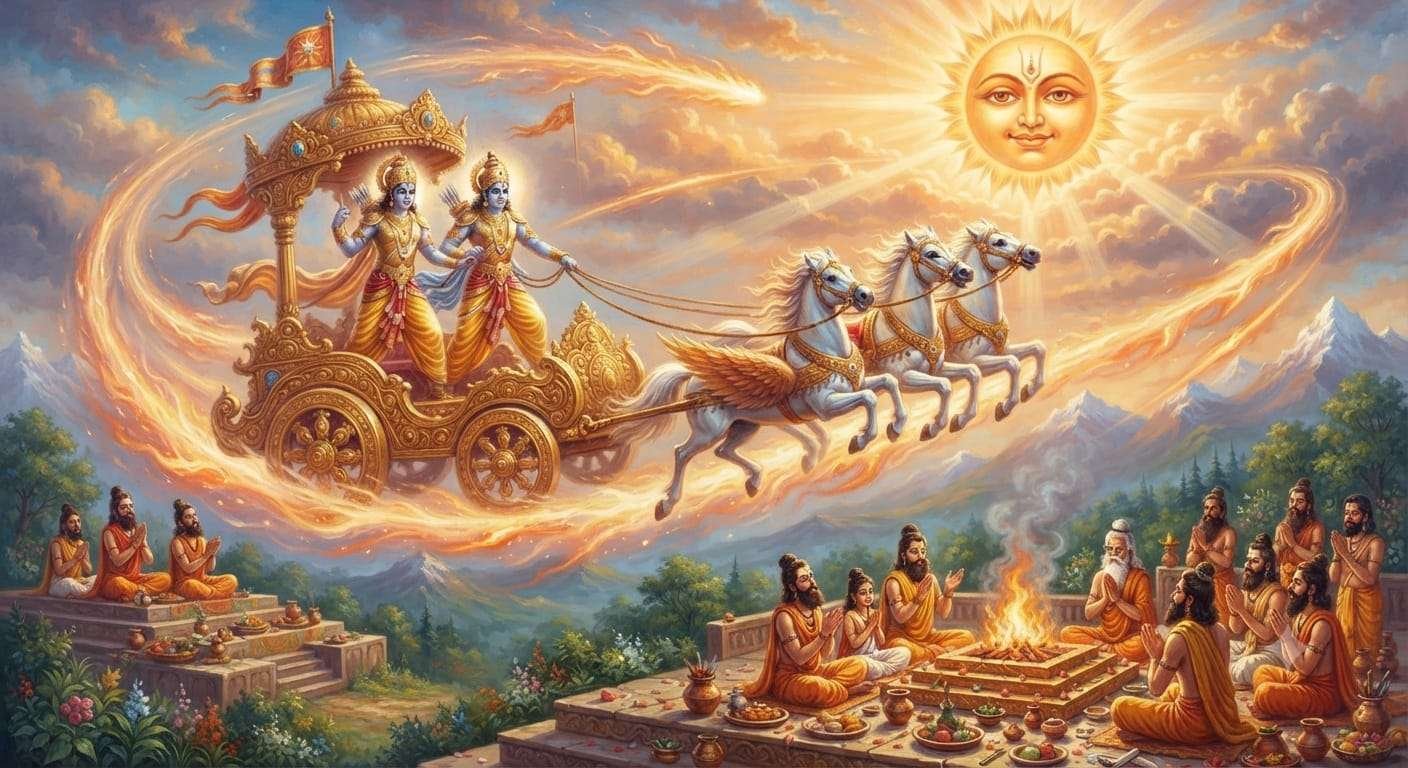
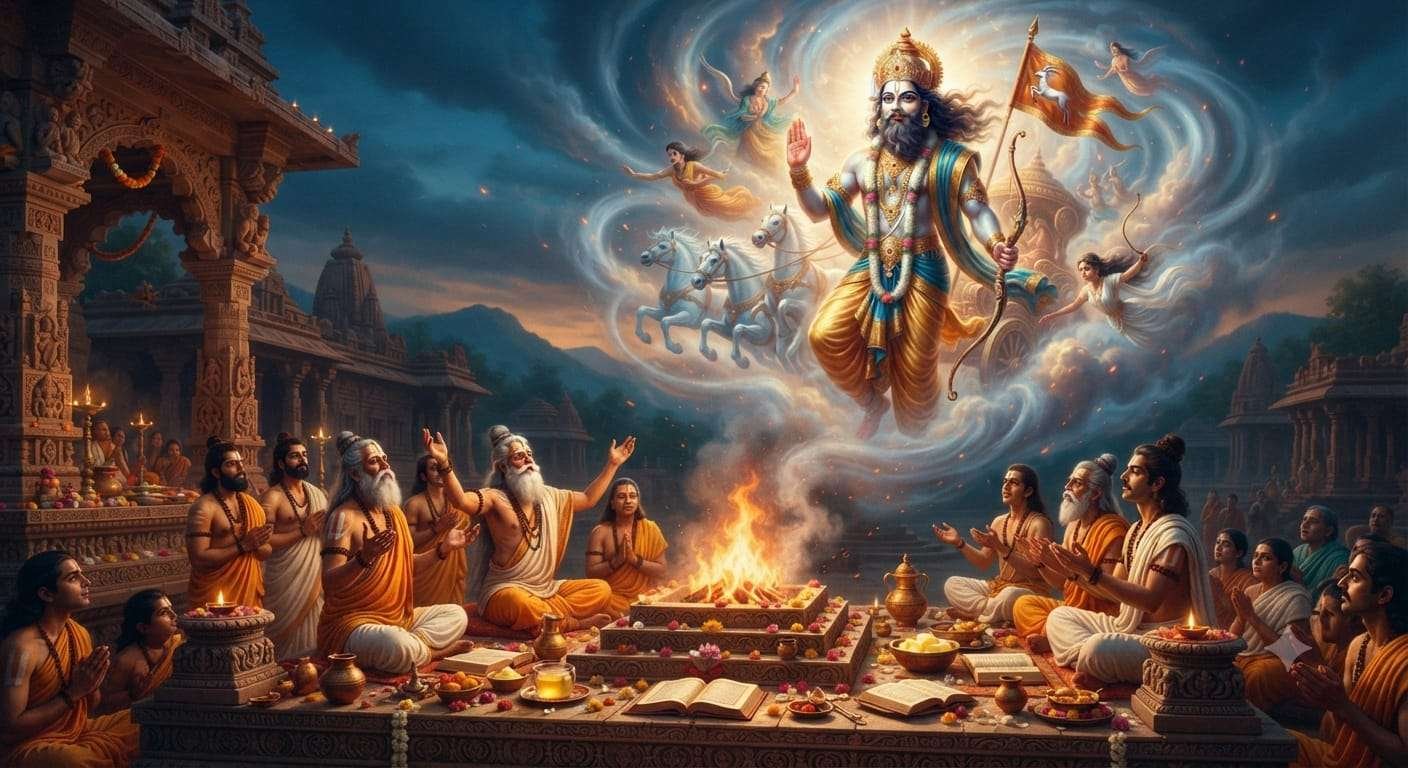
Vāyu is imagined arriving in a magnificent chariot drawn by swift horses to partake of the Soma. The chariot is one of the great recurring images of Vedic poetry, representing purposeful movement through the cosmic and psychological realms. Its horses signify powerful forces of energy, while the chariot represents an ordered structure capable of directing those forces. The image contains an implicit principle of coordination: power becomes meaningful only when it is harnessed and guided. Uncontrolled energy can become destructive, whereas disciplined energy becomes the foundation of progress.
The hymn also asks Vāyu to neutralize imprecation and make it traceless. This is a striking expression of the Vedic desire to transform harmful influences rather than merely retaliate against them. The ideal is not simply to defeat an adversary but to remove the destructive force so completely that no residue remains. Spiritually, this can signify freedom from resentment, fear, hostility and negative thought. Scientifically viewed, it also evokes the ancient human aspiration to understand and control invisible forces that affect life, even when their origins cannot be immediately perceived.
The repeated reference to horses—ninety-nine, one hundred and even one thousand—deepens the symbolism. These numbers need not be interpreted only as literal counts. They can express magnitude, abundance, multiplicity and the immeasurable dimensions of natural energy. The horse in Vedic imagery is frequently associated with speed, strength and vital power. When the horses are yoked to Vāyu’s chariot, the imagery suggests that innumerable forces of nature are being brought into an organized movement. The underlying idea is remarkably compatible with a scientific temperament: nature is not imagined as chaotic motion alone, but as forces operating according to discernible relationships and order.
One of the most remarkable descriptions identifies Vāyu’s swiftness with the speed of the mind. This comparison reveals the extraordinary psychological insight of the hymn. The mind can move instantaneously from one place to another through memory, imagination and thought, while wind can traverse vast spaces with remarkable speed. By placing these two forms of movement alongside one another, the sage draws attention to an intimate relationship between external nature and internal consciousness. Vāyu consequently becomes both the wind moving through space and the subtle principle of movement within the living being.
The suggestion that Vāyu possesses mutually balancing forces introduces another important dimension. Movement does not exist in isolation; it is maintained through relationships between opposing and complementary forces. Modern science describes nature through systems of equilibrium, interaction, pressure, motion, resistance and energy transfer. The Vedic poet obviously does not formulate these concepts in mathematical language, yet the intuition that dynamic forces operate through balance is unmistakable. The hymn therefore invites us to see spirituality and scientific curiosity not as contradictory approaches but as two different ways of contemplating the order of existence.
Vāyu also possesses an intimate connection with the breath of life. In later Indian philosophical thought, Vāyu becomes closely associated with Prāṇa, the vital force sustaining living beings. Breath is the most immediate experience of movement within the human body: inhalation and exhalation continually connect the individual organism with the surrounding atmosphere. The Vedic invocation of Vāyu can therefore be contemplated as a meditation upon this fundamental exchange between the human being and the universe. Every breath reminds us that individual life is inseparable from the larger natural environment.
The chariot, the horses, the wind and the Soma together form a magnificent symbolic architecture. The chariot may be understood as the ordered body or cosmos; the horses as the energies operating within it; Vāyu as the dynamic principle; and Soma as the refined nourishment that sustains higher activity. The priest stands at the meeting point of these dimensions, converting ritual action into conscious participation in cosmic order. The hymn consequently moves beyond a simple request for divine favour and becomes a reflection upon how life, energy and consciousness cooperate.
The reference to Vāyu arriving swiftly with his horses reinforces the Vedic celebration of responsiveness. Divine power is imagined not as distant or inert but as immediately available to the sincere invocation. The movement toward Soma can be read symbolically as the movement of consciousness toward illumination and fulfilment. The seeker calls, the vital force responds, and the meeting produces renewal. In this sense, the hymn expresses a timeless spiritual principle: aspiration becomes transformative when it is joined with disciplined action and awakened energy.
The numbers associated with Vāyu’s horses also create a sense of expanding magnitude—from ninety-nine to one hundred and then to a thousand. This progression can be understood poetically as an expansion from incompleteness toward fullness and finally toward abundance beyond ordinary measurement. The thousand horses suggest innumerable manifestations of energy, reminding the contemplative mind that the forces sustaining existence exceed the boundaries of individual perception. The language is therefore simultaneously poetic, cosmological and philosophical.
What makes the hymn particularly fascinating is its ability to hold several levels of meaning together without reducing one to another. Vāyu is the wind of the natural world, the breath of living beings, the vehicle of movement, the destroyer of harmful influences and a divine presence worthy of reverence. The horses are physical images of speed but also symbols of vital energies. Soma is a ritual offering but also an emblem of refined vitality and spiritual delight. The chariot is a vehicle but also an image of ordered existence. Such layered symbolism is one of the distinguishing characteristics of Vedic imagination.
Seen through a modern scientific temperament, the hymn can be appreciated without forcing modern scientific theories into an ancient text. The Vedic sage was not presenting equations of atmospheric dynamics, physiology or physics. Rather, he was observing nature with intense attention and expressing its mysteries through sacred poetry. Wind, speed, breath, energy, motion and equilibrium were experienced as interconnected realities. The scientific value of such a hymn therefore lies less in literal scientific propositions and more in its disciplined curiosity about the forces that govern life and the universe.
At its deepest level, Vāmadeva’s prayer to Vāyu is a celebration of movement itself. Nothing living remains permanently still: breath moves, thought moves, wind moves, energy moves and the cycles of nature move continuously. Yet meaningful movement requires direction, balance and purpose. The chariot and its yoked horses beautifully express this principle. Strength without direction is turbulence; direction without strength is helplessness. Their union creates purposeful movement.
The hymn ultimately invites the human being to recognize Vāyu within and around oneself. Every breath becomes a reminder of dependence upon the larger universe; every movement of thought reveals the extraordinary dynamism of consciousness; and every natural wind becomes an opportunity to contemplate the invisible forces that sustain life. The ancient prayer therefore transcends its ritual setting. It becomes a profound meditation on energy, breath, consciousness, balance and the eternal movement of existence. In invoking Vāyu to come swiftly to the sacred Soma, Vāmadeva is, in a deeper sense, invoking the awakening of life itself—the invisible power that transforms stillness into movement, movement into vitality, and vitality into conscious participation in the cosmic order.