



॥ Om Shri Khanderaya Namah ॥
Khandoba Mandir is a shrine dedicated to Lord Khandoba, popularly known as Khanderaya, Malhari Martand and Martand Bhairav. It is situated on Walkeshwar Road, near Teen Batti, in the historic Malabar Hill area of Mumbai. Lord Khandoba is worshipped as a manifestation of Lord Shiva and is one of the most revered regional deities of Maharashtra and parts of Karnataka.
The exact year of establishment of this particular Khandoba shrine has not been reliably documented. It is important to distinguish its history from that of the neighbouring Walkeshwar Temple and Banganga Tank, which belong to a much older religious tradition.
The presiding deity is Lord Khanderaya, also known as Malhari Martand. He is worshipped as an incarnation of Lord Shiva who manifested to destroy the demons Mani and Malla. He is traditionally depicted riding a horse and carrying weapons, particularly a sword.
His principal consort is Mhalsa, while Banai is another important consort. Turmeric, known as Bhandara, is especially sacred in Khandoba worship. Devotees invoke the Lord with the traditional chant, “Yelkot Yelkot Jai Malhar!”
The Malabar Hill temple is a relatively small neighbourhood shrine with a distinctive dome-shaped roof. Its architecture is modest compared with the larger Khandoba pilgrimage temples of Maharashtra. Nevertheless, it continues to be an important place of worship for devotees living in Mumbai.
Lord Khandoba has a special place in the religious and cultural traditions of Maharashtra and Karnataka. His worship has continued for centuries, particularly among farming communities, warriors and several other communities for whom he is the family deity.
The famous Khandoba temple at Jejuri in Pune district is the principal pilgrimage centre, while Pali in Satara district is another important shrine. As people migrated to Mumbai, they carried their family traditions and devotion to Khanderaya with them. The Malabar Hill shrine serves as a place where devotees continue these traditional forms of worship.
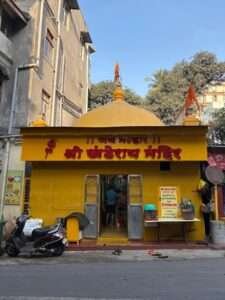
The temple is located close to the historic Banganga Tank and Walkeshwar Temple, an important religious precinct in Mumbai.
According to the traditional Khandoba Mahatmya, Lord Shiva manifested as Martand Bhairava to destroy the powerful demons Mani and Malla, who were troubling sages and disturbing their religious activities.
Unable to bear their atrocities, the sages and celestial beings approached Lord Shiva and prayed for protection. Responding to their prayers, Shiva manifested in a radiant form known as Martand Bhairava.
Riding a horse and carrying divine weapons, the Lord proceeded to battle against the demons. After a fierce battle, he defeated Mani and Malla and restored peace to the world.
Following this victory, the Lord came to be worshipped as Malhari, meaning the destroyer of Malla. He became popularly known as Khandoba or Khanderaya and is revered as a powerful protector of his devotees.
According to another important tradition, Lord Khandoba married Mhalsa and Banai. These divine marriages are significant in the religious and cultural traditions of Maharashtra and symbolise the wide acceptance of Khandoba worship among different communities.
Champashashti, celebrated during the bright fortnight of Margashirsha, is the most important festival dedicated to Lord Khandoba. Special pujas, abhishekams and turmeric offerings are performed. Somvati Amavasya and auspicious Mondays are also observed by devotees. The divine marriage celebrations of Khandoba and Mhalsa are particularly important at major Khandoba pilgrimage centres.


