There is a psychology experiment from 1966 that every investor should know about.
A researcher named Elliot Aronson recruited college students and played them audio recordings of a candidate auditioning for a quiz bowl team. The candidates were actors. Some answered 92% of difficult questions correctly and sounded impressively credentialed. Others answered only 30% and were plainly mediocre. In some recordings, the candidate spilled coffee on himself mid-session and exclaimed, with considerable embarrassment, that he had ruined his new suit.
The students were then asked to rate how much they liked each candidate.
The results were counterintuitive. The brilliant candidate who spilled the coffee was rated the most likable of the four. The mediocre candidate who spilled the coffee was rated the least likable of the four. The same clumsy accident had made the competent person more endearing and made the mediocre person more damaging to himself.
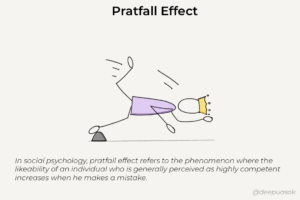
Aronson called this the Pratfall Effect. His explanation was simple and elegant: a superior person can seem superhuman, and therefore distant. A small, harmless flaw closes that distance. It makes them human. And humans trust other humans more than they trust perfection.
Experts think it explains something important about how trust actually works in investing. Not in theory. In practice, in the real world, with real money on the line.
The fund manager and the spilled coffee
Let us say a fund manager has built a strong track record over seven or eight years. Full market cycles. The 2018 IL&FS shock. The March 2020 collapse. The post-pandemic euphoria and the correction that followed. Through all of that, documented calls, attributable returns, a visible and consistent investment philosophy.
Now that manager publishes a quarterly letter. In it, he writes: “Our thesis on this position was wrong. We expected a working capital improvement that did not materialise. We held too long. Here is exactly why we got it wrong, and here is how we have revised our framework going forward.”
What happens to investor trust?
It goes up. Not down. Investors who were already in lean further. Prospective investors read that letter and think, this person is self-correcting. This person will not hide bad news from me. This is someone I can be in a long-term relationship with.
Now take a different manager. Undistinguished record. No clear philosophy. Two years of performance that could generously be called mixed. That manager publishes the same letter, word for word, admitting the same error with the same honesty.
Investors accelerate their exit. The admission does not build trust. It confirms the doubts they were already carrying. The spill is the same. The coffee lands in the same place. But the outcome is opposite.
This is the Pratfall Effect working in a fund manager’s office in Mumbai.
Why this matters more today than it ever has
Here is the part that makes this particularly relevant right now.
The fund letters, research notes, pitch decks, and investor communications that most managers produce have become, over the last two years, technically flawless. They are well-structured, cleanly written, correctly formatted, professionally polished. The grammar is perfect. The charts are elegant. The narrative flows without friction.
A significant portion of this is AI-assisted, and there is nothing inherently wrong with that. But what it has done, quietly and without announcement, is change the signal value of polish.
Polish used to mean: this person cares, this person puts in the work, this person is rigorous. Polish is now cheap. Any reasonably competent operator can produce a fund letter that looks like it came out of a top-tier asset management firm in fifteen minutes. The production value signals nothing anymore.
What signals something now is texture. The unsmoothed grain. The honest friction.
A fund letter that says, “we got this wrong, for these specific reasons, and here is our revised framework,” in a world of perfectly polished AI-generated prose, stands out the way a hand-carved wooden table stands out in a furniture warehouse. Not despite the visible grain. Because of it.
Institutional investors, family offices, and sophisticated HNIs are recalibrating, whether they are conscious of it or not. A communication that acknowledges no uncertainty, admits no error, and presents an unbroken narrative of correctness is no longer read as a signal of strength. It is increasingly read as a yellow flag. The absence of admitted error has become, quietly, a red flag of its own.
The sequence is non-negotiable
This is where the Pratfall Effect carries its most important caveat, and where investors most often misread the lesson.
It only works in one direction. Competence first. Pratfall later.
The mediocre candidate in Aronson’s experiment was not made more likable by his vulnerability. He was made less likable. The coffee spill sitting on top of an insufficient foundation was not humanising. It was damning.
In investing, this translates with uncomfortable precision. A manager who has not yet earned the track record, who has not yet demonstrated the quality of their process through at least one full cycle of markets, cannot borrow the trust that honest admission generates. The admission lands differently when it arrives on top of nothing. It is not the confession that investors trust. It is the confession arriving on top of a documented foundation of correct judgment.
This is also why manufactured humility is so quickly detected and so deeply damaging. Investors who have been around long enough have seen the strategically timed mea culpa, the admission engineered to pre-empt a worse revelation, the vulnerability performed for optics rather than felt as genuine accountability. They spot it faster than most managers expect. Performed imperfection is its own form of overengineering. The spill has to be real. The coffee has to actually land on the suit.
What the investor on the other side of the table should take from this
If you are an investor doing due diligence on a manager, or reviewing a portfolio, or deciding whether to add to a position after a drawdown, the Pratfall Effect should change what you look for.
A spotless communication record is not reassurance. It is a question. Has this manager genuinely never been wrong about anything material? Or have they simply never told me?
The manager who walked investors through March 2020 with honesty, specificity, and analytical texture, rather than reassurance and polish, built something during that period that no amount of subsequent returns could have manufactured. They built durable trust. The kind that does not redeem at the first sign of pressure.
The question to ask in due diligence is not, “when was the last time you were right?” It is, “tell me about a position where your thesis was wrong. Walk me through what you missed and how your process changed as a result.”
The quality of that answer tells you more about long-term reliability than any CAGR number on a track record sheet.
In 1966, a researcher spilled some coffee, metaphorically speaking, and discovered something that took decades to find its full application.
In investing, the lesson is this: the managers worth trusting over a long arc of time are not the ones who have never been wrong. They are the ones who, when wrong, showed you exactly how and why, because they had already earned the right to be believed when they did.
Build the track record first. Then let the coffee spill.
The sequence is everything.