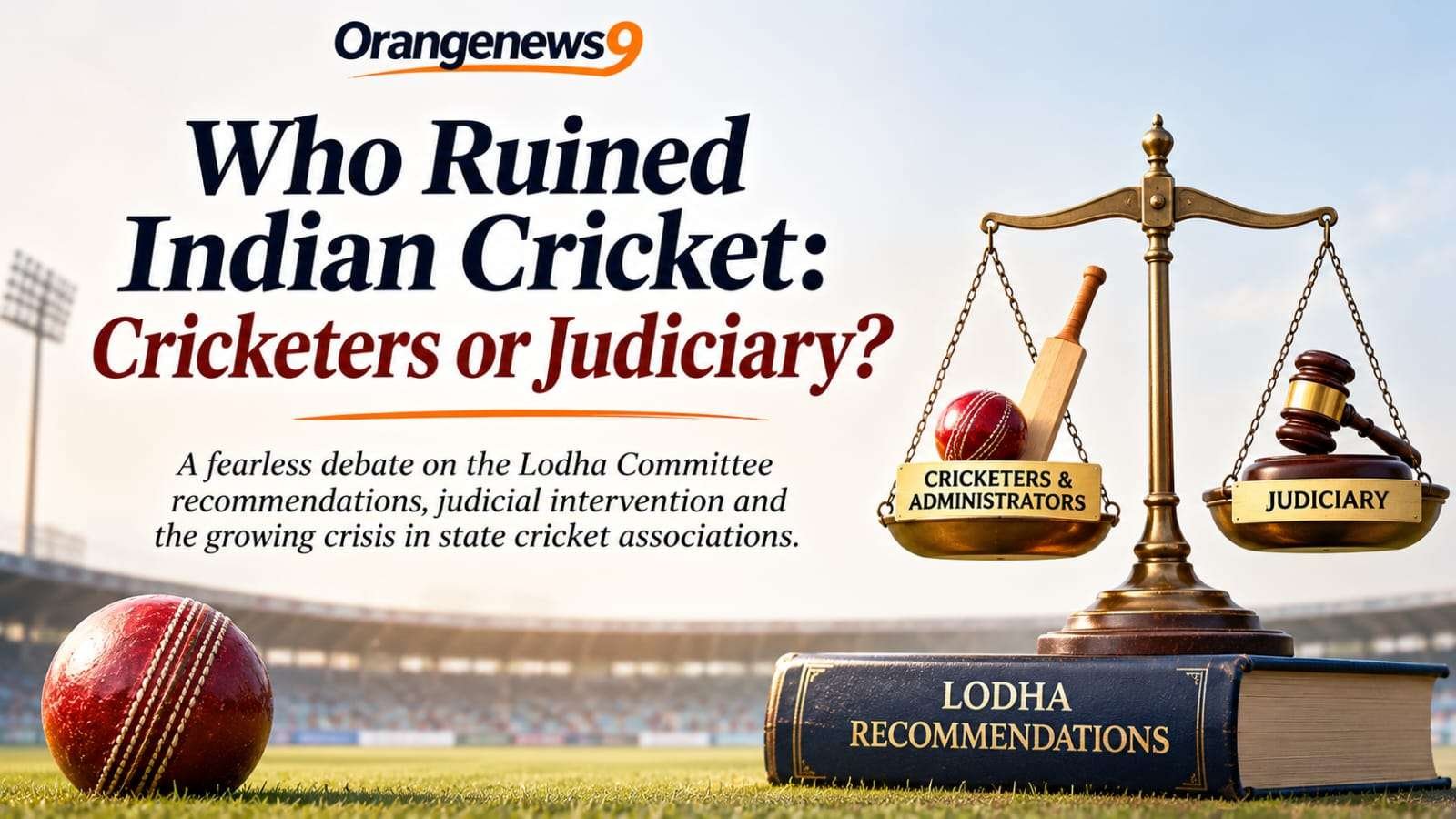
Orangenews9 opens a fearless debate on the Lodha Committee recommendations, judicial intervention and the growing crisis in state cricket associations
An interesting observation by a cricket follower has prompted Orangenews9 to raise a question that deserves a frank, fearless and nationwide debate: Is Indian cricket paying the price for flawed recommendations of the Justice Lodha Committee, or for the greed, mismanagement and self-serving conduct of those entrusted with administering the game? And, in the process, has the judiciary become an unwelcome administrator of a sport that should ideally be governed by its own elected representatives?
The observation squarely blamed the Justice Lodha Committee recommendations for the present mess, arguing that they contained loopholes. If that is indeed the case, why did the BCCI and several affiliated state associations challenge the Supreme Court’s directive to implement the recommendations in letter and spirit? Why did some associations comply while others chose selective interpretation, resulting in a confusing and contentious administrative landscape? More importantly, why should cricket suffer because its administrators cannot agree on the rules governing the game?
Orangenews9 believes it is time to put these uncomfortable questions before the cricket fraternity. We invite former and present cricketers, administrators, club secretaries, coaches, parents, players and other stakeholders, not merely from Hyderabad but from every state association, to come forward and articulate their views. No sacred cows, no convenient excuses and no protection for vested interests. Let the debate begin. – EDITOR
Cricket, which millions in Bharat follow with almost religious devotion, is increasingly caught in courtrooms rather than being administered on cricket grounds. State associations that should be nurturing talent and organising competitions have become embroiled in litigation, internal power struggles and allegations of financial and administrative irregularities. But who is responsible? Is it the judiciary, which intervenes when approached, or those who have reduced cricket administration to an avenue for personal influence, privilege and patronage?
In Orangenews9’s considered view, former international cricketers, who owe their fame, fortune and celebrity status to the very game they are supposed to protect, must shoulder a substantial share of the blame wherever their conduct has contributed to the rot. Hyderabad Cricket Association (HCA) is a glaring example of how a prestigious cricket institution can deteriorate under the stewardship of people who once enjoyed the adulation of cricket lovers. Jammu and Kashmir, on the other hand, has witnessed a different kind of administrative problem, with powerful political families and prolonged control over the association becoming contentious issues.
Judicial intervention has not produced identical outcomes everywhere. Jammu and Kashmir cricket has, in recent years, witnessed encouraging sporting progress, culminating in its maiden Ranji Trophy triumph in 2025-26. Its journey demonstrates that intervention, depending on how it is implemented and followed by institutional reform, need not always be detrimental. HCA, however, presents a far more complicated and unfortunate story.
The appointment of Justice L. Nageswara Rao by the Supreme Court as the Single Member Committee brought several alleged irregularities under scrutiny. From the sub-leasing of the stadium to a private entity and allegations of nepotism in team selections to questions over infrastructure expenditure, membership expansion, institutional club affiliations and the mushrooming of private academies, HCA appeared to have more administrative skeletons than its office-bearers were willing to acknowledge.
The controversy extended to institutional teams and clubs allegedly obtaining affiliations through questionable arrangements, including those associated with municipal grounds and government properties. Even the HCA’s own cricket academy came under scrutiny over questions of appointments and coaching qualifications. These were not trivial administrative disagreements. They concerned the credibility of an institution entrusted with the future of Hyderabad cricket.
Justice Rao barred the office bearers of 57 clubs from voting or contesting elections after identifying serious concerns, including conflicts of interest. Yet, his decision to impose a bar for one term or three years, whichever is higher, while letting clubs return by changing their committees, rather than permanently disqualifying those found ineligible, raised questions of its own. Why were such clubs not retained as non-voting associated members, if appropriate, until they satisfied eligibility requirements? Why did the exercise leave questions about other clubs and influential office-bearers unresolved? His eventual departure, accompanied by a detailed final report that drew on earlier forensic audit findings, left several issues for subsequent authorities to address.
Was this judicial intervention successful? Or did it merely open one Pandora’s box while leaving another unopened? That is a legitimate question, and Justice Rao’s decisions, like those of every other authority, should not be beyond scrutiny.
The subsequent cycle of internal disputes, court cases and successive judicial appointments only deepened HCA’s institutional crisis. The latest arrangement, under the supervision of the Justice P. Naveen Rao-led Supervisory Committee (popularly called the SMC), has once again placed the association under judicial supervision. Its supporters argue that it has made efforts to take cricket beyond Hyderabad, including initiatives to provide opportunities to aspiring district cricketers. District players have been made compulsory in TG20 teams, and district sides now feature in some local competitions. Critics, however, are entitled to ask whether these initiatives have translated into meaningful district representation in state teams and whether structural reforms have actually reached the grassroots.
A tournament or an announcement cannot, by itself, establish that district cricket has been revived. The real test is whether deserving cricketers from across Telangana are finding places in state teams on merit. If the promised transformation has not translated into measurable results, the SMC too must answer questions.
It is in this context that the observation about cricket associations becoming rehabilitation centres for retired judicial officers deserves serious consideration. But is that the fault of the judiciary, or of cricket administrators who have repeatedly failed to put their own houses in order?
Let us not forget one fundamental truth: the judiciary does not ordinarily walk into a cricket association and seize its administration without a legal basis. Someone approaches the courts, allegations are examined, disputes are litigated and judicial orders follow. Blaming judges for responding to circumstances created by administrators is convenient, but hardly an honest assessment.
There is another constituency that cannot escape scrutiny: parents of aspiring cricketers. Allegations of influence, money, power and manipulation of selections have repeatedly surfaced in the cricketing ecosystem. Wherever merit is allegedly sacrificed for connections or financial considerations, parents and intermediaries who encourage such practices become part of the problem.
The Justice Lodha Committee recommendations may well deserve a fresh, objective examination. Their implementation, interpretation and unintended consequences must be debated. But should their alleged shortcomings become a convenient shield for those who mismanaged cricket institutions?
Ultimately, what matters is not who occupies the HCA office, who controls the BCCI or which retired judge supervises an association. It is whether a talented youngster from a remote Telangana district gets a fair opportunity to represent the state.
The fundamental question remains: Who has damaged Indian cricket more — greedy former cricketers and self-serving administrators, flawed governance recommendations, or excessive judicial intervention?
The game deserves better than its administrators. And its young cricketers certainly deserve better than the endless courtroom battles of those who claim to represent them.