



One voter in a village in Chittoor district, Andhra Pradesh, has done something that should make every voter, candidate and political party sit up and take notice.
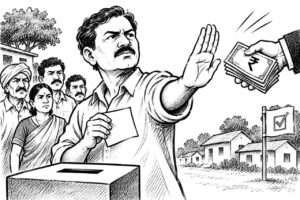
When offered Rs1,000 for his vote, he did not pocket the money and quietly vote as he pleased. He returned the two Rs500 notes in the ballot box, along with a handwritten message: ‘Sir, please take back the Rs1,000 you gave me. I will not vote after accepting money. Thank you.’ It is a small act, but a huge statement.
A vote is not a commodity
The voter deserves applause not merely for refusing Rs1,000, but for understanding something many seem to have forgotten: a vote is not for sale. Once voters sell their votes, they surrender much of their moral right to question the person they helped elect. Sadly, this voter appears to be the exception.
Democracy by auction
Vote-for-note has become so normalised that elections in some places increasingly resemble auctions. Contestants in ZPTC and MPTC elections in AP have reportedly spent crores of rupees. In one village, television reports showed villagers unanimously choosing the highest bidder.
Think about that for a moment: an elected representative chosen not by merit, integrity or public service, but by the size of his wallet.
But the blame cannot rest entirely on the candidate. The voter who demands money is an equally important part of this corrupt bargain.
The ‘investment’ has to be recovered
If crores are being spent to win a village-level election, imagine what an MLA or MP candidate may be willing to spend – first to secure a party ticket and then to win the election.
And let us not pretend that all this money is being spent out of an altruistic desire to serve the people.
For many, politics has become an investment. Once elected, the ‘investment’ has to be recovered – perhaps ten, perhaps a hundred times over – during the five-year tenure. And who ultimately pays for that recovery?
The very voter who sold his vote.
The Rs1,000 received today can come back as poor roads, compromised public services, inflated contracts, corruption and money siphoned away from development tomorrow.
The price of a vote
That is why the Chittoor voter’s Rs1,000 is worth far more than Rs1,000. He refused to mortgage his conscience.
The rest of us should ask ourselves a brutally simple question: If we sell our vote for Rs1,000, Rs5,000 or Rs10,000, with what moral authority will we demand accountability from the person we elected?
Perhaps electoral reform does not begin in Parliament, the Election Commission, or political parties. Perhaps it begins with one voter saying: ‘My vote is not for sale.’

