



As Balarama journeyed through the sacred land of Kurukshetra, a profound curiosity arose within him. Observing the sanctified plains, he asked the venerable hermits why King Kuru had once ploughed this vast stretch of earth and what sublime merit he had sought through such an extraordinary act. The aged ascetics replied that King Kuru had cherished a noble resolve deep within his heart. He desired that every soul born upon this sacred soil should ultimately attain the bliss of heaven. It was a vision born not of personal ambition but of boundless compassion for future generations.
Hearing of this remarkable undertaking, Indra, the sovereign of the celestial world, descended and questioned King Kuru regarding his purpose. When the king revealed his lofty aspiration, Indra smiled with disbelief and departed. Yet the king remained unwavering. Time and again the Lord of Heaven returned, asked the same question, received the same steadfast answer, and departed without altering the king’s resolve. At length Indra perceived that such determination sprang from genuine righteousness. Deeply pleased, he decided to fulfil the king’s wish, though in harmony with the eternal laws governing destiny.
Indra proclaimed that those who observed sacred fasting until the end of their mortal lives, and those valiant warriors who fell in battle while faithfully upholding the noble code of warfare upon the field of Kurukshetra, would attain the celestial realms. Before returning to his heavenly abode, he further declared with great reverence that the very dust and breeze of Kurukshetra possessed the power to cleanse humanity of sin, and that those who departed their earthly lives upon this sacred land would ascend to exalted worlds. Hearing this divine proclamation, King Kuru rejoiced beyond measure, for the supreme purpose of his life had been gloriously fulfilled.
Continuing his pilgrimage, Balarama recognised the hermitage where he had dwelt in an earlier age. Surrounded by flourishing mango groves, fragrant bael trees, and forests dripping with honey, the place radiated timeless sanctity. He enquired of the sages whose hermitage it was. They replied that Lord Vishnu Himself had performed severe penance there. The illustrious Sage Sandilya and many other seers had attained the highest fruits of yoga and meditation within its sacred precincts. Filled with reverence, Balarama honoured the hermits, instructed his companions to remain behind, and ascended a holy hill. There, seated upon a pleasant slope amidst the ascetics, he immersed himself in tranquil contemplation.
At that auspicious moment, the celestial sage Narada descended from the heavens. The assembled sages welcomed him with profound respect. Balarama also rose, offered due worship, presented him with an honoured seat, and humbly sat beside him along with the gathered hermits. With folded hands, he asked Narada to narrate the course of the great conflict among the Kuru heroes.
Narada solemnly recounted the fall of Bhishma, Drona, Karna, Shalya, and countless other mighty warriors. He described in vivid detail the eighteen days of relentless warfare, the destruction of Duryodhana’s vast army, and the survival of only Kripa, Kritavarma, and Ashwatthama. He narrated how the defeated Duryodhana concealed himself within the waters of the Dvaipayana lake, and how the Pandavas surrounded him, provoking the proud monarch with stern and cutting words until he emerged to face his destiny. Though bereft of kingdom, brothers, and allies, Duryodhana’s royal pride remained unbroken.
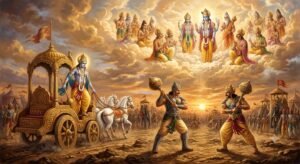
Narada then addressed Balarama with admiration. “When you behold your disciple,” he said, “you too will marvel at his indomitable spirit. A mighty duel with Bhima is now at hand. Both warriors, trained under your own guidance, possess incomparable mastery over the mace. If it pleases you, hasten there without delay, for their movements and combat shall be a spectacle worthy of immortal remembrance.”
Inspired by Narada’s words, Balarama descended the hill. He dismissed his attendants, women, servants, and companions to their respective destinations, choosing to proceed alone in his chariot. As he travelled beside the sacred River Saraswati, he reflected upon her immeasurable glory. He thought that Saraswati bestowed prosperity, peace, and spiritual elevation upon all who sought her grace. Even the gods, Indra himself, and the celestial sages descended to her sacred banks to experience her sanctity. Every righteous aspiration found fulfilment there. Bowing before the holy river with heartfelt devotion, Balarama resumed his journey and swiftly reached the Dvaipayana lake.
Vaishampayana continued his narration to King Janamejaya, saying that both Dharmaraja Yudhishthira and Suyodhana beheld the arrival of Balarama with profound respect, each silently seeking the blessings of their revered preceptor.
Listening with growing anxiety, the aged King Dhritarashtra questioned Sanjaya. “Now that Balarama has arrived,” he said, “my son’s confidence must surely have been strengthened. Tell me how the battle unfolded in the presence of his illustrious teacher.”
Sanjaya replied, “O King, the moment Balarama arrived, your son’s heart blossomed with renewed courage. His face shone with confidence, and every trace of sorrow and disappointment vanished. The sight of his beloved master restored his spirit completely.”
Duryodhana then addressed Dharmaraja with calm dignity. “Samantapanchaka,” he declared, “is revered as the northern altar of Brahma. The elders proclaim that those who lay down their lives there attain heaven. Since the Dvaipayana lake does not lie within that sacred region, let us proceed to Samantapanchaka and conclude our combat upon that holy ground.” Dharmaraja readily accepted this noble proposal.
Bearing his mighty mace upon his shoulder, Duryodhana strode forward with the majestic gait of an elephant in rut. The celestial hosts watching from the heavens admired his regal bearing. Conches resounded, mighty drums thundered, tabors echoed, horns blared, and cymbals rang throughout the battlefield. To all who beheld him, Duryodhana stood with the confidence and splendour of a conqueror.
The assembled multitudes gathered eagerly on one side to witness the final encounter. Opposite Duryodhana stood Bhimasena, clad in radiant armour, holding his massive mace, towering like a golden mountain. With his former obstinacy softened by the nearness of destiny, Duryodhana addressed the spectators courteously, requesting them to remain seated so that all might witness the contest without disorder.
As Duryodhana surveyed the assembled kings, Dharmaraja signalled for them all to be seated. He himself took his place beside Sri Krishna and Balarama. Among the gathered monarchs, Balarama shone with serene splendour like the full moon amidst a constellation of stars.
The two mighty disciples then advanced towards one another. They roared like lions challenging for sovereignty, their massive shoulders and powerful limbs displaying unequalled strength. They moved like intoxicated elephants, coiled like venomous serpents swollen with righteous wrath, and surged towards each other like two mighty oceans preparing to collide. Their fierce glances sought only the destruction of the other, while their thunderous challenges echoed across the sacred field. Standing firm in unconquerable pride, they resembled towering waves rising from the boundless sea, awaiting the decisive moment that would forever determine the destiny of the House of Kuru.

