MS Sparsha
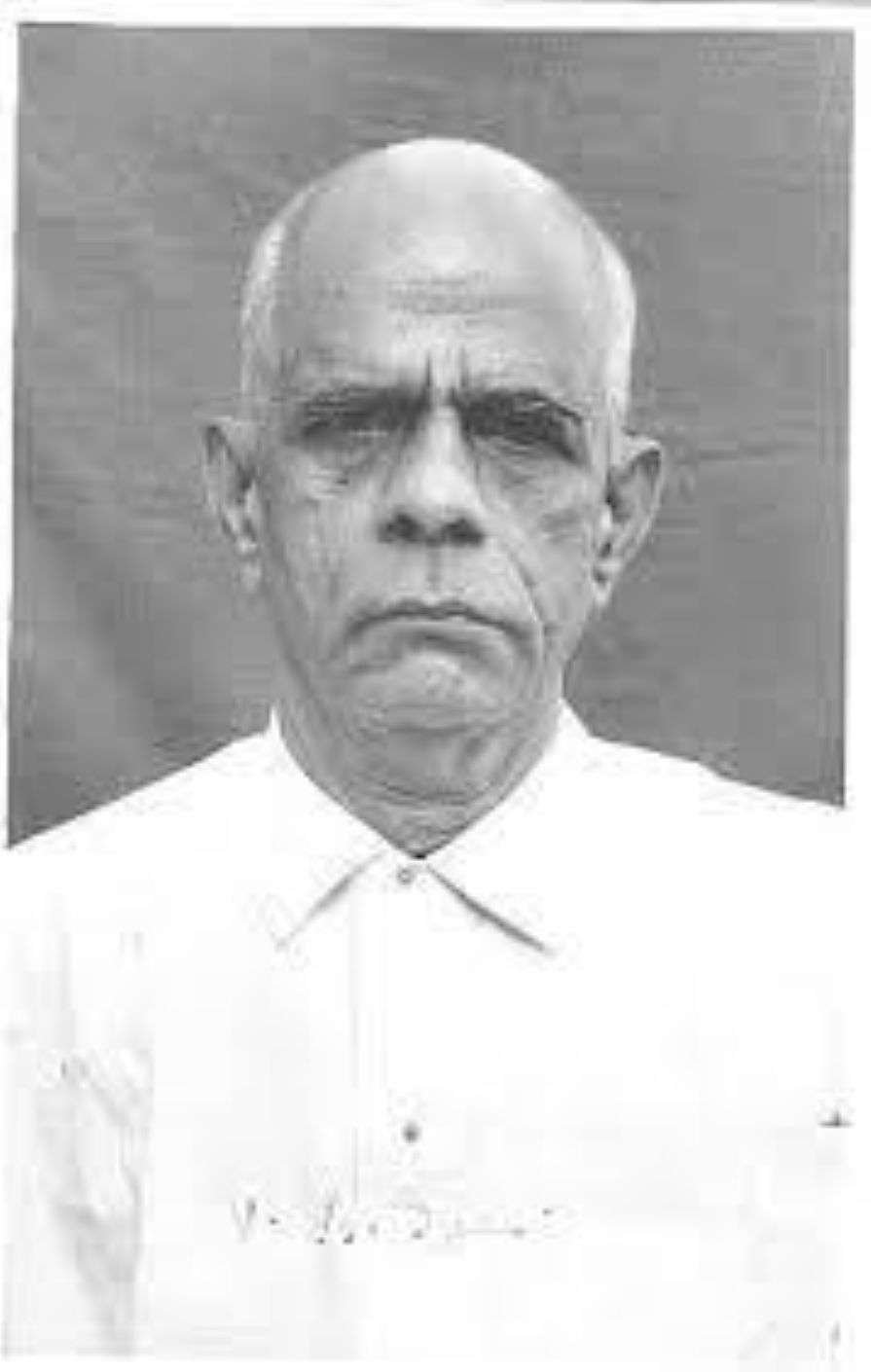
A pioneer of mathematical analysis, a distinguished academic and an inspiring mentor, Prof. V. Ganapathi Iyer left an enduring imprint on Indian mathematics through his original research and commitment to nurturing young talent.
At a time when Indian mathematics was steadily establishing its identity on the international academic stage, Prof. V. Ganapathi Iyer (November 10, 1906 – June 13, 1987) emerged as one of its most distinguished contributors. A mathematician of exceptional intellectual depth, he made foundational contributions to mathematical analysis, functional spaces and topology, earning international recognition for research that continues to form an important part of India’s mathematical heritage.
Born in Kozhikode, Iyer displayed an early aptitude for mathematics. His academic journey took him to Madras State College and subsequently the University of Madras, where he completed his Mathematics Honours B.A. in 1927. He went on to earn a Doctor of Science (D.Sc.) degree in 1938 under the guidance of eminent mathematician Ramaswamy S. Vaidyanathaswamy. This association with an outstanding mathematical scholar helped shape his research interests and prepared him for a distinguished academic career.
His most consequential institutional contribution began in 1939, when he joined Annamalai University. Over the following decades, he became one of the principal architects of its mathematics department, eventually assuming charge as Professor and Head of the Department in 1950. He held the position until 1972, helping transform the department into a respected centre of mathematical research and higher learning. Working alongside other academic pioneers, he contributed significantly to establishing Annamalai University’s reputation in mathematics across the country.
But Iyer’s influence extended far beyond the classroom and university corridors. His research covered complex analysis, entire functions, functional analysis and probability theory. He published 55 research papers, making substantial contributions to several specialised branches of mathematics. One of the lasting recognitions of his intellectual work was the mathematical space named ‘Iyer’s Space’, acknowledging his original contribution to the subject.
His investigations into Nevanlinna theory, undertaken in collaboration with mathematician S. M. Shah, added another important dimension to his research. He was particularly interested in applying functional analysis to spaces of entire functions, an area demanding extraordinary analytical ability and mathematical precision. His work earned the respect of international mathematical circles and brought recognition from eminent contemporaries, including American mathematician Prof. Marshall H. Stone.
His professional standing was equally reflected in the leadership responsibilities entrusted to him. He served as President of the Indian Mathematical Society from 1957 to 1959 and headed the Mathematical Division of the Indian Academy of Sciences in 1960. These positions reflected the confidence and esteem he commanded among India’s leading mathematical minds.
Yet, perhaps his greatest contribution was not confined to the research papers he published or the academic positions he occupied. It lay in the generations of mathematicians he inspired and trained. At a time when women remained significantly underrepresented in advanced scientific research, Iyer encouraged and mentored 15 Indian women scholars who went on to complete their PhDs in mathematics. This was a remarkable contribution to widening women’s participation in a demanding academic discipline, long before diversity in science became a widely discussed institutional priority.
His academic legacy also lives through an impressive lineage of students and scholars, including Melapalayam S. Ramanujan, Visvanatha Krishnamurthy, Karaikurichi Padmanabhan and M. R. Parameswaran, who carried forward the tradition of mathematical scholarship.
Those who knew him remembered a man of extraordinary humility, personal integrity and simplicity. Despite his intellectual stature, he remained unassuming. His research approach was equally remarkable. He was known to guide doctoral students through complex mathematical problems, sometimes dictating elaborate computations directly into the final typescript without the need for preliminary drafts. Such was his mastery of the subject and clarity of thought.
Prof. V. Ganapathi Iyer passed away on June 13, 1987, but his contributions remain embedded in India’s mathematical history. His life demonstrates that the greatness of a scholar cannot be measured merely by publications, positions or international recognition. It must also be measured by the minds he inspires, the opportunities he creates and the knowledge he leaves behind.
In that respect, Iyer was much more than an accomplished mathematician. He was an institution-builder, a mentor and a pioneer whose quiet achievements deserve far greater recognition in the story of India’s scientific heritage.