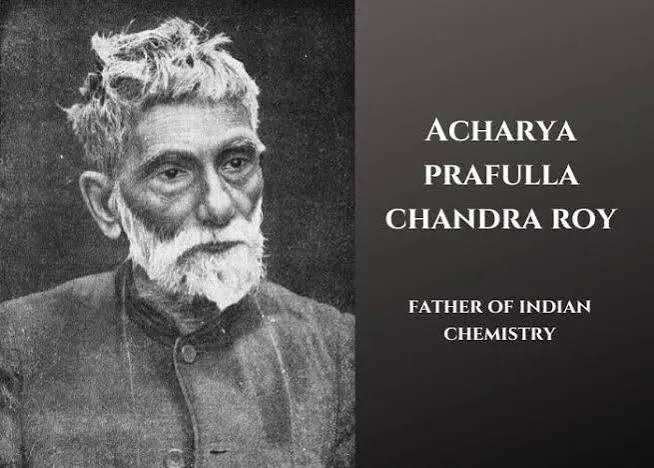
Acharya Prafulla Chandra Ray: The scientist who challenged British economic dominance, pioneered India’s pharmaceutical industry and turned chemistry into an instrument of nationalism.
MS Sparsha
India’s freedom struggle was not fought merely on the streets, in prisons or on the battlefield. Some of its most remarkable warriors fought a different kind of battle – against colonial economic exploitation, industrial dependence and the British monopoly over essential products. Among them was an extraordinary scientist whose laboratory became an instrument of nationalism and whose enterprise laid the foundations of India’s indigenous pharmaceutical industry. He was Acharya Prafulla Chandra Ray, popularly hailed as the Father of Indian Chemistry.
Born on August 2, 1861, in Raruli-Katipara village in the Khulna district of Bengal Presidency (now in Bangladesh), Ray displayed an exceptional interest in learning from an early age. His passion for science took him to the University of Edinburgh in Scotland, where he obtained his BSc and DSc degrees. Returning to India in 1888, he joined Presidency College, Calcutta, as an Assistant Professor of Chemistry the following year. He soon established himself as an accomplished researcher, earning international recognition for his pioneering work on mercurous nitrite and its derivatives.
But Ray was not content with scientific recognition or an academic career. He was deeply disturbed by India’s dependence on imported chemicals and medicines, particularly when the country possessed the intellectual talent and resources to manufacture them independently. He recognised that economic dependence was another instrument through which the British sustained their colonial domination. His answer was to demonstrate, through action, that Indians could compete with foreign manufacturers.
With a modest investment of just Rs 700, Ray began experimenting with chemical manufacturing in a rented house at 91 Upper Circular Road in Calcutta in 1892. What began as a small venture eventually developed into Bengal Chemical and Pharmaceutical Works, formally established as a limited company on April 12, 1901. It was a pioneering enterprise that challenged the prevailing colonial mindset that sophisticated medicines and chemicals could be manufactured only by British companies.
The significance of this initiative went far beyond commercial success. Ray insisted on manufacturing quality products comparable to British Pharmacopoeia standards, using indigenous skills, technology and raw materials. His enterprise demonstrated that Indian products need not be inferior to imported alternatives. It also created employment opportunities for educated Indian youth at a time when respectable industrial and professional avenues were severely restricted under colonial rule.
More importantly, Bengal Chemicals became closely associated with the nationalist movement. Ray’s circle included young revolutionaries and nationalists, and the enterprise provided an important meeting ground for people committed to India’s freedom. Historical accounts also record his assistance to revolutionary groups, including providing chemicals and acids used in their activities. His association with the freedom movement was so well recognised that the colonial administration reportedly described him as a revolutionary in the garb of a scientist.
His patriotism was never confined to industrial enterprise. Ray sympathised with different streams of the national movement and maintained close associations with leaders such as Mahatma Gandhi, C.R. Das and Subhas Chandra Bose. His famous declaration during the Non-Cooperation Movement in 1924, “Science can afford to wait but Swaraj cannot”, captured his conviction that national freedom was more urgent than even scientific advancement.
A remarkable teacher and institution-builder, Ray also inspired generations of scientists, including Meghnad Saha and Shanti Swarup Bhatnagar. His two-volume work, A History of Hindu Chemistry, published in 1902 and 1909, brought India’s ancient scientific achievements to international attention, challenging the colonial assumption that scientific knowledge was exclusively a Western inheritance.
Equally impressive was his personal simplicity and philanthropy. He donated substantial portions of his earnings towards education, scientific research and public causes. In 1921, he even donated his future university salary to strengthen the chemistry department and establish research fellowships.
Ray passed away on June 16, 1944, but his legacy continues through the institution he founded and the generations of Indian scientists and entrepreneurs he inspired.
Today, when India speaks of Atmanirbhar Bharat and pharmaceutical self-reliance, it is worth remembering the visionary who practised these ideals more than a century ago. Acharya Prafulla Chandra Ray proved that scientific excellence, industrial enterprise and patriotism could reinforce one another. He did not merely manufacture medicines; he manufactured confidence in India’s capabilities. That is why this remarkable chemist deserves a permanent place among the unsung heroes of the nation’s freedom struggle.