


ततः शङ्खाश्च भेर्यश्च पणवानकगोमुखाः ।
सहसैवाभ्यहन्यन्त स शब्दस्तुमुलोऽभवत् ॥
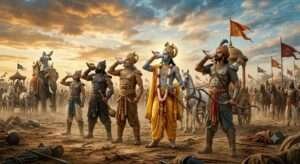
When Bhishma, the grandsire of the Kuru dynasty, raised his conch and blew it with the force of a lion’s roar, the atmosphere of the battlefield changed instantly. His blast was not merely the sound of a warrior announcing the beginning of combat; it was the symbolic declaration of the Kaurava army’s readiness to enter a conflict whose consequences would extend far beyond the battlefield of Kurukshetra. The commanders, already assembled in formation, responded by taking up their respective instruments. Conches, kettledrums, tabors, trumpets, bugles and the resonant horns of the battlefield burst forth together. The combined sound became immense, tumultuous and overwhelming.
Sanjaya, narrating the scene to the blind king Dhritarashtra, describes the sound as tumula—tremendous, tumultuous and formidable. Yet the manner in which the events unfold in the Gita carries a significance deeper than the mere description of military preparation. The first sound of the Kaurava army emerges from anxiety, confrontation and the necessity to demonstrate strength. The battlefield is already charged with uncertainty. Though Duryodhana has gathered a formidable army, his words to Dronacharya reveal a mind intensely conscious of the opposing force. His enumeration of warriors is therefore not simply an account of military strength; it also exposes the psychological tension underlying the Kaurava camp.
Bhishma’s conch becomes the immediate response to that tension. As the eldest and most revered warrior among the Kauravas, his roar provides confidence to the assembled army. Yet the epic deliberately places this powerful sound before the answering declaration of the Pandavas. The contrast is important. The Mahabharata repeatedly distinguishes between outward strength and inward conviction. A battlefield may be filled with weapons, warriors, and deafening sounds, yet the decisive force of a conflict ultimately arises from the principles for which the combatants stand.
The Pandavas then answer the Kaurava challenge. Their conches do not merely continue the noise of war; each instrument is associated with a particular warrior and carries a distinct symbolic identity. Krishna blows Panchajanya, Arjuna Devadatta, Bhima Paundra, and the other Pandava heroes sound their respective conches. Their response reverberates across the field. Sanjaya describes this sound as extraordinary and powerful, reaching across the earth and heavens and piercing the hearts of the sons of Dhritarashtra.
This distinction in Sanjaya’s narration is worthy of careful reflection. The sounds of both armies are objectively part of the same battlefield event, yet the epic does not present their psychological effect in identical terms. The Kaurava army produces a tumultuous challenge; the answering sound of the Pandavas is represented as something that strikes fear into the hearts of their opponents. The narrative therefore moves beyond military reporting into moral and psychological observation.
Sanjaya occupies a unique position in this great drama. He is neither a combatant nor an ordinary spectator. Through the divine vision granted to him by Vyasa, he becomes an extraordinary witness to events taking place on the battlefield. His narration possesses the factual quality of a report, but it also carries the sensitivity of one who understands the deeper meaning of what he is witnessing. His account does not merely tell Dhritarashtra what the warriors are doing; it reveals the emotional, ethical and spiritual dimensions of the conflict.
This becomes especially significant because Sanjaya is speaking to Dhritarashtra, whose attachment to his sons is one of the central causes of the tragedy. Sanjaya does not openly preach to the king at every moment, nor does he turn the narration into a direct moral argument. Instead, the sequence of events itself becomes an ethical commentary. By carefully describing the conduct, words and reactions of both sides, he allows the truth of the situation to emerge through the narrative.
In this sense, Sanjaya may be understood as a witness who stands between history and dharma. He reports what he sees, but his narration is not spiritually empty. His descriptions repeatedly bring out the contrast between external power and inner righteousness, between pride and responsibility, and between attachment and truth. His position gives him a remarkable narrative neutrality in form while allowing the moral structure of the Mahabharata to reveal itself through the events he describes.
The significance becomes still greater when Krishna begins to speak to Arjuna. Sanjaya is no longer merely reporting movements of armies and declarations of warriors. He becomes the privileged narrator of one of humanity’s most profound spiritual dialogues. What Krishna teaches Arjuna is heard by Sanjaya through the extraordinary vision granted to him, and he subsequently conveys that teaching to Dhritarashtra. Thus, the battlefield reporter becomes the narrator of the divine message.
There is therefore a profound transition in the role of sound in the opening of the Gita. At first, sound announces war. The conches awaken armies, challenge opponents and intensify the atmosphere of confrontation. Soon, however, amidst that terrifying noise, another kind of sound emerges—the voice of Krishna. The sounds of weapons and conches belong to the external battlefield; Krishna’s words belong to the inner battlefield of the human soul. The first announces conflict between armies, while the second addresses the eternal conflict within human consciousness.
The genius of the Gita lies precisely in this transformation. Kurukshetra becomes both a historical battlefield and a symbolic field of dharma, where human beings confront duty, attachment, fear, grief and moral uncertainty. Arjuna’s crisis is not merely the hesitation of a warrior before battle. It represents the universal human crisis that arises when competing obligations, relationships and values collide. Krishna’s response therefore transcends the immediate circumstances and becomes a teaching on action, knowledge, devotion, self-mastery and liberation.
Sanjaya’s narration preserves this extraordinary transition for posterity. He begins as the voice describing the armies assembled for war and ultimately becomes the voice through which the divine dialogue reaches the world. His account therefore possesses two dimensions: the historical and the spiritual. He records what happened at Kurukshetra, while simultaneously transmitting the wisdom that transformed that battlefield into a source of eternal philosophical reflection.
The opening clash of conches thus acquires a meaning far greater than a military announcement. The tumultuous sound of war represents the external world in which human beings struggle for power, position and victory. The answering voice of Krishna represents the eternal wisdom that seeks to bring order to the turmoil within the human mind. Between these two sounds stands Sanjaya—the witness, narrator and transmitter—preserving for humanity the moment when the noise of war gave birth to a dialogue about the nature of truth itself.
That is why the Gita remains eternal. The armies of Kurukshetra belong to a distant age, but the questions raised by Arjuna remain present in every generation. Whenever duty conflicts with attachment, whenever fear obscures judgment, whenever success and failure disturb the mind, and whenever a human being searches for the right path amid uncertainty, the dialogue of Krishna and Arjuna becomes relevant again. The conches may have fallen silent, the warriors may have disappeared, and the battlefield may have passed into history, but the truth revealed through that battlefield continues to resound.