


अन्ये च बहवः शूरा मदर्थे त्यक्तजीविताः ।
नानाशस्त्रप्रहरणाः सर्वे युद्धविशारदाः ॥
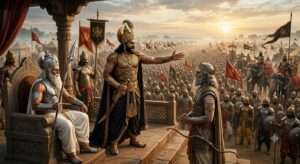
Duryodhana’s words reveal more than a simple enumeration of the warriors assembled on the battlefield. They expose the psychology of power when power has begun to mistake obedience for greatness. Standing before the vast armies of Kurukshetra, he proudly declares that many mighty heroes have come prepared to surrender their lives for his sake. The words carry an unmistakable sense of vanity: he sees the presence of accomplished warriors as a confirmation of his own importance, rather than as a consequence of the political and dynastic circumstances that have brought them to war.
The expression “madarthe tyaktajivitah” — “those who have renounced their lives for my sake” — is particularly revealing. Duryodhana does not say that these warriors have assembled for dharma, justice, truth, or the protection of the kingdom. He places himself at the centre of their sacrifice. In his imagination, their lives have acquired meaning through their allegiance to him. This is one of the subtle dangers of absolute power: the ruler begins to regard the loyalty of others as proof of his own greatness, while the loyal themselves may gradually lose the freedom to question whether the cause they serve is righteous.
The Mahabharata, however, invites the reader to look beneath Duryodhana’s confidence. The Kaurava army contains some of the greatest warriors of the age—Bhishma, Drona, Kripa, Karna, Ashwatthama, Vikarna, and many other accomplished fighters. They possess extraordinary knowledge of warfare, weapons and military strategy. Yet the presence of great individuals does not automatically make the cause they serve righteous. The epic repeatedly establishes a distinction between strength and righteousness, loyalty and truth, power and dharma. A powerful army can protect an unjust cause; a multitude of warriors cannot transform adharma into dharma merely by their presence.
Duryodhana’s hurried enumeration of these heroes also reveals an inner contradiction. If he were completely secure in his moral position, there would be little need to reassure himself by counting the warriors standing beside him. His attention repeatedly turns toward the numerical and military strength of his side. He wants to establish that his army possesses sufficient power to confront the Pandavas. Yet the deeper question of Kurukshetra is not simply, Who has more warriors? It is, For what purpose are these warriors fighting?
This distinction becomes especially significant in relation to Bhishma. The grandsire is not merely another soldier in the Kaurava ranks. He represents the ancient authority of the Kuru dynasty, its memory, discipline and institutional continuity. Duryodhana knows that Bhishma’s presence lends enormous psychological and military strength to his side. Hence he directs attention toward the protection of Bhishma and the preservation of the Kaurava formation around him. Beneath the language of military instruction lies an important political reality: the authority of an illustrious elder can provide legitimacy to a cause even when the cause itself remains morally disputed.
Bhishma’s own position is one of the great tragedies of the Mahabharata. He possesses immense wisdom and understands the complexities of dharma, yet his terrible vow binds him to the throne of Hastinapura. His loyalty to the Kuru establishment places him on the battlefield against those whose cause he knows to possess considerable righteousness. The epic therefore presents a profound distinction between knowing dharma and being able to act according to dharma. Knowledge alone does not always liberate a person from the consequences of an earlier commitment.
The same complexity appears in Drona. He is the teacher of both the Kauravas and the Pandavas. His affection for Arjuna is well known, yet circumstances, obligations and royal dependence draw him into the Kaurava camp. Kripa, too, belongs to the old Kuru establishment. Karna’s loyalty to Duryodhana arises from gratitude, friendship and the honour Duryodhana bestowed upon him when society had denied him recognition. Each of these men has a different reason for standing on that side of the battlefield. The Mahabharata does not reduce them to simple villains. Instead, it shows how human beings can become entangled in obligations, gratitude, vows, relationships and political structures until their personal virtues become instruments in a conflict whose larger moral meaning is deeply troubling.
This is why Duryodhana’s confidence becomes dramatically ironic. He sees a formidable collection of heroes; the epic reader sees a gathering of greatness caught within a morally destructive circumstance. The warriors may be physically alive, armed and prepared for battle, but the question of their inner freedom is far more difficult. When an individual surrenders moral judgment completely to another person’s ambition, physical life may continue while moral independence gradually diminishes.
The statement that those who join a tyrannical power are already “dead morally” therefore acquires a deeper meaning when understood as a philosophical observation rather than as a judgment upon every individual warrior. The Mahabharata repeatedly warns that moral death begins when conscience becomes subordinate to power. A person need not lose his life to lose his ethical freedom. He may remain celebrated, powerful and victorious while allowing fear, attachment, ambition, gratitude or unquestioning loyalty to silence the voice of conscience.
Duryodhana’s greatest mistake is therefore not merely that he possesses an enormous army. His deeper error is that he mistakes the availability of power for the legitimacy of power. He believes that if eminent warriors stand behind him, his position must be secure. But Kurukshetra teaches that numbers cannot determine truth. Weapons cannot manufacture righteousness. Authority cannot erase injustice. And the loyalty of powerful men cannot permanently protect a cause that has violated the deeper principles of dharma.
The contrast with Krishna is profound. Krishna does not stand before Arjuna displaying an army to prove his greatness. He offers himself without weapons. His presence is not an assertion of political power but an embodiment of discernment. On one side stands an immense military establishment; on the other stands Krishna, who chooses not to wield a weapon. The Gita thus quietly overturns the ordinary human measurement of strength. True strength is not merely the ability to destroy an enemy; it is the wisdom to distinguish what ought to be defended from what ought to be surrendered.
Kurukshetra consequently becomes more than a battlefield between two branches of a royal family. It becomes a battlefield within the human conscience. Duryodhana represents the mind that measures success through possession, numbers, allegiance and external authority. Arjuna represents the mind that pauses before action and asks whether victory itself has meaning when the price is the destruction of those whom one loves. Krishna’s teaching emerges precisely at that point of moral crisis.
The eternal truth of the Gita lies in this transformation. Human beings may surround themselves with wealth, influence, supporters, institutions and armies, but none of these can substitute for inner clarity. A multitude may follow a powerful person, yet the multitude cannot make that person’s desire righteous. A great warrior may master weapons, yet mastery over the self is a higher achievement. And a ruler may command the loyalty of thousands, yet the ultimate measure of his life remains the relationship between his actions and dharma.
Duryodhana therefore stands before the armies of Kurukshetra with immense external strength, but the Mahabharata asks the reader to look beyond the spectacle. The real measure of a person is not how many are willing to fight for him, but whether he possesses the wisdom to ask what they are being asked to fight for. The greatest tragedy of adharma is that it can recruit talent, courage, scholarship, loyalty and even greatness into its service. Yet when conscience is abandoned, all these virtues can become instruments of destruction.
Thus the verse is not merely a catalogue of warriors. It is a mirror held before human ambition. Duryodhana sees heroes who have “given up their lives for my sake.” The deeper vision of the Gita asks us to see another truth: no human being becomes truly great because others are prepared to die for him; greatness begins when a human being is willing to subordinate his own ego to truth, justice and dharma.

