


The real message of Dussehra is not the burning of effigies but the destruction of evils hidden in the mind and society.
Every year on the evening of Dussehra, huge effigies of Ravana are burned with blazing firecrackers. Amid the gleam of fireworks, the resounding sound of firecrackers, and the applause of spectators, the victory of good over evil is celebrated. Within minutes, Ravana’s effigy is reduced to ashes, and people return home wishing Happy Vijayadashami. But one question remains before us every year: if Ravana is truly dying, why are the evils in society constantly increasing? After all, who is the Ravana who is burned every year, and who is the Ravana who rises in a new form every year?
Dussehra is not merely a religious festival or an occasion for entertainment, but a festival of introspection and social awareness. The true purpose of Ravana Dahan is to remind us that no matter how powerful ego, injustice, deceit, greed, and immorality may be, they are ultimately destined to fall. But ironically, we have limited this message to an annual event. The effigies are getting bigger, the celebrations are getting grander, and the expenditure on fireworks is increasing, but are the evils within us diminishing in the same proportion?
Ravana of the Ramayana was learned, powerful, and a devotee of Lord Shiva. He possessed many virtues, but his arrogance and the serious sin of abducting another man’s wife nullified all his achievements. His end symbolizes that even knowledge, power, and wealth cannot make a man great if his conduct lacks dignity and morality. Ravana’s defeat teaches us that a person’s true identity is determined not by his scholarship or reputation, but by his character and actions.
Today’s Raavan isn’t the name of a single face or character. He embodies a mindset that violates the rights of others, exploits the weak, and disregards morality for self-interest. When a daughter’s dignity is attacked, when a daughter-in-law is harassed for dowry, when justice and rights are traded for bribes, when addiction devastates a family, and when greed destroys relationships, then we must understand that Raavan is not present in an effigy, but alive in our social system and human thinking.
The irony is that we show less alacrity in recognizing evil in others than we do in looking within ourselves. We immediately see the arrogance of others, but our own arrogance seems like self-respect. We consider others’ deceit a crime, but compromises made for our own self-interest are considered practical. We pronounce harsh judgments on others’ mistakes, while finding a hundred excuses for our own. This dual nature keeps the Ravana within us alive.
Today, problems like violence against women, corruption, fraud, drug addiction, and the erosion of moral values are matters of serious concern in society. Religious ceremonies alone are not enough to address these issues. To achieve this, families, schools, administration, and society—all must fulfill their responsibilities. Simply instilling good values in children is not enough; they must also see examples of honesty, sensitivity, and equality in their behavior. Fear of the law is necessary, but even more important is the maintenance of a moral consciousness that distinguishes between right and wrong.
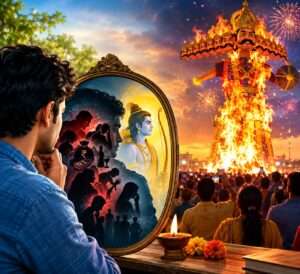
A major crisis of Dussehra is that we have begun to value symbols, while lagging in embracing the values behind them. It’s easy to invoke Ram’s name, but difficult to follow his ideals. Praising truth is simple, but standing up for it requires courage. It’s easy to talk about justice, but supporting it even against one’s own interests is a test of true character. It’s easy to preach decorum, but it’s difficult to enforce the discipline of decorum on one’s desires and behavior.
Ram is not only a symbol of faith but also an inspiration for ideals like truth, justice, duty, and dignity. These values are meaningful only when they are reflected in our behavior. If a person returns from attending a religious event but mistreats his family members at home, behaves dishonestly at work, or exploits the weak in society, he should seriously reconsider his conduct. The true value of religion is determined not by external display, but by humane behavior.
To make Ravana Dahan meaningful, it’s essential that we transform this festival into an opportunity for self-improvement. Each person should look within and honestly acknowledge which of their behaviors are harming others. Some should learn to control their anger, some should resolve to refrain from greed, some should make it a habit to treat women with respect, and some should speak out appropriately instead of remaining silent in the face of injustice. Similarly, society should make collective efforts to combat problems like corruption, violence, dowry, and drug addiction.
We must also understand that opposing evil isn’t just about speeches and slogans. Supporting victims of crime, mustering the courage to testify against injustice, not encouraging corrupt practices, and respecting the rights of others along with our own are also part of the struggle against Ravana. Social change begins not on a grand platform, but with small, ethical decisions by individuals.
Today, the need isn’t about how tall the effigies of Ravana should be, but rather how high our own character should be. More important than the loudness of the fireworks, is how loud our voices against injustice should be. The height of the effigy fades in a few hours, but the height of character can guide society for generations.
If, after burning the effigy of Ravana on Dussehra, we return home with our ego, greed, jealousy, and immorality intact, we should consider our own failure, not the success of the celebration. The end of evil comes not with the fall of the effigy in the field, but with the awakening of dissent against injustice and a commitment to morality within humanity.
This Vijayadashami, let your resolution not just be to burn an effigy of Ravana. Let it also be to identify one evil within yourself and eliminate it, to protest against injustice, and to bring positive change to another person’s life through your actions. The day we begin to do this, Dussehra will cease to be just a tradition but will become a campaign for social change.
Ravana is burned every year, but evil lives on as long as we allow it space within and around us. The true Vijayadashami will be the day when, along with the effigies, our own evils are burned, and the ideals of Rama are reflected in our conduct.

