



M Radha Madhavi
भवान् भीष्मश्च कर्णश्च कृपश्च समितिञ्जयः ।
अश्वत्थामा विकर्णश्च सौमदत्तिस्तथैव च ॥
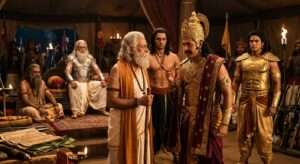
Duryodhana, though inwardly disturbed by the gathering circumstances and by the sudden confrontation with the consequences of his own motives and past actions, immediately attempted to recover his composure. His anxiety was not the anxiety of a man prepared to acknowledge his errors; rather, it was the nervousness of a ruler who sensed that the situation was moving beyond his control. The sight of the Pandava army, arranged with remarkable discipline under the leadership of Dhrishtadyumna, had already shaken his confidence. Yet, true to his authoritarian temperament, Duryodhana quickly gathered himself and sought to conceal his apprehension beneath a display of command.
It was at this moment that his words toward Dronacharya became significant. Addressing his teacher, he deliberately emphasized the latter’s identity as a Brahmana warrior and master of the science of arms, while simultaneously attempting to provoke him into a stronger response. His manner contained an element of humiliation disguised as praise. By referring to the formidable strength assembled by the Pandavas and reminding Drona of the circumstances surrounding their military preparation, Duryodhana was not merely describing the battlefield; he was subtly placing psychological pressure upon his own preceptor.
The irony was profound. Drona was the very teacher who had trained both the Kauravas and the Pandavas in warfare. The weapons, formations, strategies, and disciplines that now stood opposed on the battlefield had, to a considerable extent, emerged from the same school of instruction. Duryodhana therefore stood before a teacher whose affection and obligations were divided by history, while his own political conduct had transformed former students into enemies. His words attempted to convert that complicated relationship into an immediate military obligation.
Duryodhana then began enumerating the principal warriors on his own side: Bhishma, Karna, Kripacharya, Ashvatthama, Vikarna, and the son of Somadatta. The verse presents these names as symbols of the immense military strength available to the Kaurava cause. Bhishma represented experience, authority, and the accumulated wisdom of generations. Karna represented extraordinary martial ability combined with an intense personal allegiance to Duryodhana. Kripacharya represented mastery of warfare and the discipline of an accomplished teacher. Ashvatthama embodied the fierce continuation of Drona’s martial lineage. Vikarna, though a Kaurava prince, had previously shown that conscience could survive even within the atmosphere of the royal court. Somadatta’s son represented another established warrior house aligned with the Kaurava side.
Yet the very manner in which Duryodhana lists these warriors reveals his state of mind. A genuinely confident commander need not repeatedly establish the greatness of his forces. Duryodhana’s enumeration can therefore be understood as both a military assessment and a psychological exercise. He was strengthening his own confidence by verbally assembling before himself the names of those upon whom he believed victory depended. His words were directed toward Drona, but they also served to reassure himself.
There is another important dimension to this passage. Duryodhana was attempting to create a sense of collective obligation among the warriors surrounding him. By naming Bhishma, Karna, Kripa, Ashvatthama, Vikarna, and Somadatta’s son, he was constructing an image of an impregnable circle of protection. The underlying message was clear: the Kaurava army possessed enough distinguished warriors to overcome whatever strength the Pandavas could deploy. But military strength is never determined merely by the number or reputation of warriors. It also depends upon unity of purpose, moral conviction, disciplined leadership, and the willingness of individuals to sacrifice personal interests for a common cause.
This distinction becomes especially important in the Mahabharata. The Kaurava army was vast, and its commanders were individually formidable. Yet the epic repeatedly demonstrates that numerical superiority and personal prowess cannot by themselves guarantee the success of a cause. Bhishma’s loyalty to the throne did not erase his affection for the Pandavas. Drona’s obligations as a royal preceptor could not completely extinguish his personal connections with his former disciples. Karna’s loyalty to Duryodhana arose from gratitude and friendship, but it was also entangled with questions of identity, honour, and destiny. Thus, beneath the outward unity of the Kaurava army existed profound emotional and ethical complexities.
Duryodhana’s reference to these warriors therefore carries a deeper psychological significance. He was trying to transform a complicated moral situation into a simple military calculation. If enough powerful warriors stood on his side, he could avoid confronting the uncomfortable question of whether the cause for which they were fighting was itself righteous. This is one of the enduring psychological insights of the Gita: human beings often attempt to compensate for inner uncertainty by accumulating external strength.
Drona’s silence becomes equally meaningful. The Acharya did not respond to Duryodhana’s provocation in the manner the king perhaps expected. Silence, in such a moment, could be more powerful than argument. Drona understood the political and emotional complexity of the situation. He knew that Duryodhana’s words were not merely an innocent account of military strength. They carried accusation, pressure, and an implicit demand that the teacher prove his loyalty.
Duryodhana therefore found himself in an unusual position. The more he tried to assert authority over his teacher, the more clearly his own insecurity became visible. He had intended to command confidence, yet his speech revealed anxiety. He wanted Drona to act with absolute commitment, yet the very necessity of urging him exposed the absence of complete trust. The king was surrounded by great warriors, but he still felt compelled to remind them—and himself—of their strength.
This is where the narrative of the Gita begins to move beyond the historical battlefield into the battlefield of the human mind. Kurukshetra is not merely a geographical field where two armies have assembled. It becomes a representation of the conflict between desire and duty, attachment and truth, power and righteousness, fear and self-knowledge. Duryodhana’s conduct represents the mind attempting to protect its chosen position even when circumstances begin to expose its weaknesses.
His invocation of Bhishma, Karna, Kripa, Ashvatthama, Vikarna, and Somadatta’s son is therefore more than a catalogue of warriors. It is an attempt to construct security through external power. But the Gita gradually reveals that security founded upon fear, attachment, and the desire to possess cannot provide lasting peace. The deepest strength comes from clarity of duty and freedom from the compulsive need to control the outcome.
The silence of the Acharya consequently becomes part of the larger philosophical atmosphere of the scene. Duryodhana seeks immediate reassurance; Drona offers no corresponding emotional affirmation. The king wants the authority of the teacher to reinforce his own position, but the teacher’s restraint leaves the king to confront his own uncertainty. His subsequent words and actions can thus be read as an increasing effort to overcome inner instability through outward assertion.
The eternal lesson is subtle. When a person knows that his foundation is secure, he does not need to continually proclaim the strength surrounding him. When the mind is disturbed, however, it often counts its possessions, allies, achievements, and powers in an attempt to silence its own doubts. Duryodhana’s speech illustrates this condition with remarkable clarity. He sees an army before him, but beneath that army lies a deeper conflict—the struggle between the power he has accumulated and the truth he does not wish to confront.
Thus, this verse marks not merely the introduction of several great warriors but the continuation of Duryodhana’s psychological revelation. His words seek to strengthen Drona, yet they simultaneously expose his own dependence upon the strength of others. The Mahabharata presents this contradiction deliberately. The man who wishes to command the destiny of an empire discovers that he cannot command the conscience, loyalty, or inner freedom of those around him.
In that sense, the battlefield has already begun its work before the first weapon is raised. The armies stand opposite one another, but the decisive struggle has entered the human heart. The Gita will ultimately teach that the greatest victory is not the conquest of another person, kingdom, or army, but the conquest of ignorance, attachment, fear, and ego within oneself. Duryodhana’s anxious enumeration of his warriors stands at the threshold of that greater teaching: outward power may fill the battlefield, but only inner truth can determine the meaning of victory.

