MS Sparsha
In 1850, a schoolteacher in Delhi spent his own money to publish a mathematics book. A leading review in Calcutta dismissed it as “cumbersome,” “clumsy,” and almost “schoolboy-like.” Thousands of miles away, however, one of the greatest logicians of the age saw something very different—a work possessing “merit of a peculiar kind.”
That teacher was Ramchundra of Delhi, a largely forgotten Indian mathematician who attempted to solve difficult problems of maxima and minima using algebra alone, without calculus. More than a century later, he would be described as “De Morgan’s Ramanujan.”
Ramchundra was born around 1821 in Panipat. His father worked in the revenue department but died in 1831, leaving behind a widow and six young sons with very little money. In 1833, Ramchundra entered the English Government School in Delhi. Mathematics did not initially make much impression on him. But towards the end of his six years there, something changed. He became fascinated by the subject and began studying mathematics books on his own at home.
He left school in 1839 and spent two years working as a writer, supporting his wife while also helping to finance the education of his five younger brothers. In 1841, his abilities earned him a senior scholarship of Rs 30 a month. By 1844, he had become a teacher of European science at Delhi College.
Ramchundra was not merely teaching mathematics. He was trying to make it accessible to Indian students. He translated mathematical works into Urdu and spent four or five years wrestling with a question that fascinated him: could problems involving maxima and minima be solved algebraically, without relying on the calculus that was then becoming central to higher mathematics?
His answer was published in 1850.
Titled A Treatise of Problems on Maxima and Minima, Solved by Algebra, the book was printed in Calcutta at Ramchundra’s own expense. His purpose was modest but significant: he wanted to provide students who had not yet advanced to calculus with another way of approaching difficult mathematical problems.
The response from the influential Calcutta Review, however, was far from encouraging. The reviewer considered Ramchundra’s method unnecessarily cumbersome and its execution clumsy, even “schoolboy like,” while questioning whether the book had any practical value.
Ramchundra did not quietly accept the verdict. He responded to the criticism in newspapers. More importantly, he sent copies of his work abroad.
His efforts eventually reached Augustus De Morgan, the celebrated British mathematician and logician. De Morgan recognised that there was something unusual in Ramchandra’s achievement. He described the work as having “merit of a peculiar kind” and believed that encouraging such intellectual effort could contribute to the revival of the Indian mind.
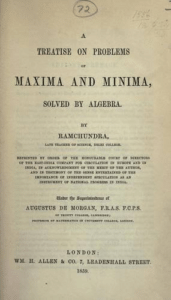
De Morgan helped arrange a London edition of the treatise in 1859 and wrote an extensive preface. It also incorporated autobiographical notes that Ramchundra himself had sent.
History, meanwhile, was moving violently around him. Delhi was convulsed by the uprising of 1857, yet Ramchundra survived the upheaval. In January 1858, he became headmaster of the Thomason Civil Engineering College at Roorkee. By the end of the same year, he was headmaster of a new school in Delhi.
His career continued despite recurring ill health. He retired in 1866, at just 45. Four years later, he became director of education in Patiala.
Ramchundra died in Delhi on August 11, 1880.
Perhaps the most poignant glimpse of the man comes from the final page of his 1850 book. On page 185, Ramchundra wrote that he had more to say but feared that enlarging the work further would make it too long, and so he stopped.
That modest sentence has acquired an extraordinary poignancy with time. He had ideas left unwritten, problems left unsolved and perhaps mathematical insights that disappeared with him.
In 1981, mathematician Ivan Niven published Maxima and Minima Without Calculus, dealing with many of the same ideas and some of the same problems. Yet Ramchundra’s name did not appear in its text, index or bibliography.
It took until 1998 for writer Charles Musès to give this forgotten mathematician a memorable description: “De Morgan’s Ramanujan.” In 2007, an Indian edition of Ramchundra’s treatise was finally revised and published in Chennai.
But recognition came extraordinarily late.
Ramchundra’s story is therefore not merely about mathematics. It is about intellectual courage—the courage of a poor Indian teacher who taught himself, supported his family, educated his brothers, worked in Urdu, challenged established mathematical methods and spent his own money to put his ideas into print.
He was dismissed in his own time, recognised by one of Europe’s finest mathematical minds, and then almost forgotten again.
And perhaps the saddest irony remains on the last page of his own book.
The man who could have told us what he left out was simply afraid of taking too much of our time.