


MS Sparsha
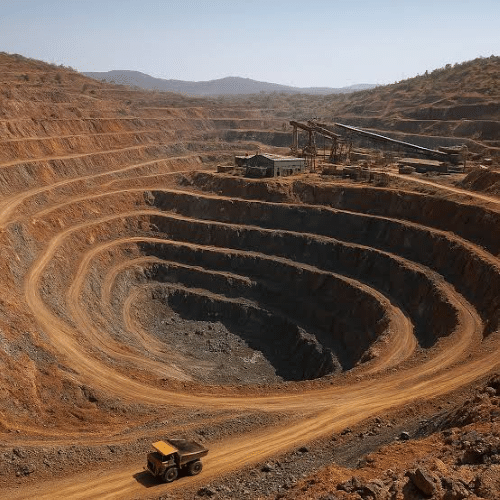
When one hears of the Kolar Gold Fields (KGF), the first thought that comes to mind is gold. But buried deep beneath those famous gold mines lies a remarkable chapter in India’s scientific history—a story in which Indian scientists went underground not in search of precious metal, but in pursuit of one of nature’s most elusive particles.
In 1965, scientists descended nearly 2.3 kilometres underground into the Kolar Gold Fields to conduct an experiment that sounded almost unbelievable. Their laboratory was not located in a university or a modern research complex. It was deep inside one of the world’s deepest mines of that era.
They were looking for neutrinos—subatomic particles so elusive that they are often described as “ghost particles”. Billions of neutrinos pass through our bodies and through the Earth every second, yet they interact so weakly with matter that detecting even a few of them is an extraordinary scientific challenge.
The answer lay in going deep underground.
Earth’s atmosphere is constantly bombarded by cosmic rays, generating a shower of particles that can overwhelm sensitive detectors. The KGF scientists found a remarkably simple but ingenious solution: use the Earth itself as a shield.
At a depth of about 2.3 kilometres, enormous quantities of rock stood between the experiment and the surface. Much of the unwanted cosmic-ray background was filtered out by this vast natural shield. Neutrinos, however, could continue travelling through the rock because of their extraordinarily weak interaction with matter.
The scientists therefore waited for the rare event when a neutrino would interact with matter and produce a detectable signal.
And it happened.
The KGF experiment recorded events interpreted as muons produced by neutrino interactions in the surrounding rock. The results were reported in Physics Letters in 1965 and became one of the pioneering observations of atmospheric neutrinos, placing KGF among the world’s earliest underground neutrino laboratories.
For Indian science, it was a remarkable achievement. Particles originating in cosmic processes were being studied by scientists sitting more than two kilometres beneath the Earth’s surface.
But there is another, equally important, dimension to this story.
The scientists could go underground because generations of miners had already gone there.
The 2.3-kilometre underground infrastructure was not created for the neutrino experiment. It was the product of decades of arduous mining. Thousands of miners had descended into the depths, excavating rock, maintaining underground passages and sustaining the enormous infrastructure required to operate the mines. Even essential services such as pumping groundwater and maintaining access to the deep workings were dependent on the mining workforce.
In an extraordinary convergence, a gold mine became a physics laboratory.
The miners had gone underground looking for gold. Scientists followed them, looking for particles from the sky.
That unlikely partnership between miners, mining infrastructure, Indian physicists and international scientific collaborators transformed KGF into a pioneering centre for underground particle physics. The mine’s extraordinary depth, initially created for an entirely different purpose, became a priceless natural asset for science.
There is something profoundly beautiful about that coincidence.
The miners dug into the Earth searching for something buried beneath it. The scientists went into the same darkness searching for something arriving from above.
Gold brought people into KGF. Science gave the depths a completely different meaning.
The KGF experiments also remind us that great scientific achievements are rarely the work of scientists alone. Behind every sophisticated experiment can be an army of people whose contribution may never appear in a scientific paper—the workers who build, maintain, operate, and sustain the infrastructure that makes discovery possible.
The names of the scientists associated with the KGF experiments may find their place in the history of particle physics. But the miners who made those extraordinary depths accessible deserve to be remembered too.
KGF, therefore, is not merely a story about gold.
It is the story of how India’s mining heritage unexpectedly became part of humanity’s search for the invisible universe.
And sometimes, the most fascinating treasures are not found in the rocks beneath our feet—but in the secrets travelling silently through them.


A Thoughtful and Refreshingly Simple Presentation
The article “KGF: A Different Story” is commendable for the author’s thoughtful approach and ability to look at a familiar subject from a different perspective. The strength of the piece lies not merely in its observations, but in the clarity with which they are conveyed. The author avoids unnecessary complexity and presents the ideas in simple, accessible language, allowing the reader to engage naturally with the subject. This simplicity, combined with a well-observed narrative and balanced presentation, reflects good journalistic and literary sensibility. Overall, it is a sincere and engaging piece of writing that demonstrates the author’s ability to make a familiar story appear fresh and meaningful.