



There comes a time in the life of every civilisation when it must have the courage to revisit the stories it has been taught, separate history from hagiography and ask a simple but uncomfortable question: Are we honouring history—or merely inheriting a narrative?
Bharat needs that debate today.
The birth anniversary of Mohandas Karamchand Gandhi last week provided an appropriate occasion to ask whether independent Bharat should continue to treat Gandhi’s political legacy as almost synonymous with the freedom struggle, or whether the time has come to place that legacy in its proper historical proportion and give equal, if not greater, national space to those who built the Bharat that followed independence.
This is not a call to erase Gandhi from history. Nobody can erase him. Nor should anyone attempt to. Gandhi was undeniably one of the most influential political leaders of the freedom movement, and his mass mobilisation, satyagraha and moral vocabulary profoundly affected Indian politics.
But influence is not the same as exclusive ownership of history.
And that distinction has become overdue.
The debate was triggered, among other things, by the forthright intervention of seasoned writer N. Natarajan, a proud contributor to Orangenews9, and subsequently by the razor-sharp intervention of Dr Anand Ranganathan, one of the most recognisable and widely followed young Indian voices in contemporary public discourse.
What makes Ranganathan’s intervention particularly significant is not merely his willingness to criticise Gandhi. It is his insistence that historical personalities should be examined through facts, events and evidence rather than protected by the halo that generations of Indians were taught to place around them.
A scientist, researcher, historian and philosopher in his own distinctive way, Dr Ranganathan has repeatedly demonstrated that he is prepared to question established narratives and confront uncomfortable chapters of history without the protective comfort of political correctness.
Please watch: https://x.com/ARanganathan72/status/2105730290006278316
His recent video message on Gandhi was particularly provocative because he did not merely make a political attack. He placed before his audience a series of historical events, political decisions, and documented positions which, in his interpretation, present a very different picture from the almost universally reverential Gandhi narrative handed down to generations of post-Independence Indians.
And that is precisely why his intervention deserves to be heard.
One may disagree with Ranganathan’s interpretation. One may challenge his conclusions. One may produce historical evidence to establish a different interpretation. But dismissing him merely because he questions a revered national icon is no longer an intellectually sustainable response.
This is especially important for Gen Alpha, which is growing up in a vastly different information environment from the generations born immediately after Independence.
For decades, a particular version of history was largely transmitted through textbooks, official institutions and a relatively small group of influential historians. Today, a young Indian can access archival material, speeches, correspondence, contemporary newspaper reports, books and competing interpretations within minutes.
The old monopoly over historical narrative is disappearing.
And Ranganathan’s appeal lies precisely there.
He does not appear before his audience merely as another political spokesperson asking people to accept a party line. He comes before them as a scientist and researcher questioning accepted narratives and asking Indians to examine the evidence and draw their own conclusions.
That is why his voice cannot simply be wished away.
Indeed, Dr Ranganathan is not alone.
A new generation of articulate Indians is increasingly asking uncomfortable questions about the freedom movement, Partition, Congress politics, the constitutional journey, civilisational history and the manner in which post-Independence history was written and taught. Supreme Court lawyer J. Sai Deepak is among the prominent contemporary voices, besides Subanshu Trivedi or Manoj Muntashir (His original name was Manoj Shukla, and he was born in Gauriganj, Amethi, Uttar Pradesh; he adopted “Muntashir” as his pen name. He is a prominent Bollywood lyricist, poet, scriptwriter, and dialogue writer who wrote the scripts and dialogue for films like Adipurush and the Hindi version of Baahubali 2) voices challenging established interpretations of India’s civilisational and constitutional history. There are others across literature, cinema, academia, journalism, and public discourse.
What is significant is that these voices are predominantly post-Independence born.
They are not fighting the battles of 1947.
They are questioning the interpretations of 1947 that were handed down to them.
That distinction is crucial.
And perhaps this is precisely why the debate is becoming increasingly uncomfortable for the old historical establishment.
For decades, generations of Indians were expected to accept certain historical conclusions almost as articles of faith.
The new generation is asking for the footnotes.
That is not a threat to history. It is history finally being interrogated.
Take the Khilafat movement.
Gandhi did throw his considerable political weight behind the Khilafat cause in the early 1920s in the hope of creating Hindu-Muslim political unity and strengthening the anti-British movement. That is historical fact. Scholars have debated for decades whether bringing a religious grievance into Indian nationalist politics was a political miscalculation or a deliberate strategy of mass mobilisation.
Either way, it deserves discussion.
The question is not whether Gandhi should be called a saint or a villain.
The question is why Indians should be prevented from examining his political decisions.
If Gandhi’s political choices are open to examination—and they are—then they must be examined without the protective shield of sainthood.
The same intellectual honesty is required when discussing Partition.
India did not become independent through one man’s philosophy, one movement or one political instrument.
The freedom struggle was a vast and complicated national experience involving Congress mobilisation, revolutionary nationalists, Subhas Chandra Bose and the Indian National Army, countless unnamed freedom fighters, the Second World War, Britain’s post-war economic exhaustion, changing international circumstances, the INA trials, the Royal Indian Navy mutiny of 1946 and the growing difficulty of sustaining imperial authority.
The contribution of Netaji Subhas Chandra Bose cannot therefore be confined to a footnote merely because his methods differed fundamentally from Gandhi’s.
Nor should the often-repeated claim that Bose alone drove the British out be presented as settled history. The historical record is considerably more complex.
But one thing is beyond dispute: Bose created a military and psychological challenge to British authority that deserves its rightful place in the national narrative.
That is precisely where the historical debate becomes meaningful.
There is also the controversial account of former British Prime Minister Clement Attlee’s alleged remarks to Justice P.B. Chakraborty in 1956, which has subsequently been cited by writers arguing that Bose and the INA played a far greater role in British calculations than conventional accounts acknowledge.
Whether one accepts that account in full or not, it is evidence that should be examined, debated and contextualised—not simply ignored because it disturbs the established narrative.
The freedom movement was bigger than one man.
Bharat’s independence was bigger than one ideology.
And its history is certainly bigger than one political family.
The same intellectual honesty is required when discussing Jawaharlal Nehru and Sardar Patel.
The popular claim that Gandhi simply “appointed” Nehru as Prime Minister also needs greater historical precision. The 1946 Congress leadership contest, provincial nominations, Patel’s position, Gandhi’s intervention and the eventual political process that resulted in Nehru becoming the first Prime Minister deserve to be taught in their complexity.
It is perfectly legitimate to debate whether Patel had greater organisational backing within the Congress at that moment.
It is equally legitimate to acknowledge that Nehru ultimately became the first Prime Minister and led the country through its extraordinarily difficult formative years.
History should be neither worship nor vilification.
It should be evidence.
Patel’s contribution to the integration of India’s princely states remains one of the monumental achievements of the early Republic.
Ambedkar’s contribution to the Constitution is equally monumental.
But even here, accuracy matters.
The Constitution was not written by Ambedkar alone. He chaired the Drafting Committee, but the Constitution emerged from the Constituent Assembly, its committees, debates and deliberations.
Similarly, calling the Constitution exclusively “Ambedkar’s Constitution” is no more historically accurate than reducing India’s freedom to “Gandhi’s freedom”.
No individual owns a civilisation.
Bharat belongs to its civilisation and its people.
The same need for historical honesty arises with Article 370 and Article 35A.
Whatever one’s political position on their merits, their constitutional history should be taught factually—their origins, the constitutional orders through which they operated, the political circumstances surrounding them, their consequences and their eventual abrogation.
The same principle should govern every contentious chapter of Indian history.
Teach the event.
Teach the competing arguments.
Teach the consequences.
And let the citizen judge.
This is precisely where the debate over the National Education Policy becomes important.
If schoolchildren are finally exposed to multiple strands of the freedom movement, India’s civilisational history, indigenous scientific achievements, the contributions of Bose, Patel and Ambedkar, the complexities of Partition, the constitutional journey and the enormous scientific achievements of post-Independence Bharat, that should not automatically be described as “rewriting history”.
History belongs to evidence.
If an old textbook contains omissions, omissions should be corrected.
If a new textbook contains exaggerations, those too should be corrected.
If one historian’s interpretation is challenged by another, students should know that.
The answer to biased history is not counter-biased history.
It is more history.
Unfortunately, the political establishment that once benefited from a particular historical narrative appears uncomfortable when that narrative is questioned.
The desperation becomes more visible when old and often selectively interpreted texts and controversies are repeatedly dragged into contemporary politics in an attempt to revive caste, communal or historical fault lines.
Manusmriti, caste discrimination, Partition, communal violence and religious history are all legitimate subjects of scholarship.
But they should be studied as history, not converted into permanent electoral ammunition.
A modern constitutional democracy cannot build its future by endlessly reopening every historical wound for contemporary political mobilisation.

Bharat has a much larger destination.
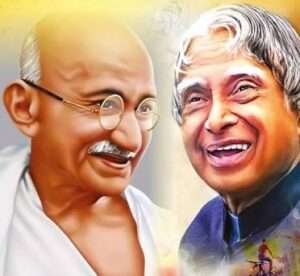
And this is where Dr A.P.J. Abdul Kalam enters this debate—not merely as another national icon, but as a symbol of the Bharat that should now capture the imagination of its young.
If Gandhi represented one powerful strand of India’s anti-colonial political imagination, Kalam represented India’s scientific self-confidence.
The contrast is striking.
Gandhi’s political vocabulary revolved around moral resistance, simplicity, non-violence and mass mobilisation.
Kalam’s Bharat was about science, technology, missiles, defence self-reliance, education, innovation and transforming young Indians into nation-builders.
DRDO records Kalam’s leadership in India’s Satellite Launch Vehicle programme and his subsequent role in shaping the Integrated Guided Missile Development Programme.
His contribution helped establish the technological foundation for India’s Agni and Prithvi missile programmes and India’s broader strategic capabilities.
Agni-5, for example, represents the evolution of this indigenous strategic capability, with an officially stated range of up to 5,000 kilometres.
BrahMos represents another remarkable chapter in this journey—a jointly developed Indo-Russian supersonic cruise-missile system in which Kalam played an important role in facilitating the programme.
This is the Bharat that a new generation can identify with.
Not because Gandhi must be erased.
But because Bharat must stop behaving as though its history ended with Gandhi.
That is the real argument.
A nation of more than 1.4 billion people cannot continue to construct its collective self-image around a handful of political personalities from the freedom struggle.
It must celebrate the scientists, soldiers, engineers, entrepreneurs, constitutionalists, administrators, social reformers and innovators who built the Bharat that followed.
Kalam therefore offers something uniquely valuable to today’s Bharat.
He did not ask young Indians merely to remember the past.
He asked them to build the future.
That is precisely why the Gandhi-versus-Kalam debate should not become another personality cult.
The more profound question is whether Bharat should move from a politics of remembrance to a culture of achievement.
And here, perhaps, lies the most important course correction of all.
The purpose of history is not to create permanent heroes and permanent villains.
The purpose of history is to ensure that the next generation does not repeat the mistakes of the previous one.
If Gandhi’s contribution to the freedom movement is worthy of remembrance, let it be remembered.
If his political decisions deserve criticism, let them be criticised.
If Bose’s contribution deserves greater recognition, give it to him.
If Patel’s integration of Bharat deserves greater prominence, teach it.
If Ambedkar’s constitutional contribution deserves deeper understanding, teach that too.
If Kalam’s scientific nationalism can inspire millions of young Indians, let Kalam inspire them.
Why should celebrating one diminish another?
The problem begins only when one personality is placed beyond scrutiny and an entire generation is expected to inherit that reverence unquestioningly.
That era should end.
Not with hatred.
Not with historical revenge.
But with intellectual freedom.
And this is why voices such as Dr Anand Ranganathan matter.
He represents something larger than his individual argument about Gandhi.
He represents a generation that is unwilling to accept “because we were told so” as an adequate historical explanation.
If his arguments are wrong, disprove them with stronger evidence.
If they are partially right, correct the textbooks accordingly.
If some conclusions remain contested, teach the contestation.
But shutting down the debate merely because Gandhi occupies a revered place in India’s political memory would amount to replacing historical inquiry with historical reverence.
Bharat should have outgrown that fear by now.
The question before the country is therefore not simply whether Gandhi should be “dumped”.
That perhaps is too simplistic.
The real question is whether Gandhi should continue to occupy the disproportionately central position in Bharat’s national imagination that he has occupied for decades.
That is a legitimate debate.
And if the time has come to rebalance the national pantheon, the alternative is not another political leader.
It is a civilisation confident enough to celebrate Gandhi, Bose, Patel, Ambedkar, Kalam, Sarabhai, Bhabha and thousands of lesser-known nation-builders without fearing that honouring one diminishes another.
The transition from Gandhi to Kalam, therefore, need not mean disrespecting the past.
It can mean changing the question we ask of our national heroes.
From:
“Who helped us become free?”
to:
“Who helped us become capable?”
That is the debate Bharat’s Gen Alpha deserves.
And perhaps the most important lesson of all is this:
A mature civilisation does not need to destroy its old icons. It simply refuses to remain imprisoned by them.
Gandhi can remain in history.
But Kalam—and the scientific, technological, strategically confident and self-reliant Bharat he symbolised—can become the inspiration for the future.

