Kolkata: The EC’s decision to assign new names and symbols to two rival TMC factions triggered a sharp political face-off on Friday, with the Mamata Banerjee camp challenging its detractors to demonstrate their grassroots support, while the breakaway faction sought to turn the new identities into an argument against personality-driven politics.
The EC allotted the Mamata Banerjee-led faction the name ‘Mamata All India Trinamool Congress’ and the ‘Football Player’ symbol, while the rival group led by Arup Roy was assigned ‘Democratic Trinamool Congress’ and the ‘Envelope’ symbol for the October 6 bypolls in West Bengal.
The arrangement is interim, pending a final decision on the rival claims over the original party name and the ‘Flowers and Grass’ symbol.
The EC’s action came amid the organisational dispute and directed both factions to submit choices to enable their candidates to contest the bypolls.
Former chief minister Mamata Banerjee, reacting to the decision, described it as a “black day” in the country’s democratic history and said her faction would challenge the order politically, democratically and legally. The rival faction argued that its new party’s name signals that it is not the property of an individual.
Chief Minister Suvendu Adhikari attributed the TMC’s present crisis to what he described as the TMC’s past political positions, including statements relating to Hinduism and the Ram temple.
Banerjee said, “We will not surrender. We will not bow our heads before political pressure. We will fight this battle democratically and legally.” She also asserted that the interim arrangement did not amount to acceptance of the EC’s decision.
She questioned the timing of the move, pointing out that the by-election process was already underway and nominations had been completed.
Banerjee said she could not “leave” the All India Trinamool Congress, which she claimed to have founded and built through nearly three decades of political struggle, and maintained that the twin-flower symbol had been associated with the party for 28 years.
She also questioned the rival faction’s organisational claims, saying her camp had submitted documents relating to elections conducted from the grassroots to the national level.
The Mamata camp’s response to the new symbol was simultaneously combative and rooted in the party’s established political imagery.
Senior TMC leader Kalyan Banerjee challenged the rival faction to demonstrate its support on the ground, asking Trinamool workers from across Bengal to assemble at Kolkata’s Brigade Parade Ground.
“Let Trinamool workers from every corner of Bengal come to Brigade Parade Ground. Divide the field into two sides with a rope, and the numbers on either side will speak for themselves,” he said.
The challenge sought to shift the focus from the EC’s nomenclature decision to the question of which faction commands greater support among the party’s grassroots workers and cadre.
TMC MLA Kunal Ghosh, meanwhile, sought to link the new football-player symbol with Mamata Banerjee’s political brand, posting a photograph of himself in football attire.
“Khela hobe (there will be a game). Mamata-di’s name is enough. Trinamool Congress is her creation and her right,” he wrote on social media.
The football symbol also allowed the Mamata camp to revive “Khela hobe”, a slogan that became a defining feature of the TMC’s campaign during the 2021 West Bengal Assembly election.
The rival faction sought to give a different political meaning to the EC’s choice of ‘Democratic Trinamool Congress’.
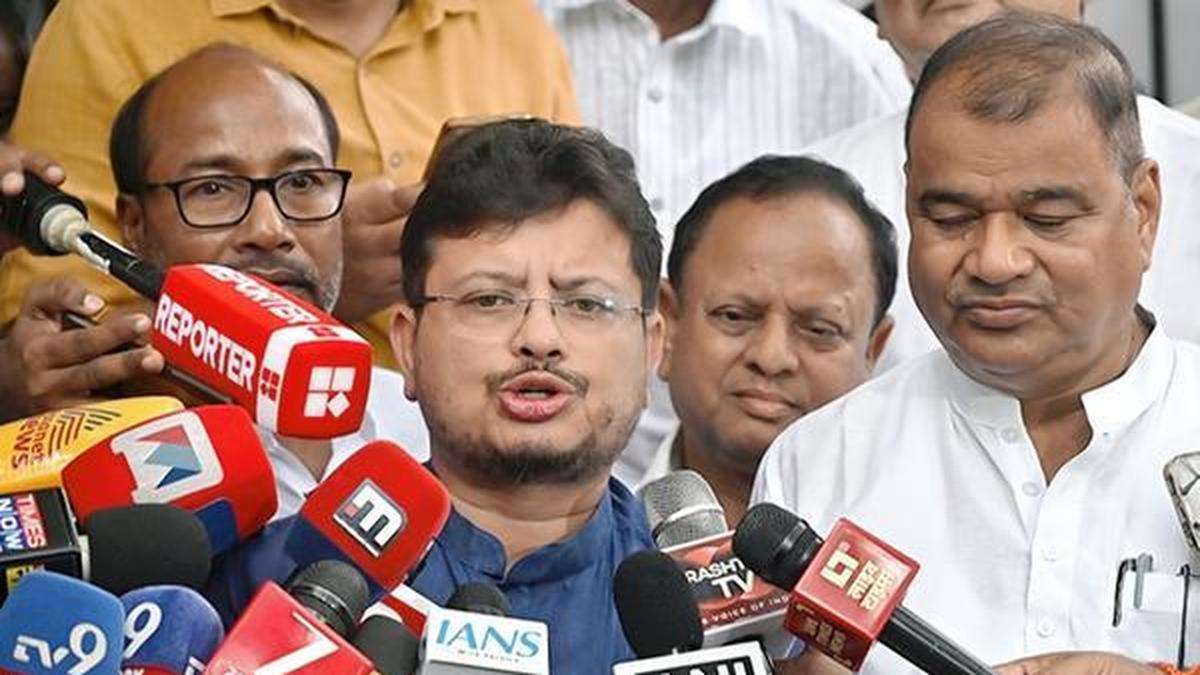
Ritabrata Banerjee said the absence of an individual’s name from the new party name underscored his faction’s argument that political parties could not be treated as the property of an individual or family.
“This highlights the nature of a party driven by an individual cult,” he said, referring to the Mamata-led faction’s new name.
“In politics, concepts like private limited companies or dynastic heirs hold no meaning. There is no such thing as ownership in the political system,” he said.
“Nobody’s name is in our party’s name. We are emphasising democracy. This is not a party owned by an individual. That is harmful to democracy,” Ritabrata said.
He also said his faction had submitted ‘Nationalist Trinamool Congress’, ‘West Bengal Trinamool Congress’ and ‘Democratic Trinamool Congress’ as its three choices and that the EC had explained why the first two could not be allotted.
The faction, he said, had received its first choice of symbol — the envelope — and would respect the Commission’s decision.
“We make decisions collectively. We started reaching out to people just last night, and a virtual meeting took place this morning,” Ritabrata said, adding that there was no question of challenging the EC’s authority.
The BJP, meanwhile, sought to portray the TMC’s internal crisis as a consequence of its own organisational politics.
West Bengal Chief Minister Suvendu Adhikari said the EC’s decision had been taken according to rules after hearing both sides and asserted that the BJP had no direct role in the dispute.
“Mamata Banerjee could not keep her own party united. The party has split into two, three, four factions. She herself is responsible for this,” he said.
Adhikari also invoked a Sanskrit verse on arrogance and attributed the present crisis to what he described as the TMC’s past political positions, including statements relating to Hinduism and the Ram temple.
“Calling Hinduism a dirty religion, calling the Maha Kumbh a death Kumbh, and taking out a procession on the day of the Ram temple consecration saying ‘we do not accept the Ram temple’… Everything has been destroyed by the curse of Lord Ram,” he said.
Union Minister of State Sukanta Majumdar said the EC’s action reflected a point in Mamata Banerjee’s political career when she should consider leaving politics.
“Mamata Banerjee has also played her role in Indian politics. I believe her time to exit politics has now come. The sooner she understands this, and the more smoothly she makes her exit, the better it will be for her and for everyone,” he said.