



Gajan Mata Temple is a revered hill shrine situated at Gajangarh, near Dharamdhari in Pali district of Rajasthan. The temple is located on the Bhura Bhakhar/Gajangarh hill, with the goddess worshipped in a sacred cave. Gajan Mata is traditionally identified with Chamunda Mata and is especially revered as the Kuldevi of the Parihar or Pratihar community.
Local tradition places the establishment of the shrine at around 1,000 years ago, with a traditional date of Vikram Samvat 1017, Ashadha Shukla Navami, corresponding approximately to 960 CE. A Dharamdhari historical tradition associates this period with the consecration of the goddess and the establishment of the settlement. However, this dating comes from traditional sources rather than independently verified archaeological evidence. Therefore, it is safer to describe Gajan Mata as a shrine with more than a millennium of sacred tradition rather than definitively stating that the present temple structure is 1,000 years old.
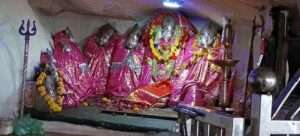
The presiding deity is Gajan Mata, traditionally regarded as a form of Maa Chamunda. According to local tradition, the goddess manifested herself in seven forms at this sacred hill, with Gajan Mata being the principal form worshipped here.
The temple complex also has shrines associated with Kala-Gaura Bhairava, Lord Ganesha, and Lord Hanuman, while a nearby shrine is dedicated to Alakh Mahadev.
Gajan Mata is particularly revered as the Kuldevi of the Parihar or Padihar lineage, although devotees from several other communities also worship her. For these families, the shrine is not merely a temple but an important ancestral centre of worship.
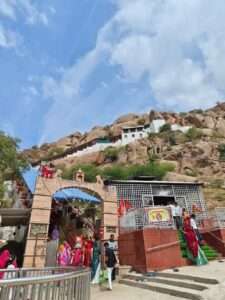
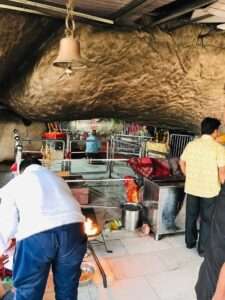
The most distinctive feature of Gajan Mata Temple is its natural setting. The goddess is traditionally believed to have manifested inside a natural cave in the Bhura Bhakhar hill, and this sacred cave remains the central focus of worship.
The temple is surrounded by the rocky landscape of Gajangarh and an extensive area traditionally regarded as sacred land. The hill, cave shrine and natural surroundings give Gajan Mata Temple a character quite different from the grand stone temples generally associated with Rajasthan.
The sacred landscape around the temple is also connected with traditions concerning Navagrahas and the 64 Yoginis, adding another layer of religious significance to the site.
The history of Gajan Mata is closely connected with the Parihar rulers of Mandore and the traditional history of Dharamdhari.
According to local tradition, Raja Nahar Rao Parihar of Mandore played an important role in the history of the shrine. The traditional account states that the king granted Dharamdhari and surrounding lands to Kripaldevji Panchlod Rajpurohit, a devotee who was entrusted with the worship and service of the goddess.
The tradition further states that a tamrapatra, or copper-plate grant, recording this land grant has been preserved by the descendants of Kripaldevji. The descendants of the Panchlod Rajpurohit family are traditionally associated with the continuing service of Gajan Mata.
The copper-plate tradition is an important part of the local history, although its exact date and contents have not been independently established through a published archaeological or epigraphic study. It is therefore best understood as a preserved temple tradition.
The Sthalapurana of Gajan Mata begins with Maa Chamunda and Raja Nahar Rao Parihar.
According to the traditional account, Raja Nahar Rao was travelling from Mandore with his wedding procession. He wished that his revered family deity, Maa Chamunda, would accompany him on the journey.
The goddess agreed, but placed one condition before him. Wherever the king asked her to stop, she would remain there and would not proceed any further.
As the grand wedding procession travelled through the region near present-day Dharamdhari, it passed the Bhura Bhakhar hill. At that time, a devotee named Kripaldevji Panchlod Rajpurohit was tending his cows near the hill.
The wedding procession was accompanied by the sounds of drums, horses, elephants and people. The noise frightened the cows, and they began running in different directions.
Kripaldevji tried to control the frightened animals. In his distress, he called upon the goddess and asked her to stop and protect his cows.
At that moment, according to the sacred tradition, the atmosphere suddenly changed. A tremendous roar was heard, accompanied by a powerful storm. Maa Chamunda manifested herself upon the hill, and the goddess is believed to have taken her abode inside a sacred cave in the mountain.
Because of the extraordinary garjana, meaning a thunderous roar, that accompanied her manifestation, the goddess came to be known as Gajan Mata.
The tradition further states that the goddess manifested in seven sacred forms, accompanied by Kala-Gaura Bhairava, Ganesha and Hanuman. The hill consequently became an important centre of worship, while Kripaldevji was entrusted with the continuing service of the goddess.
The story is also connected with the traditional origin of Dharamdhari. Raja Nahar Rao is said to have granted land to Kripaldevji in recognition of his devotion and service to the goddess. The settlement subsequently became associated with the preservation of dharma, giving rise to the traditional name Dharamdhari.
The relationship between Gajan Mata and the Panchlod Rajpurohit family is believed to have continued through generations, making the shrine an important example of the continuing connection between a temple, a community and its ancestral traditions.
The temple’s association with cattle is also remembered in its traditional practices. During the annual festival, cows were traditionally brought to the foothills, milk was collected and used to prepare kheer as prasada, while devotional singing and night-long jagran were conducted in honour of the goddess.
The principal annual festival of Gajan Mata is held on Ashadha Shukla Navami. Large numbers of devotees, particularly members of the Parihar and Padihar communities, visit Dharamdhari for darshan and special worship of the goddess.
A traditional fair is held around the temple, with devotees arriving from different parts of Rajasthan and neighbouring regions. Some devotees undertake padayatras to reach the sacred hill.
The festival includes special pujas, devotional singing, jagran and offerings to Gajan Mata. Traditional practices connected with cows and the preparation of kheer as prasada are also remembered as part of the festival traditions.

