Mukhya Praana
This is an article series. Please read all previous articles before reading this article. The URLs for all previous articles are located in the SPECIAL THOUGHTS section.
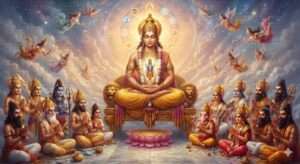
Earlier, we had learnt that there are 49 different types of Vaayu-s. We had learnt about Pravaha Vaayu, the Devata in Level 11… and Aham Vaayu, the Devata in Level 9. Now let’s learn about the Vaayu who is the highest among all Vaayu-s… who is a Ruju Yogi Devata… and is the most important among all the Devata-s/Jeevaatma-s. This Devata is referred to by a few different names such as Mukhya Praana Vaayu, Mukhya Praana, Praana Vaayu, Praana Tattva, Praanaagni, Pavana, Pavamaana or simply Vaayu. He is a Ruju Yogi Devata in the 99th position in Level 3 and is of the Saatvika-Saatvika-Saatvika-Saatvika category. In the future, after the completion of the current Para Kaala and when the new Brahmaanda is created, this Ruju Yogi Devata will advance to the 100th position in Level 3 and become the next Chaturmukha Brahma.
As mentioned earlier, Pravaha Vaayu is a highly underrated Devata. But one may not be wrong in saying that Praana Vaayu is even more underrated. The word Vaayu has been defined as “vayate iti vaayu:”, which means the one who weaves or connects everything is referred to as Vaayu. From this, and from a brief internet search too, it seems as though the words “Weave” and “Web” may’ve originated from the Sanskrit word Vaayu. Thus, Vaayu is the Devata who weaves together everything in the entire Brahmaanda. More importantly, Vaayu is the Devata who connects every Jeevaatma to Paramaatma. Furthermore, Vaayu is that Devata who connects all the Devata-s, in all different hierarchical levels that we’ve learnt about so far, too, with Paramaatma.
There is a story mentioned in the Chaandotya Upanishat, Bruhadaaranyaka Upanishat and also in Shad-Prashna Upanishad which illustrates the importance of Mukhya Praana Vaayu. The story goes somewhat along these lines (pardon my paraphrasing and dramatic embellishments). All the Devata-s assembled were debating as to which one of them is the most supreme. They decided to put this to test. As we’ve learnt so far, the Devata-s have Abhimaana over our various Indriya-s. So, they thought that it would be a good test to try exiting from the body of a certain individual… and the one whose exit causes the individual to die will be considered the supreme. So…
- The Ashvini Devata-s (Level 18) exit the body and as a result the person was unable to smell anything, but was still alive.
- Next, Agni (Level 15) exits the body, which results in the person losing the ability to speak, but… the individual was still alive.
- Next, Varuna (Level 13) exits the body, and the individual can’t taste anything as the taste buds in the tongue become non-functional, but… the individual was still alive
- Next, Soorya (Level 12) exits the body, and the individual goes blind, but… still alive
- Next, Indra (Level 8) exits the body. As Indra is the Abhimaani Devata for all Indriya-s, his exit results in the individual losing the functionality of all Indriya-s and also the ability to move… but yet, the mind is still active and individual was still alive
- Next, Shiva (Level 5) exits the body. As Shiva is the Abhimaani Devata for Manas (mind), his exit caused the individual to become comatose… but yet, the individual is still breathing and therefore still alive.
- Lastly, Praana Vaayu exits the body. That is when the individual finally dies… thus proving that Praana Vaayu is the highest among all the Devata-s.
But… somehow, the Devata-s thought that the above experiment was still not conclusive. Therefore, they embarked on the converse of the above experiment by entering back into the individual in the same order they had exited. Thus, Ashvini Devata-s re-entered the body of the individual. But the person didn’t come back alive. Next, Agni entered, hoping that the individual would start speaking… but nope, that was not to be. The individual was still dead. Varuna, Soorya, and Indra all entered one after the other, hoping that there would be at least some movement, a few words, a little blink of the eye from the individual. But none of it happened at all. Even Shiva entered the body of the individual, hoping that the mind will become active and some movement can be seen. But the individual was still dead. And finally, when Praana Vaayu entered the body, the person came alive, and all Indriya-s started functioning.
In Kannada, there are 3 common ways to say that an animal died:
- “Sat Hoyitu” – Here “Sat” refers to Paramaatma. “Hoyitu” means “Gone” or “Went away”. So, “Sat Hoyitu” means “Paramaatma is gone or God has exited the body”.
- “Praana Hoyitu” – Here “Praana” refers to the Devata who is popularly known by the name Mukhya Praana Vaayu or simply Praana. Thus, “Praana Hoyitu” refers to Praana – the Devata who connects the Jeevaatma to Paramaatma – exiting the body. As far as I’m aware, this expression exists in Hindi as “Praan Chalaa Gayaa”; in Tamil as “Uyir Pochi” (“Uyir” means breath); in Telugu as “Praanam Poyindi”; in Malayaalam as “Praanan Poyi” and so on.
- “Jeeva Hoyitu” – Lastly, “Jeeva” refers to the “Jeevaatma”. So, “Jeeva Hoyitu” means “Jeevaatma has exited the body”. This expression too exists in Hindi as “Aatmaa Chalaa Gayaa”; in Telugu as “Jeevam Poyindi”; in Malayaalam as “Jeevan Poyi” and so on.
As you can see, the above expression clearly illustrates that the awareness of Praana exists in common linguistics in almost all languages of Indian descent… but we hardly realize it. More specifically, Praana Vaayu is that Devata who stays within each living being and keeps chanting the Hamsa Mantra for a total of 788,400,000 times, which basically defines the life span. Some animals, such as dogs, cheetahs, deer etc. breathe very rapidly. This may be because of rapid physical activity such as running to hunt or to avoid being hunted or simply to cool the body. Rapid breathing causes the 788,400,00 breaths to be completed very quickly. On the other hand, Yogi-s breathe very slowly, thus taking a very long time to exhaust the 788,400,00 breaths. This stretches out their life span to a much longer time, sometimes to several centuries. Regardless of how long it takes to breathe so many times, once Praana Vaayu completes chanting these many Hamsa Mantra-s, he exits that body taking both Paramaatma and the Jeevaatma out of that body… which results in death of that living being. Thus, Mukhya Praana is the very reason why we are ALIVE.
Pancha Praana
Another common expression in Kannada language, for example, is “nanage sihi tindi andare pancha praana”. There is no clear way to translate this to English… but a lose translation would be like “sweets mean Pancha Praana to me”, which is basically another way of saying “I really love sweets”. But why use the expression “Pancha Praana” to convey extreme affinity? This is because, as explained above, one stays alive as long as Praana is in the body. The word “Pancha” means “Five,” and Praana exists in the body in 5 different forms, namely Praana, Apaana, Udaana, Samaana and Vyaana. Let’s ponder over these 5 forms of Praana.
- Praana – This refers to the energy that is coming into a body. A simple analogy would be how a mobile phone’s battery gets charged when it’s plugged into an electric socket. In the Vedic Shaastra-s, there are also references to Praana being the energy flowing through the Naadi-s (channels of energy) on the right half of the body. This energy is also said to be masculine. Basically, the source of energy is the air we breathe, the water we drink and the food we consume. We may be able to survive without food for days, or even up to a month or more. But we can’t survive that long without water. We may only be able to survive, at the most, for a few days. But we can’t survive without air for much longer than a few minutes.
- Apaana – This refers to the energy that is going out of the body or being spent by the body. In the mobile phone analogy, this is the energy that the radio, the LEDs, the Camera, the Apps etc. draw from the battery. Similar to Praana, in the Vedic Shaastra-s, there are references to Apaana being the energy flowing through the Naadi-s on the left half of the body. This energy is also said to be feminine. All our Indriya-s expend the Praana energy… and there is always some outcome when each Indriya spends the energy… and what comes out is the Apaana For example, the Paayu Indriya excretes the waste that’s harmful to us. Energy is needed for this to happen. Dead people/animals cannot and do not excrete, correct? As long as we are alive, the digestive system will function and waste will need to be excreted. Similarly, menstruation in women will happen until menopause. This too is an example of Apaana through Upastha Indriya.
- Udaana – This refers to the energy flowing through the Sushumnaa Naadi which is the central channel of energy. All the 7 Chakra-s talked about in Yoga Shaastra are in this central Sushumnaa Naadi. The Jeevaatma is situated in the Anaahata Chakra, which is at the center of the chest in this Sushumnaa Naadi. A Jeevaatma seeking Moksha will have to move upwards in this Sushumnaa Naadi towards Vishuddhi Chakra, Aajnyaa Chakra and finally exit the body through the top of the skull. Udaana is the energy necessary to get to the Tureeya Avasthaa (fourth state or the deep state of meditation) as well.
- Samaana – This refers to the energy flowing to all parts of the body. The Praana energy that was taken in through air, water and food has to reach all parts of the body for their respective functioning and necessary reparations & replenishments. Any part of the body that does not receive the Praana energy will start dying. In other words, the Praana energy has to reach each cell and all the components of the cell (nucleus, chromosomes, mitochondria, and so on). Naadi-s are the channels of energy in our body. These Naadi-s have sub-channels and branches that take energy to every corner of the body.
- Vyaana – This refers to the energy that goes even beyond Samaana and reaches the bone marrows and bone joints. Bone marrow is where the blood cells are created. There are various components that make up the blood. Shortage of any component causes severe health issues requiring transfusion. And, the bone joints need to be soft enough to be flexible and absorb shocks, but hard enough to carry the load. Infections in the joints and/or worn inflexible joints cause severe pain and impede our movement and functionality.
All of the above should make us think how complicated this entire creation is… where everything seems to depend on everything else, in one way or the other. Mukhya Praana is the Devata who handles all these dependencies and connects everything together. Basically, the above Pancha Praana-s are the very reason we are alive. And this reflects in our common linguistic expressions such as “I like it so much that I can’t live without it” or “nanage sihi tindi andare praana” or “sihi tindi andare pancha praana”.
Praanaayaama
As Yoga has become a worldwide fad now, people all over the world have heard the words Praana and Praanaayaama. Certified Yoga teachers teach various types of Praanaayaama, such as Bhastrikaa Praanaayaama, Bhraamaree Praanaayaama and so on. But what is basic idea behind Praanaayaama? Here my take on this topic. Imagine a balloon filled with water. Suppose the balloon can hold 500 ml of water… then the balloon membrane will exert a certain amount of pressure on the water. Suppose, we try to force another 100 ml of water into the balloon. This will cause the pressure exerted by the balloon membrane to increase, correct? Similarly, this body that I live in, is like a balloon. It has a certain size. And it is filled with about 6500 ml of blood. What we also have are the lungs.
When we inhale, the lungs expand… and this reduces the space available for the blood inside the body and thus, the same amount of blood has to exist in smaller amount of space. This exerts pressure on all the fluids inside the body, thus forcing it into every available extra space. And when this happens, the energy absorbed into the blood will reach every nook and corner of the body. Next comes the exhale cycle, when the lungs shrink in size. But this increases the space available for the fluids in the body, which causes a kind of vacuum effect. Thus, inhaling pressurizes the body fluids and exhaling causes a mind vacuum effect. This is when all the excrete worthy matter ought to be removed from every nook and corner of the body. This cycle repeats like every few seconds constantly pushing the essential energy to every corner of the body with every inhalation and removing he waste from every corner with every exhalation.
But… our problem is that we almost never breath well. Most of the times when are focused on some work or the other and we hardly pay attention to how we are breathing. In other words, we are barely breathing. This neither forces good energy into every corner of the body, nor does it remove the waste at a cellular level. When this happens day after day, month after month, year after year and continues for decades, matter which needs to be excreted gets stuck inside cellular spaces and that causes various illnesses.
In general, the word “Health” has the word “Heal” in it. A doctor can prescribe a certain medicine, but a doctor can’t really heal a patient. Healing is a trait that pertains only to Devata-s. Asura-s don’t really care about healing. In fact, they take pleasure in harming, and not healing. Nor are any Raajasik Jeevaatma-s interested in healing. Therefore, we ought to work toward strengthening the Devataa Sannidhaana in our space, starting from our own body expanding to the Pooja room in our home, our entire home, our town, state, country and the entire world. When we take a deep breath and inhale air which is rich in Saatvik energy, and hold our breath, it creates a pressure on all the fluid matter in our body and forces all the energy into every corner of the body. This has a very high healing effect and can cure all illnesses. In my considered opinion and experience, there is no illness that cannot be cured through Praanaayaama. I even mentioned this to a Pharmacy Scientist and his response was “I agree with you, I don’t know why this didn’t occur to me”.
The Vedic way of life prescribes various ways to minimize expenditure of Apaana, Samaana and Vyaana energies so as to maximize the Udaana energy, which contributes to the ultimate goal of exiting all the 3 bodies (Sthoola, Sookshma, and Linga Shareera-s) thus getting out of the seemingly eternal cycle of birth/death.
In Rig Veda, there is an entire Mandala of Mantra-s in praise of Praana Tattva by the name of Pavamaana Mandala. Priests praise the greatness of this Mandala to no end. In addition, as had been mentioned earlier while explaining about Devata-s in Level 15, there is a very important Sookta called Praanaagni Sookta. This was given to us by Maharshi Bhrugu. It praises Praana Tattva by many unique names such as Darshata, Mati, Ruta, Dasha Pramati, Madhwa, Maatarishva, and so on. Unlike Brahma… Mukhya Praana does take Avataara on earth. The main purpose of Praana Tattva’s Avataara on earth is to establish his ability to ascend to the position of Chaturmukha Brahma in future, which is the most important position in the entire universe.
We shall ponder over the Avataara-s of Mukhya Praana next.