



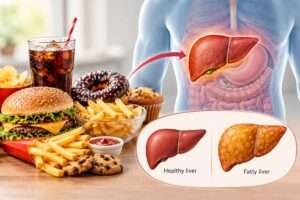
Yes, eating junk food is a major contributor to non-alcoholic fatty liver disease (NAFLD). Junk food and ultraprocessed items can contribute to fat build-up in the liver through several mechanisms. Sweetened drinks and candies contain fructose, which is metabolised by the liver and can contribute to fat production. Fried and fast foods are often high in saturated fats and, in some products, trans fats, which can contribute to metabolic dysfunction, inflammation and fat accumulation in liver cells.
Refined carbohydrates, white flour and baked goods can cause rapid blood sugar rises and, with repeated excessive intake, contribute to insulin resistance, which promotes excess energy storage and liver fat accumulation. A lack of fibre in many such foods can also reduce satiety, encourage overeating and contribute to weight gain.
A person walks into my clinic with no abdominal pain, no jaundice and perfectly ordinary energy levels when a routine ultrasound, perhaps done for an entirely different reason, reports two words that immediately cause anxiety: “Fatty liver.”
A large systematic review and meta-analysis published in Frontiers in Public Health in 2025 evaluated nine studies involving 169,771 participants and found that higher fast-food consumption was associated with a 55% increased risk of NAFLD and a 37% higher risk of obesity. Clinical research also highlights the importance of the amount of fast food consumed.
A 2023 study published in Clinical Gastroenterology and Hepatology, involving 3,954 adults, found that when fast food contributed 20% or more of daily calorie intake, liver fat was significantly higher. The association was particularly pronounced among people who already had obesity or type 2 diabetes. The surprising part is that many people do not even consider it a disease.
They may say, “I don’t drink alcohol, so how can I have fatty liver?” Or, “My liver enzymes are normal, so there is nothing to worry about.” Both assumptions can be misleading. Fat can accumulate in the liver for many reasons, particularly in association with obesity, diabetes, insulin resistance, abnormal cholesterol, and a sedentary lifestyle. And while fatty liver can remain relatively harmless in many people, in some it progresses to inflammation, scarring, cirrhosis and even liver cancer.
Fatty liver is no longer just an alcohol story
The terminology itself has evolved. What was traditionally called non-alcoholic fatty liver disease (NAFLD) is now increasingly referred to as metabolic dysfunction-associated steatotic liver disease (MASLD). The change reflects an important understanding: metabolic health is central to the disease.
The World Health Organization (WHO) recognised steatotic liver disease as an important and growing noncommunicable disease challenge in 2026, estimating that it affects around 1.7 billion people worldwide. And this is particularly relevant to India. A 2025 systematic review and meta-analysis of South Asian populations, including a large number of Indian studies, estimated MASLD prevalence at about 34.7% in populations not selected for diabetes.
Among people with type 2 diabetes, the pooled prevalence was approximately 60%. These numbers should make us pause.
One need not be an alcoholic to have fatty liver
Alcohol is certainly an important cause of liver disease, but it is not the only one. Excess body weight, abdominal obesity, insulin resistance, type 2 diabetes, high triglycerides, abnormal cholesterol, hypertension and physical inactivity can all contribute to metabolic dysfunction-associated steatotic liver disease. And there is another misconception particularly relevant to Indians: being thin does not automatically mean the liver is healthy. Some people with a normal body mass index can still have significant metabolic dysfunction and fatty liver. This is sometimes referred to as lean MASLD. South Asians can develop metabolic complications at lower levels of body weight compared with many other populations, making waist circumference, metabolic health and lifestyle important—not merely the number on the weighing scale.
Why does fat accumulate in the liver?
The liver plays a central role in processing fats, sugars and energy. When there is insulin resistance and excess energy intake, more fatty acids can reach the liver, and the liver itself can produce and store more fat. Over time, this can lead to accumulation of triglycerides within liver cells. Initially, this may cause relatively little damage. But in some people, excess fat is accompanied by inflammation and cellular injury. This more advanced inflammatory form is now called metabolic dysfunction-associated steatohepatitis (MASH) and can eventually lead to fibrosis, or scarring, of the liver. And fibrosis is what we particularly worry about.
Normal liver test does not always mean a normal liver
This is one of the most important messages for patients. Someone may have fatty liver on ultrasound while having normal alanine aminotransferase (ALT) and aspartate aminotransferase (AST) levels. Liver enzymes are useful, but they are not a perfect measure of liver health and cannot reliably tell us whether significant fibrosis is present. Therefore, the statement “my liver tests are normal” should not automatically end the evaluation in a person with metabolic risk factors or imaging evidence of fatty liver. The more important question is: Does this person have liver fibrosis?
Not every fatty liver needs a liver biopsy
Fortunately, modern evaluation does not mean that every patient needs an invasive liver biopsy. A doctor can initially assess metabolic risk factors, liver enzymes and other routine blood tests and calculate non-invasive fibrosis scores such as the Fibrosis-4 (FIB-4) index.
Depending on the person’s risk, further assessment may include transient elastography, commonly known as FibroScan, which can provide information about liver stiffness and liver fat. The European Association for the Study of the Liver (EASL), European Association for the Study of Diabetes (EASD) and European Association for the Study of Obesity (EASO) 2024 clinical practice guidelines recommend a stepwise approach to identifying people at risk of advanced fibrosis rather than treating every person with fatty liver as though they have the same disease severity.
This distinction is important. A person with simple steatosis and no significant fibrosis does not have the same prognosis as someone with advanced fibrosis.
The liver can respond to lifestyle change
For many people, the most powerful treatment begins with something that sounds deceptively simple: change the lifestyle. Weight reduction can significantly reduce liver fat. The 2024 EASL-EASD-EASO guidelines recommend a sustained weight reduction of at least 5% to reduce liver fat, 7–10% to improve liver inflammation and 10% or more to improve fibrosis in adults with MASLD and overweight. This does not mean crash dieting. A sustainable eating pattern rich in vegetables, fruits, legumes, whole grains, nuts and other minimally processed foods, while reducing ultra-processed foods and sugar-sweetened beverages, is recommended.
The same guidelines support a Mediterranean-style dietary pattern where appropriate, while emphasising that the diet should also be practical and sustainable for the individual. For an Indian patient, this does not mean abandoning Indian food. It means changing portions, cooking methods and food quality—reducing excessive refined carbohydrates, sweets, sugary drinks, fried foods and highly processed foods while increasing vegetables, pulses, whole grains and adequate protein.
Exercise is medicine for the fatty liver
Exercise should not be prescribed only to people who want to lose weight. Page 2 of 4 Physical activity can improve metabolic health and reduce liver fat even when there is little change on the weighing scale. A combination of aerobic activity and resistance training is often practical. Brisk walking, cycling, swimming, jogging according to fitness level, along with strength training can all form part of a sustainable programme.
The 2024 EASL-EASD-EASO guidelines recommend physical activity and exercise to reduce steatosis, tailored to the individual’s preference and ability. The objective is not to punish the body for having fatty liver. It is to make the body metabolically healthier.
What about diabetes and cholesterol?
Fatty liver rarely exists in isolation. A person with MASLD should also be assessed for diabetes or prediabetes, hypertension, abnormal cholesterol, obesity and cardiovascular disease. This is important because cardiovascular disease is a major health concern in people with metabolic dysfunction-associated steatotic liver disease. Treating diabetes, blood pressure and cholesterol is therefore not separate from treating fatty liver. It is part of managing the same metabolic problem. Medications should be selected according to the individual’s overall medical condition rather than simply taking a “liver medicine” because an ultrasound shows fatty liver.
Don’t fall for ‘liver detox’ claims
The diagnosis of fatty liver has created a huge market for detox drinks, herbal preparations, powders and supplements claiming to “clean the liver.” There is no magical liver-cleaning drink. In fact, the 2024 EASL-EASD-EASO guidelines state that nutraceuticals cannot currently be recommended for MASLD because evidence regarding both their effectiveness and safety remains insufficient. Some supplements marketed as natural can themselves cause liver injury. The safest approach is therefore not to add more unregulated products to an already overburdened lifestyle, but to address the metabolic causes of the disease.
The ultrasound report is not the end of the story
When an ultrasound says “fatty liver,” the correct response is neither panic nor dismissal. It should lead to a conversation. How much does the person weigh? What is the waist circumference? Is there diabetes or prediabetes? What are the triglycerides and cholesterol levels? Is blood pressure controlled? How much alcohol is consumed? What medications and supplements are being taken? Is there evidence of fibrosis? These questions tell us much more than the words “fatty liver” alone.
The liver often gives us time, if we use it
The frightening thing about advanced liver disease is that symptoms may appear late. The encouraging thing about fatty liver is that it can provide an opportunity to intervene much earlier. A person discovered to have fatty liver today may still have years in which metabolic health can be dramatically improved, liver fat reduced and progression prevented. The goal should therefore not be to simply make the ultrasound report normal.
The goal is to protect the liver— and the heart, blood vessels, kidneys and metabolic health of the person attached to it. Fatty liver is not merely an incidental finding on an ultrasound. It can be an early warning sign of metabolic disease. The earlier we recognise that warning, the greater our opportunity to change the outcome.

