The Duleep Trophy final may have produced a winner, but more importantly, it threw up a question that Indian cricket cannot afford to ignore: where is the next generation of Test batsmen and quality spinners coming from?
For too long, the IPL has been treated as the principal shop window for Indian cricketing talent. There is no denying its enormous value, but T20 cricket cannot be the sole laboratory for identifying players capable of succeeding in the longer formats. The Duleep Trophy, with its emphasis on technique, temperament and patience, once again demonstrated why domestic first-class cricket must remain the backbone of India’s talent hunt.
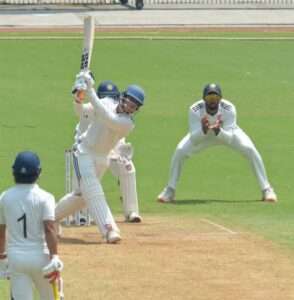
One name that particularly caught the eye was Shikar Mohan. He looked every inch a batsman with the potential to go a long way. His wide-ish on-drive off Mohammed Siraj was not merely a stroke of timing; it was a glimpse of the class and confidence required at the highest level. His ability to work the ball into the leg-side region with a straight bat showed a sound technique and, more importantly, an understanding of how to construct an innings.
These are precisely the qualities selectors need to watch closely.
The final also highlighted the contrasting fortunes of the two sides. East Zone had Abhimanyu Easwaran, a proven run machine, providing the stability expected of a seasoned domestic performer. Kumar Kushagra ably supported the cause, while Ishan Kishan’s double hundred effectively broke the back of South Zone’s challenge. It was a reminder that the domestic circuit possesses considerable batting depth if selectors are prepared to look beyond the glamour and immediacy of the IPL.
South Zone, meanwhile, found its bowling resources, particularly the spin department, badly exposed. C. V. Milind stood out for his lion-hearted effort and refused to surrender, but he appeared to be carrying too much of the responsibility himself.
And that brings me to what is perhaps the most worrying aspect of the tournament: where have India’s quality spinners disappeared?
South Zone’s struggles against spin—and the difficulty in producing a sustained threat—should concern anyone who believes Test cricket remains India’s ultimate examination. It is difficult not to wonder why experienced campaigners are not being utilised more effectively or why the domestic system is seemingly producing fewer spinners capable of controlling an innings and exploiting a wearing surface.
The sight of S. Gopal in the South Zone setup also raises questions. He may not be Anil Kumble or Subhash Gupte—and comparisons with those giants would be unfair—but Indian cricket has traditionally prided itself on producing clever, thinking spinners. That tradition must not be allowed to disappear.
Perhaps it is time to invoke the wisdom of the old masters. Erapalli Prasanna, Bishan Singh Bedi and Srinivas Venkataraghavan represented three different schools of spin bowling, but all possessed something modern cricket desperately needs: an understanding of flight, deception, patience and the art of setting up a batsman.
Their generation did not learn spin through technology alone. They learned it through thousands of overs, imagination and relentless experimentation.
India’s batting, too, is entering a delicate transition. With Virat Kohli and Rohit Sharma having exited international cricket, the cushion of two enormously experienced run-getters is gone. The next generation must now assume responsibility, and that transition cannot be left entirely to the IPL ecosystem.
The Duleep Trophy has therefore delivered a timely message. The talent is there. The question is whether we are looking in the right places.
India must continue to celebrate the IPL, but it must not allow the shortest format to overshadow the demanding apprenticeship of first-class cricket.
If India wants another generation of Test greats, it must look beyond the obvious, reward performances in the domestic arena and rediscover the art of identifying players before they become household names.
The next Kohli, the next Rohit—and perhaps, most urgently, the next Prasanna or Kumble—may already be playing somewhere on a domestic ground.
We simply need to watch more closely.