



The greatest tragedy of our times is that a patient today enters a hospital not merely with a disease but with two things that instantly determine his fate — his health insurance card and the size of his insurance cover.
The bigger the cover, the bigger the smile at the reception.
Welcome to India’s new healthcare business model, where “cashless” often means that somebody else is making cash while you are left counting your blessings, bills and betrayals, besides adding more complications, if not ailments, to yourself.
Health insurance was originally conceived as a social safety net. It was meant to save families from financial ruin during medical emergencies. Today, in far too many cases, it has become a three-way tug of war between corporate hospitals, insurance companies and governments, with the patient hanging helplessly in the middle.
The gullible middle class is perhaps the biggest victim. Bombarded day and night with advertisements promising “unlimited restoration benefits”, “zero waiting periods”, “super top-up covers” and “cashless treatment anywhere”, people are made to believe that purchasing a Rs.50 lakh or Rs.1 crore health insurance policy is synonymous with purchasing peace of mind.
Unfortunately, what many end up purchasing is a ticket into a maze.
Perhaps, people should realise that walking into a corporate hospital with a fat cashless health insurance cover is sometimes like voluntarily announcing one’s bank balance. The treatment begins not with the disease but with discovering how much insurance coverage one carries. A Rs.5 lakh cover attracts one set of recommendations, Rs.25 lakh another and Rs.50 lakh perhaps warrants a grand medical expedition. What began as acidity may soon discover friendships with hypertension, borderline diabetes, vitamin deficiencies, cardiac concerns and half-a-dozen specialist referrals. One enters with a minor ailment and returns home carrying a thicker medical file and a few more worries than one originally walked in with.
There is another cruel irony. Many patients who walk into hospitals are already emotionally shattered. They are vulnerable and willing to spend every last rupee to save their loved ones. The magic word “cashless” provides psychological comfort and lowers financial resistance. Suddenly, every test appears necessary, and every procedure sounds urgent. By the time discharge arrives, the original ailment may have been cured, but the patient is left battling stress, anxiety, and lifelong medication for newly discovered medical possibilities. Sometimes, the treatment becomes more traumatic than the disease itself.
There was a time when people feared diseases. Today, many fear medical emergencies more than diseases themselves. A fever is manageable, but the hospital bill isn’t. Chest pain can perhaps be treated, but the anxiety of hearing words like “let us rule out this possibility” or “there could be another complication” can itself become a lifelong ailment. Ironically, thousands are no longer merely patients of diseases; they have become patients of the healthcare system itself.
The moment a patient flashes his cashless insurance card, the entire treatment protocol mysteriously changes. What could have been managed with conservative treatment suddenly requires a battery of investigations. Blood tests multiply faster than rabbits. CT scans, MRIs, cardiac profiles, specialist consultations and pathological investigations begin arriving like festival invitations.
After all, why should anyone complain? The patient isn’t paying. The insurance company is!
Except that somebody eventually pays. Either through higher premiums next year or through claim rejections and deductions when genuine emergencies strike.
Ironically, today’s middle-class Indian lives under three perpetual fears — a child’s education, loss of employment and a medical emergency. The first may take away his savings, the second his livelihood and the third can take away everything that he has painstakingly built over a lifetime. It is perhaps no coincidence that people now pray harder before entering a hospital than they do before entering a temple.
Once upon a time, doctors asked, “What is troubling you?” Today, the system silently asks, “What is your insurance cover?”
Ironically, even doctors privately acknowledge that the system has become increasingly commercialised. Corporate hospitals themselves complain of delayed settlements and arbitrary deductions by insurance companies. Insurance companies accuse hospitals of inflated billing. Hospitals accuse insurance companies of arm-twisting and delayed payments. Governments occasionally announce yet another health scheme amidst much fanfare.
And the patient? He continues to remain the sacrificial goat in this unholy alliance — milked by one, billed by another and abandoned by the third.
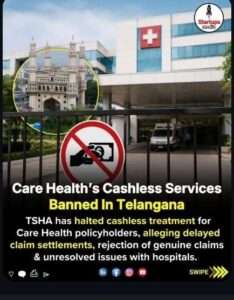
The latest controversy involving the suspension of cashless treatment services by member hospitals of the Telangana Specialty Hospitals Association for policyholders of Care Health Insurance has once again exposed the cracks in this business model. Patients are now expected to pay upfront and seek reimbursement later while hospitals and insurers settle their disputes. The consequences are immediate and painful for ordinary families caught in medical emergencies.
Perhaps someone should ask a simple question. If hospitals and insurance companies cannot trust each other, why should patients blindly trust either of them?
The greatest marketing gimmick of the century is undoubtedly the word “cashless”. Nothing in healthcare today is cashless. Somebody is paying. Somebody is profiteering. Somebody is suffering. The word merely changes the direction in which money flows.
Perhaps the new definition of “cashless treatment” needs revisiting. The treatment may be cashless for the patient at the billing counter, but it certainly isn’t greedless inside the system.
Our filmmakers saw this menace much before policymakers did. Films such as Tagore, Gabbar Is Back and Mersal questioned corruption in hospitals, unethical medical practices and the growing commercialisation of healthcare and health insurance. They were dismissed by some as exaggerated cinematic fiction. Reality, unfortunately, appears to have overtaken fiction.
There is an old cynical joke that if one walks into certain hospitals with a headache, one walks out poorer, if not sicker. Another equally cynical observation doing the rounds is that corporate hospitals would perhaps not spare even a dead person if accompanied by a premium cashless insurance card. The sarcasm is cruel, but it reflects growing public distrust.
In India today, a medical emergency has become the only emergency where everyone profits except the patient. Hospitals make money. Insurance companies collect premiums. Third-party administrators make money processing claims. Diagnostic laboratories flourish. Pharmaceutical companies prosper. Governments collect taxes. Lawyers are engaged when disputes arise. Social media influencers are paid to promote insurance products. The only person who loses is the patient. If he survives, he loses his savings and peace of mind. If he doesn’t, his family may spend years paying loans and pursuing reimbursement claims.
Health insurance itself is not the villain here. Millions of Indians have genuinely benefited from it. Ethical hospitals save countless lives every day. Dedicated doctors continue to serve humanity with remarkable commitment.
The villain is greed.
Greed that prescribes unnecessary investigations. Greed that inflates hospital bills. Greed that delays legitimate claim settlements. Greed that hides exclusions and fine print in fifty-page policy documents. Greed that forces distressed families to run from one counter to another while their loved ones fight for survival.
Governments too cannot escape responsibility. Healthcare regulation in India continues to remain woefully inadequate. Why are treatment packages for common procedures not standardised? Why should patients become collateral damage whenever hospitals and insurance companies disagree? Why aren’t arbitrary claim rejections penalised more severely? Why should ordinary citizens become unwilling participants in corporate negotiations?
Health emergencies are not business opportunities.
People do not enter hospitals seeking discounts or luxury experiences. They enter with fear in their eyes and hope in their hearts. Their vulnerability should never become somebody else’s business model.
Before buying the next flashy health insurance policy advertised by smiling celebrities and social media influencers, ask difficult questions. Read the exclusions. Verify the network hospitals. Understand reimbursement procedures. Compare grievance redressal mechanisms. Most importantly, remember that “cashless” does not necessarily mean “hassle-free.”
The day a hospital begins looking at an insurance card before looking into a patient’s eyes, healthcare ceases to be a service and becomes a business. The day profit begins deciding treatment protocols, society itself falls sick.
India needs better hospitals, better insurance and better regulation—not bigger bills and cleverer ways of emptying people’s pockets in the name of saving lives. Healthcare cannot become an industry that survives on human helplessness. If it does, we are not merely treating diseases—we are institutionalising exploitation.


stronger regulation, greater transparency, standardized treatment protocols, fair claim settlement practices, and accountability wherever unethical practices occur are needed.