



॥ ॐ नमः प्रणवार्थाय शुद्धज्ञानैकमूर्तये ।
निर्मलाय प्रशान्ताय दक्षिणामूर्तये नमः ॥
गुरुर्ब्रह्मा गुरुर्विष्णुः गुरुर्देवो महेश्वरः ।
गुरुः साक्षात् परं ब्रह्म तस्मै श्रीगुरवे नमः ॥
Sri Govinda Bhagavatpada Cave and Adi Shankaracharya Shrine Temple is nestled on the sacred Mandhata (Shivapuri) Island amidst the holy waters of the River Narmada, just below the revered Omkareshwar Jyotirlinga Temple. The ancient Sri Govinda Bhagavatpada Cave, popularly known as Shankaracharya Cave is one of the most revered spiritual sites associated with Adi Shankaracharya. This sacred cave is one of the holiest pilgrimage sites in the Advaita Vedanta tradition and holds a unique place in the spiritual history of Sanatana Dharma.
It was here that the eight-year-old Adi Shankaracharya, after undertaking an extraordinary journey on foot from Kalady in Kerala in search of a true Guru, met the great sage Sri Govinda Bhagavatpada. This divine meeting marked the beginning of one of the greatest Guru–Shishya traditions in Indian history. Under the guidance of his Guru, Adi Shankaracharya attained the highest knowledge of Advaita Vedanta and was entrusted with the mission of reviving Vedic Dharma and spreading its timeless philosophy throughout Bharat. Even today, the cave radiates an atmosphere of profound peace, attracting seekers, saints, scholars, and devotees from across the world.
The natural cave has existed since ancient times and is believed to have served as a meditation abode for sages for thousands of years. Its greatest historical and spiritual significance dates to the 8th century CE, when Jagadguru Adi Shankaracharya met Sri Govinda Bhagavatpada here. The cave has therefore been revered as a sacred pilgrimage site for over 1,200 years.
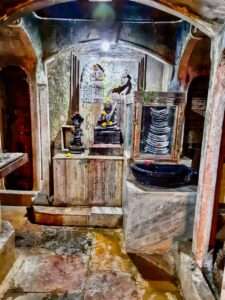
The cave enshrines Sri Govinda Bhagavatpada in meditation, the revered Guru of Jagadguru Adi Shankaracharya. A shrine dedicated to Adi Shankaracharya and a sacred Shiva Linga is also worshipped inside the cave, symbolising Lord Shiva, the eternal source of knowledge, while Dakshinamurthy represents the supreme Guru principle.
The shrine is housed within a simple natural rock cave that has retained its ancient meditative character. Stone steps lead into the cave, where the shrines of Sri Govinda Bhagavatpada, Adi Shankaracharya, and the sacred Shiva Linga create a serene and spiritually uplifting atmosphere.
After taking leave of his mother Aryamba, the young Adi Shankaracharya renounced worldly life and embarked on a long pilgrimage in search of a realized Guru. His spiritual quest eventually brought him to the sacred banks of the River Narmada at Omkareshwar, where Sri Govinda Bhagavatpada, the illustrious disciple of Sri Gaudapadacharya, was immersed in deep samadhi inside this cave.
According to traditional accounts narrated in the Shankara Digvijaya and Advaita traditions, the Narmada River was in fierce flood when Adi Shankaracharya arrived. Filled with devotion to Mother Narmada, he offered heartfelt prayers. Another widely cherished legend states that he contained the raging floodwaters within his kamandalu (water pot), thereby protecting the cave where his Guru remained absorbed in meditation. This miraculous event revealed the extraordinary spiritual power of the young ascetic.
When Sri Govinda Bhagavatpada emerged from his prolonged meditation, he asked the young seeker a simple yet profound question:
“Who are you?”
In response, Adi Shankaracharya spontaneously composed six sublime verses explaining the true nature of the Self beyond body, mind, ego, caste, and worldly identity. These verses later became famous as the Nirvana Shatakam (Atma Shatakam), beginning with the immortal words “Mano Buddhyahankara Chittani Naham.”
Recognising the young boy’s supreme spiritual realization, Sri Govinda Bhagavatpada accepted him as his disciple and initiated him into the sacred order of Sanyasa. Under his Guru’s guidance, Adi Shankaracharya mastered the essence of the Upanishads, Bhagavad Gita, and Brahma Sutras. Before sending him forth, Govinda Bhagavatpada instructed him to compose authoritative Bhashyas on these scriptures and spread the philosophy of Advaita Vedanta throughout Bharat.
This sacred cave thus became the birthplace of a spiritual renaissance that transformed the religious and philosophical landscape of India. The Guru–Shishya bond forged here continues to inspire millions of devotees, making this cave one of the holiest centres of Guru Bhakti and Advaita Vedanta. Pilgrims believe that worship offered here removes ignorance, bestows wisdom, strengthens devotion to the Guru, and guides seekers towards self-realisation.
Guru Purnima is the most important festival celebrated here with special Guru Puja, Vedic chanting, and spiritual discourses. Adi Shankaracharya Jayanti, Mahashivaratri, Narmada Jayanti, and Kartika Purnima are also observed with great devotion.
On this sacred occasion of Guru Purnima, remembering the divine wisdom revealed by Adi Shankaracharya:
॥मनो बुद्ध्यहंकार चित्तानि नाहं ।
न च श्रोत्र जिह्वे न च घ्राण नेत्रे ।
न च व्योम भूमिर् न तेजो न वायुः ।
चिदानन्द रूपः शिवोऽहम् शिवोऽहम् ॥


