



A wise man knowing well the separate existence of the senses and their rise and fall as separate (from Brahman), grieves not.
The wise man is not affected by the senses. He has vairagya, dispassion, towards the sense objects. Sense objects have no meaning without the senses. The rise and fall of the senses refers to sense objects as well.
The Viveka and Vairagya are evident in this mantra. Viveka is the clarity of the intellect to discriminate between right and wrong. A wise man can discriminate/distinguish Brahman and sense objects. Viveka is to separate the real from the illusory. Vairagya is not to be influenced by the illusion. The majority of the seekers have viveka but not vairagya.
IMAGE 33.1 & 33.2
The difference between Brahman and senses:
- Senses are produced by respective five elements – space, air, fire, water and earth. The root cause of the senses is the five elements. Brahman is said to be a causeless cause. There is no cause and effect to
- Senses are subject to rise and fall, whereas Brahman is not subject to rise and fall.
- Senses are continuously subject to change. Different sense objects keep coming your way, and your experiences keep changing. The change is in the impermanence of the senses, which contributes to the impermanence of the experience. Brahman does not go through change.
You can measure your wisdom by the Viveka, the capacity to distinguish between Brahman and senses, and then apply vairagya.

When the senses go through the rise and fall, you experience grief. A wise man, having separated the senses from Brahman, does not experience grief. The implication is that the wise man is unaffected by joy and sorrow, heat and cold, praise and censure, profit and loss. There is no grief for him as he is firmly established in Brahman. Having separated essential and non-essential, he is firmly rooted in essential and not affected by whatever happens to the non-essentials.
At the worldly level, when your work is not appreciated, and it does not affect you, then you are not attached to it. The expectations can be sensual pleasures, mental demands, and intellectual assertions. As long as egocentric demands are there, you will find the world will not satisfy your demands, and you will be in grief. Grief is not because of the world, but your egocentric relation with the world. One who is endowed with wisdom is liberated from sorrow. A person who experiences Brahman is untouched by sorrow. This is a statement of fact, and one has to apply it.
Mind is superior to the senses, intellect is superior to the mind, Mahat is superior to the intellect, and unmanifest is superior to Mahat.
And Purusha is superior to unmanifest. It is all-pervading and attributeless. On knowing That, the mortal is free and attains immortality.
The principle that governs or establishes the point is that the subtle controls the gross. The mantra talks of the steps as under:
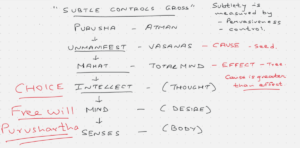
Subtlety is measured by two factors pervasiveness and control. We are using control to understand this mantra.
Q: Vasanas do manifest, so why is it specified as unmanifest in the chart?
A: Vasanas are unmanifest like the seed. You only know the manifestation of the seed only when there are shoots coming from the ground. Similarly, you know the manifestation of vasana only when it expresses as a thought in the intellect. Vasanas express and manifests as thought, which is grosser than vasanas. If there is no stimulus, vasana is in the unmanifest state.
Q: What is mahat, the total mind?
A: Total mind is collective vasana. Collective vasanas impact your thought pattern.
Eg: You entertain a thought to watch a movie. The thought has cropped up through a friend or the media. The mahat has influenced you to watch the movie. When you go to the theatre, you see many people around you. This is the mahat or combined vasanas of all people.
So, be aware of the mahat you are exposing yourself to. Mahat will condition you to be what you are. The law of attachment sets in. ‘As you think, so you become.’ Mahat influences a thought, you entertain that thought, and you become it.
We are in satsang entertaining the thought of Brahman in this 1.30 hours. If you are not entertaining during the course of the day, then there will not be any transformation. It depends on what you groom your thoughts during the day.
Q: Is total mind mahat superior to intellect?
A: Intellect and mind are thoughts. Intellect is rational thought and mind is irrational thought. Rational aspect of intellect makes it superior to irrational aspect of the mind.
Eg: When you go to a rock music concert of 10,000 people, it is not possible to sing carnatic music in that atmosphere. You may not have interest in rock music but having ended up there, the mahat of 10,000 will influence you. Your thought of carnatic music will gain traction.
The thought of mahat is more powerful than one person’s thought. You have the choice whether to go for rock music or Carnatic music. Intellect can choose.
In the above chart, intellect is inferior to mahat and the vasana. Intellect has got the purushartha free will to go with the vasana or against the vasana. This extraordinary faculty is given only to human beings. If this free will is not there, we all will be victims of our vasanas. We are not victims of vasanas but the choices we have made.
Q: Is intellect guided by conscience?
A: It is the conscience which oversees the actions or decisions made by the intellect. This mantra does not talk of conscience which is a separate aspect.
Q: Guruji, when you say we are not a victim of our vasanas but the choices we make, it is contradicting the earlier statement when you had mentioned that everyone is helplessly expressing their vasanas. Please clarify.
A: Both statements are not contradictory. You can apply it to others when we say that everyone is helplessly expressing their vasanas and is a victim of their vasanas. When we say you are not a victim, you are defined by your choices, you apply to yourself. We cannot decide why and how somebody has made the choices. We have nothing to do with others’ choices. When you look at them as someone acting contrary to your views, it helps you to keep your intellectual sanity. Otherwise, you keep complaining about their actions.
One can choose the field of action based on their vasanas, but how they conduct themselves in that field is on their choices.
Q: How you explain subtlety with reference to pervasiveness?
A: Pervasiveness can be measured by where all does Brahman, vasanas, intellect, etc. pervade. Vasanas are there in waking, dream, and deep sleep states. Vasanas are not there in the Turiya, fourth state. Brahman is there in all three states and beyond it in the turiya state as well. Thus, Brahman is superior to vasanas.

