



For decades, Bharatiyas have been fed a remarkably convenient version of the freedom struggle: the Congress fought the British, Mahatma Gandhi led the nation, Jawaharlal Nehru became the first Prime Minister and, almost as a natural consequence, the British packed their bags and left.
Now, the time has come to call that bluff—particularly in the wake of the Congress refusing to accept the democratically elected government’s position on the official version of Vande Mataram, insisting instead that it will stick to the version endorsed by leaders of that era, including Mahatma Gandhi, Jawaharlal Nehru, Sardar Patel and Mohammad Ali Jinnah in 1937. If this is not a challenge to parliamentary democracy, what is?
Hence, the real story needs to be told to younger generations. It is simple: the Congress claim may be emotionally satisfying and politically useful.
But history is rarely that simple.
The question today is not whether the Congress participated in Bharat’s freedom struggle. It unquestionably did. Nor can anyone seriously deny the enormous popular influence of Mahatma Gandhi or the contribution of countless Congress workers who endured imprisonment, repression and hardship.
The real question is far more fundamental: did the Congress alone win freedom for Bharat?
That claim does not withstand serious historical scrutiny.
The real question is something else: Did the Congress alone win Bharat’s independence?
The answer, according to the historical record, is an emphatic no.
Bharat’s independence was the consequence of a long, complicated and often contradictory struggle involving constitutional politics, revolutionary movements, mass mobilisation, armed resistance, international circumstances, two World Wars and, crucially, the growing realisation within the British establishment that its ability to depend indefinitely on Bharatiya armed forces to sustain colonial rule could no longer be taken for granted.
That larger story deserves to be told.
And telling it does not diminish Gandhi or Congress. It restores the many other heroes, movements and circumstances that were subsequently pushed to the margins of the popular narrative.
Consider Subhas Chandra Bose.
Netaji’s Indian National Army was militarily defeated. But to conclude from that that the INA was historically irrelevant would be a serious mistake. Bose demonstrated that Bharatiyas were prepared to take up arms against the Raj under a Bharatiya command and fight for an independent Bharat.
More importantly, the INA trials at the Red Fort generated extraordinary public sympathy across the country. The issue resonated across political and communal divisions and placed the British authorities under considerable political pressure.
Then came the Royal Indian Navy uprising of February 1946.
That episode deserves far greater attention than it generally receives in conventional political narratives. Ratings in Bombay and elsewhere rebelled against their British officers, and the unrest spread to ships and establishments in several cities. Sympathy demonstrations and strikes accompanied the revolt.
The significance was not simply the size of the mutiny. It was what it represented.
The British Empire ultimately rested not merely on administrators and laws but on the ability to enforce those laws. If the loyalty of the armed forces could no longer be assumed, the foundations of colonial rule were inevitably weakened.
Former British officials and later historians have debated precisely how decisive the INA and the 1946 military unrest were in the final British decision to leave. There is no justification for reducing that decision to a single event. But neither is there any justification for pretending that these developments were irrelevant.
The uncomfortable question is obvious: Could Britain continue ruling Bharat if it could no longer confidently depend on Bharatiya soldiers to enforce British authority?
That question deserves to be examined alongside the familiar story of mass political mobilisation.
The Second World War had also fundamentally weakened Britain economically and strategically. The British Empire emerged from the war heavily burdened. Anti-colonial movements had gathered strength across Asia and Africa, while the international environment had changed dramatically.
Britain faced a world in which maintaining the Bharatiya Empire was becoming increasingly expensive, politically difficult and strategically less sustainable.
Meanwhile, Congress had unquestionably played a major role in mobilising Bharatiyas.
Gandhi’s Non-Cooperation and Civil Disobedience movements transformed the nature of anti-colonial politics. The Quit India Movement of 1942, despite the severe repression that followed and the imprisonment of its leadership, demonstrated the depth of popular opposition to British rule.
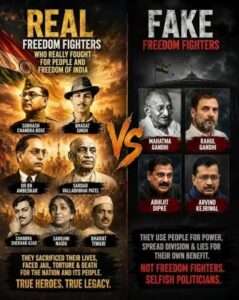
But even here, history refuses to fit neatly into party propaganda.
The Quit India leadership was imprisoned almost immediately. The movement was brutally suppressed, and for much of the war the British retained administrative control. Meanwhile, Bose and the INA pursued a completely different strategy, while revolutionary and militant traditions continued to influence Bharatiya political consciousness.
The point is not to declare one strategy the sole cause of independence. It is to recognise that the struggle operated on several fronts simultaneously.
So why should one political organisation be credited retrospectively with the entire achievement?
The question becomes even more uncomfortable when the story reaches Partition.
The Congress narrative cannot celebrate independence while treating Partition as somebody else’s history. Nor is it historically serious to claim that one ideological camp alone created the demand for Partition.
The Muslim League under Muhammad Ali Jinnah formally advanced the demand for Pakistan, and the Lahore Resolution of 1940 became a decisive milestone in that political process. Communal tensions, competing political ambitions, British policies, constitutional deadlock and the failure of major political forces to agree on a common constitutional settlement all contributed to the catastrophe of 1947.
The final outcome was therefore not merely freedom.
It was freedom accompanied by the vivisection of the country, unprecedented communal violence and the displacement of millions.
That tragedy belongs to the history of independence too.
There is therefore something profoundly unhealthy about converting Bharat’s freedom struggle into a political family heirloom.
Congress was undoubtedly an important vehicle of Bharat’s freedom movement. But Bharat was never liberated by a single man, a single family or a single organisation.
And what, after all, does “Congress” represent in its original sense? A congress is an assembly, a coming together of people. It was never the private property of one family.
Indeed, there is a remarkable irony here. Mahatma Gandhi himself, after independence, wanted the Congress organisation to be dissolved and transformed into a non-political social-service organisation—the Lok Sevak Sangh—because he believed that the organisation’s principal purpose had been fulfilled.
That is a historical fact worth remembering.
Should Rahul Gandhi and his unquestioning supporters not at least know this elementary chapter of the history they so confidently invoke while claiming political ownership of the freedom struggle?
Gandhi mobilised millions through non-violent mass movements. Bose challenged the British Raj through armed struggle and built the INA. Revolutionary groups kept the spirit of resistance alive, often at enormous personal cost. Countless ordinary Bharatiyas went to prison, faced bullets, lost livelihoods, sacrificed careers and families, and participated in movements whose names may never find their way into today’s political speeches.
And then there were the many who did not fit comfortably into any single political narrative.
There were revolutionaries, tribal resistance movements, peasant uprisings, underground networks, students, workers, soldiers and ordinary citizens who resisted colonial authority in different ways and at different times.
Their methods differed. Their ideologies differed. Their visions of a free Bharat sometimes differed profoundly.
But their existence makes one thing impossible to deny: the freedom struggle was never a one-party enterprise.
Nor did the story end on August 15, 1947.
Sardar Vallabhbhai Patel’s extraordinary role in integrating the princely states demonstrated that the enormous task of nation-building had only begun when the Union inherited independence. Rajendra Prasad and countless others also played important roles in shaping the new republic.
Freedom was therefore not a single morning in New Delhi. It was the culmination of decades of resistance followed by the immensely difficult task of constructing a nation out of the ruins of colonial rule and Partition.
That is the history young Bharatiyas deserve.
But there is another important caveat.
The answer to an exaggerated Congress-centric history cannot be an exaggerated anti-Congress history. Replacing one political mythology with another would merely repeat the same mistake.
If earlier narratives overemphasised some figures while marginalising others, the answer is not to manufacture another selective history in reverse.
The answer is to put all the evidence on the table.
That includes Gandhi and Nehru. It includes Patel and Rajendra Prasad. It includes Bose and the INA. It includes Bhagat Singh and Chandrashekhar Azad. It includes revolutionaries, tribal movements, peasant resistance and innumerable ordinary Bharatiyas whose sacrifices never produced statues, memorials or prominent chapters in school textbooks.
It includes the naval ratings who rebelled in 1946.
It includes the millions whose names have disappeared from public memory.
Most importantly, it includes the British side of the story: their economic exhaustion after the Second World War, the changing international order and their growing anxiety about the reliability of the armed forces on which colonial rule depended.
That is why the emerging contest over history matters.
The arrival of social media has broken the monopoly of traditional gatekeepers over historical narratives. That does not mean every viral video is true. Quite the opposite. Social media can spread nonsense as efficiently as it spreads facts.
A WhatsApp clip is not a primary source. A dramatic YouTube presentation is not automatically history. A political speech is certainly not an archive.
But neither should established narratives receive immunity from scrutiny merely because they have been repeated for decades.
Historians must be challenged by evidence, not political loyalty.
Archives must be examined. Original documents must be read. British records must be compared with Bharatiya accounts. Claims must be tested rather than merely repeated.
If a historical claim survives that scrutiny, let it stand.
If it does not, let it fall.
That is not an attack on history. That is history doing its job.
The greatest disservice to Bharat’s freedom fighters is not questioning the old narrative. It is continuing to tell a sanitised version in which some heroes are permanently celebrated while others are reduced to footnotes because their politics became inconvenient to later generations.
Bharat did not become independent because of one surname.
It did not become independent because of one party.
It became independent because, over decades, millions of Bharatiyas challenged an empire in different ways—and because, by the mid-1940s, Britain increasingly recognised that its ability to govern Bharat indefinitely was disappearing.
That is a much bigger story than the Congress.
And perhaps that is precisely why it deserves to be told.

